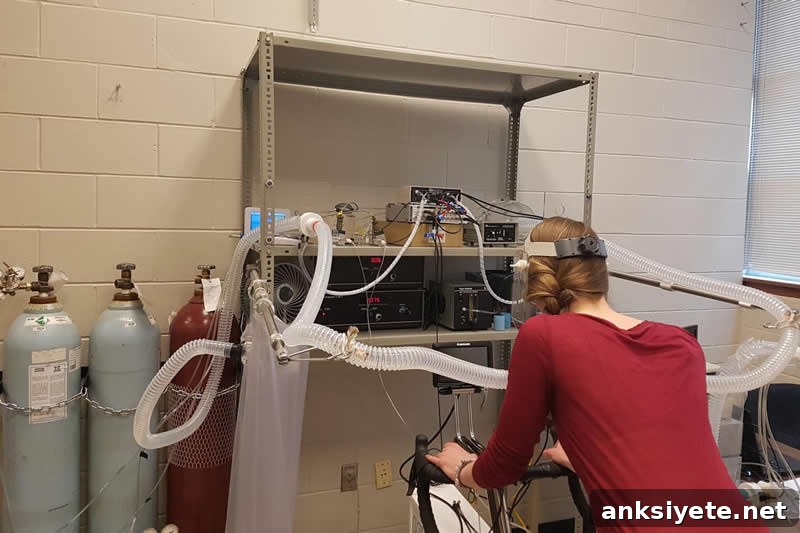
Summary: New research indicates that, on average, women must exert more effort to breathe during intense exercise than men. These findings clarify how biological sex can influence respiratory mechanics during exertion and may help explain sex differences in airway conditions such as asthma and chronic obstructive pulmonary disease (COPD).
Source: Experimental Biology
Overview
Although both women and men are capable of exceptional athletic performance, recent research shows that women typically perform more respiratory work than men when exercising at maximal effort. The study provides insight into how airway size and airflow dynamics contribute to differences in breathing effort between sexes and offers context for understanding why airway diseases may present differently in women and men.
Key findings
Researchers found that the respiratory muscles in women generally must do more work to move the same volume of air during high-intensity exercise. The study suggests this extra work is largely a consequence of smaller average airway diameters in women, which raise airflow resistance, particularly when breathing becomes faster and more turbulent with increasing exertion.
Study design
The research team recruited a small group of healthy volunteers—six men and five women—to complete two maximal incremental exercise tests on a stationary cycle. During each test, participants breathed through a mouthpiece connected to a large reservoir bag. In one session the bag contained ambient room air; in the other it contained a helium–oxygen gas mixture. Both mixtures provided the same oxygen concentration, and participants were not informed which gas they were inhaling on each test day.
To directly quantify the work of breathing, investigators measured esophageal pressure using a slender tube inserted into the nose and advanced to the esophagus. This pressure monitoring allowed precise calculation of the mechanical effort required by the respiratory muscles during progressively intense exercise.
Results and interpretation
When participants breathed the helium–oxygen mixture, the measured work of breathing showed no meaningful difference between sexes. Helium has a much lower density than normal air, which promotes smoother, laminar airflow in the airways and reduces resistance. In contrast, when subjects breathed room air the women in the study required significantly more respiratory work than the men.
These outcomes support the idea that airway diameter and airflow pattern substantially influence breathing effort. At low ventilation rates—such as rest—airflow tends to remain laminar even in smaller airways, so differences in work are minimal. But as exercise intensity and airflow increase, flow can shift from laminar to turbulent. Turbulent flow generates greater resistance and demands more muscular effort to maintain adequate ventilation. Because airflow becomes turbulent at lower flow thresholds in smaller airways, women are, on average, likely to encounter this transition earlier during intense exercise.
Physiological implications and variability
Principal investigator Paolo Dominelli, PhD, emphasized that the observed sex differences are population-level trends tied to average airway size, not absolute rules for individuals. Airway diameter varies widely across people, and a man and woman of the same height can still have similar airway dimensions. The study’s findings therefore illuminate a common physiological mechanism but do not predict breathing effort for any specific person without direct measurement.
Understanding how the laminar-to-turbulent transition in airflow influences breathing work has clinical relevance. It may help explain sex-related patterns seen in airway disorders such as asthma and COPD, where airflow resistance and the energetic cost of breathing are important contributors to symptoms and disease severity.
Study publication and credits
The research findings were summarized in an abstract published in The FASEB Journal and were to be presented at the American Physiological Society annual meeting held in conjunction with the 2020 Experimental Biology conference; the in-person meeting was canceled due to the COVID-19 pandemic.
About this neuroscience research article
Source:
Experimental Biology
Media Contacts:
Anne Frances Johnson – Experimental Biology
Image Source:
The image is credited to Paolo Dominelli, University of Waterloo.
Original Research: The study will be published in FASEB Journal.