Summary: A new technique called NeuroPAL enables researchers to identify every neuron in the nervous system of the microscopic worm C. elegans, letting scientists record whole-brain activity and decode neural network dynamics in unprecedented detail.
Source: Columbia University
The human brain contains roughly 86 billion neurons connected by an estimated 100 trillion synapses. Each neuron contributes to movement, sensation, memory, decision-making, and other functions, yet the sheer scale of this network leaves many questions about how neurons coordinate to produce behavior.
To tackle analogous questions at a fully resolvable scale, scientists at Columbia University have developed NeuroPAL (Neuronal Polychromatic Atlas of Landmarks), a genetic coloring method that makes it possible to identify every neuron in the nervous system of Caenorhabditis elegans, a widely used model organism.
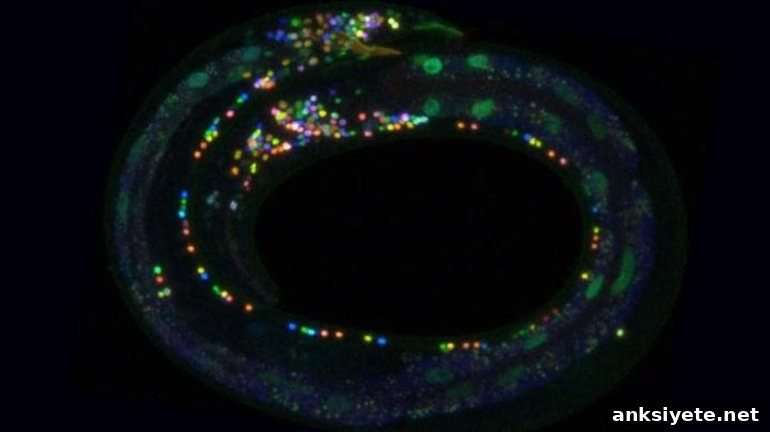
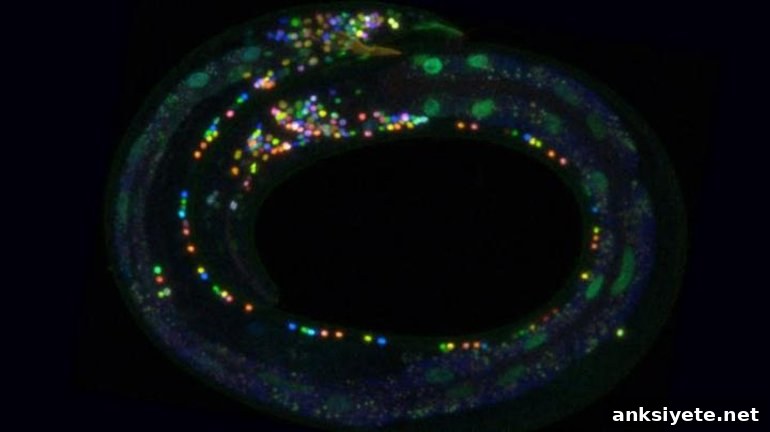
Published in the Jan. 7 issue of the journal Cell, the study describes how NeuroPAL uses combinations of fluorescent proteins encoded in neuronal DNA to generate a stereotyped, multicolor map across the entire hermaphrodite nervous system. The resulting color signatures allow researchers to identify individual neurons visually, even while imaging the entire nervous system active in real time.
“It’s remarkable to observe the whole nervous system at once and see how its many parts act together,” said Oliver Hobert, professor in the Department of Biological Sciences at Columbia and a principal investigator with the Howard Hughes Medical Institute. “Under the microscope, neurons light up in precise, vivid colors—like Christmas lights glowing in the dark.”
NeuroPAL’s design intentionally leaves the green, cyan, and yellow emission channels free of the transgene’s fluorescence, enabling the simultaneous use of commonly employed reporters such as GCaMP and other gene-specific reporters of activity or expression. Because the fluorescent labels are genetically encoded and tied to specific promoters, a cell’s color can also reveal whether particular genes are expressed in that neuron.
To support analysis, the team created two pieces of software: one automates identification of neurons in NeuroPAL images, and the other generalizes the coloring strategy by optimizing color assignments for potential use in other cell types or organisms that can be genetically manipulated. Together, the transgene and software let researchers record brainwide activity patterns and match those patterns to identified neurons.
“Using NeuroPAL we recorded whole-brain activity patterns and decoded how the worm’s nervous system responds to sensory cues,” said Eviatar Yemini, a postdoctoral researcher in Columbia’s Department of Biological Sciences and the study’s lead author. The technique allowed the team to track dynamic responses across every neuron while preserving cell identity throughout the recording.
The investigators emphasize that NeuroPAL is not only a technical achievement but also a practical tool for discovery. Because the colors are genetically encoded and reproducible, NeuroPAL can reveal where specific genes are present or absent and can uncover abnormalities in neuronal differentiation caused by mutations.
Hobert and Yemini made NeuroPAL available to the research community before publication, and several independent studies have already demonstrated the tool’s utility. By making neurons visually identifiable at the whole-brain level, NeuroPAL enables experiments that connect gene expression, cell identity, and neural activity—helping researchers pinpoint where and how biological systems fail when disease or genetic mutations disrupt them.
Collaborators on the project include Liam Paninski (Columbia University), Vivek Venkatachalam (Northeastern University), and Aravinthan Samuel (Harvard University).
About this brain mapping research news
Source: Columbia University
Contact: Carla Cantor – Columbia University
Image: The image is credited to Eviatar Yemini
Original Research: Closed access. “NeuroPAL: A Multicolor Atlas for Whole-Brain Neuronal Identification in C. elegans” by Eviatar Yemini et al. Cell
Abstract
NeuroPAL: A Multicolor Atlas for Whole-Brain Neuronal Identification in C. elegans
Highlights
- •NeuroPAL: a genetically encoded strain that produces a stereotyped fluorescent color map enabling identification of all neurons in C. elegans.
- •Accompanying semi-automated identification software maps reporter gene expression patterns onto identified neurons.
- •NeuroPAL reveals neuronal differentiation defects in mutant backgrounds, aiding analysis of cell-fate changes.
- •Combining NeuroPAL with calcium indicators such as GCaMP allows dynamic, whole-brain recordings that link activity patterns to identified neurons.
Summary
Accurately resolving neuronal identities in whole-brain images is a long-standing challenge for systems neuroscience. The NeuroPAL approach addresses this in C. elegans by introducing a multicolor transgene that creates a reproducible, organism-wide color map across the hermaphrodite nervous system, enabling unambiguous neuronal identification. Because NeuroPAL avoids fluorescence in the green, cyan, and yellow channels, it is compatible with many activity and expression reporters. The study demonstrates three primary applications: mapping brainwide expression of metabotropic receptors for acetylcholine, GABA, and glutamate to complete a neurotransmitter receptor map; detecting cell-fate changes caused by transcription factor mutations; and recording whole-brain responses to attractive and aversive chemosensory cues to characterize multimodal sensory coding.