
Summary: Researchers report that defects in the Ets1 gene are linked to immune changes characteristic of systemic lupus erythematosus (SLE).
Source: Institute for Basic Science
Researchers at the Academy of Immunology and Microbiology, Institute for Basic Science (IBS) and Pohang University of Science and Technology (POSTECH) in South Korea have identified how defects in the Ets1 gene contribute to immune system abnormalities associated with systemic lupus erythematosus (SLE). In the December issue of Immunity, the team reports that loss or mutation of Ets1 in both mice and humans correlates with hallmark SLE immune features and highlights a potential therapeutic target.
Systemic lupus erythematosus is an autoimmune disorder in which the immune system produces autoantibodies that attack healthy tissues and organs, including skin, kidneys, joints and blood vessels. Genetic susceptibility plays a major role in SLE: more than 60 genes have been associated with the disease, yet the precise mechanisms linking many of these genes to SLE remain unclear. The IBS/POSTECH study focused on Ets1, a gene ranked among the top four SLE-associated genes in Asian populations, to determine how Ets1 defects drive autoimmunity.
“Many SLE patients carry mutations in Ets1, but why a faulty Ets1 leads to autoimmunity was not well understood. We aimed to clarify that connection,” said Sin-Hyeog Im, corresponding author of the study.
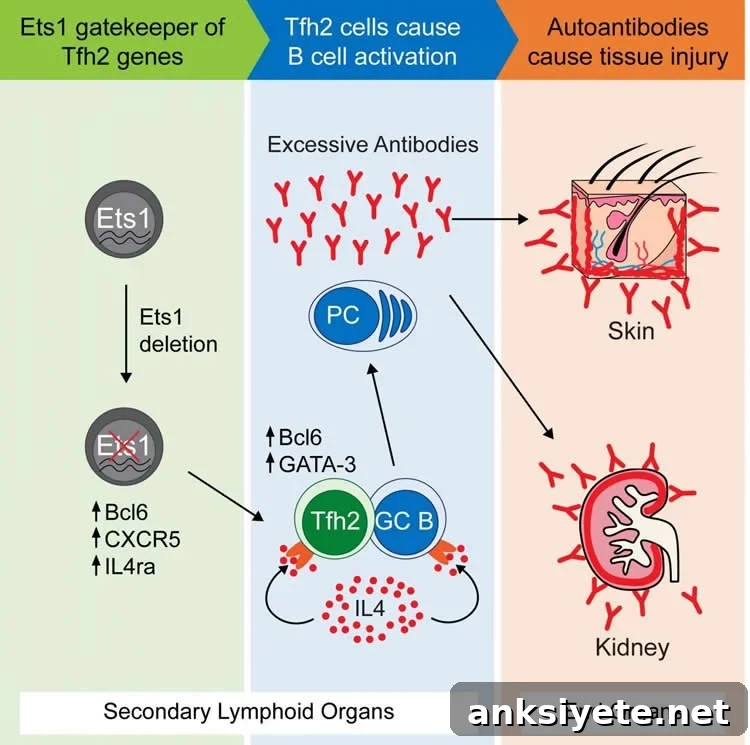
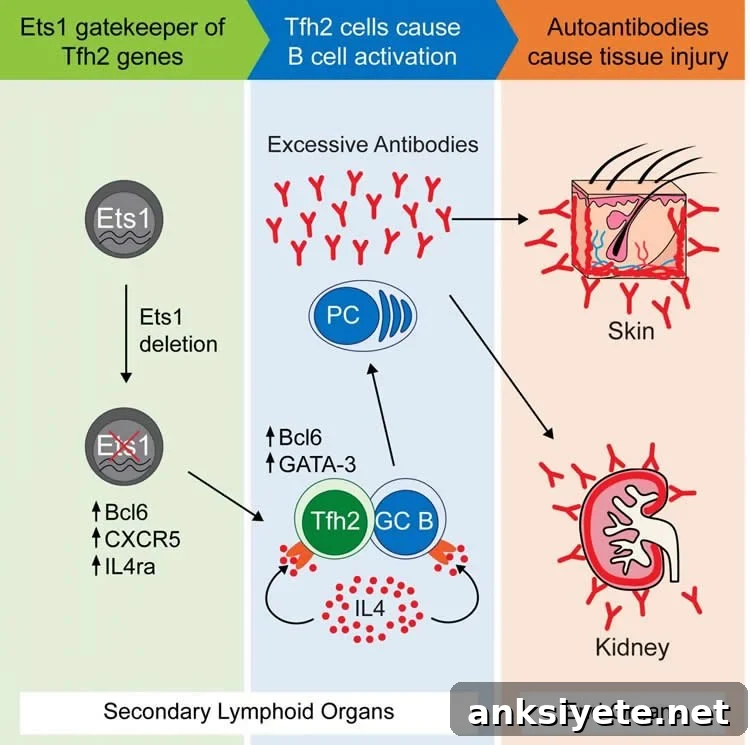
To uncover how Ets1 contributes to immune tolerance, the researchers selectively removed the Ets1 gene from distinct immune cell types in mice. They discovered that deletion of Ets1 specifically in CD4+ T cells was sufficient to trigger SLE-like autoimmunity. Further analysis revealed that Ets1 acts as a regulator of a subset of T helper cells known as T follicular helper type 2 (Tfh2) cells.
Tfh2 cells provide help to B cells in secondary lymphoid organs, such as lymph nodes and the spleen, promoting antibody production. The study found that Ets1 restrains the expression of key Tfh2-associated genes—blocking the expansion of Tfh2 cells. When Ets1 is absent or mutated, this regulatory brake is released: Tfh2 cells expand, interact with B cells, and drive the production of autoantibodies. The researchers observed the same pattern—elevated Tfh2 activity correlated with increased autoantibodies—in both mouse models and human SLE patients.
Importantly, the team also tested a targeted intervention within this pathway. They treated mice that lack Ets1 with an antibody that blocks IL4, a cytokine involved in the Tfh2–B cell interaction. Anti-IL4 treatment reduced features associated with autoimmunity, including a decrease in spleen enlargement and a lower number of antibody-producing plasma cells. These results suggest that IL4 blockade may reduce autoantibody production and related pathology in cases where Ets1 expression is low and Tfh2 cells are expanded.
Current SLE treatments primarily rely on broad immunosuppression with steroids, which can relieve symptoms but often cause serious side effects. Therapies aimed at directly inhibiting B cell activation have shown limited success in trials, underlining the need for alternative strategies. The IBS/POSTECH findings identify a mechanistic link between an SLE-associated gene and a defined immune cell pathway, offering a rationale for targeted therapies that modulate Tfh2 activity or IL4 signaling in selected patient groups.
“SLE is a clinically diverse disease, making uniform treatment challenging,” added Sin-Hyeog Im. “Our data indicate that patients with reduced Ets1 expression and expanded Tfh2 populations might benefit from therapies that block IL4 or otherwise control Tfh2-driven B cell activation.”
Implications and next steps
This study links the loss of Ets1 function to expansion of a specific T helper cell subset (Tfh2) that promotes autoantibody production, offering a clearer molecular explanation for how mutations in this SLE-associated gene can drive disease. By demonstrating that IL4 blockade can partially reverse pathology in an Ets1-deficient model, the research provides a focused therapeutic hypothesis: patients with low Ets1 expression and elevated Tfh2 cells may benefit from treatments that inhibit IL4 signaling or otherwise constrain Tfh2–B cell interactions.
Funding and source
Funding: Study funded by the Institute for Basic Science.
Source and reporting: Dahee Carol Kim, Institute for Basic Science. Original research published in Immunity.