
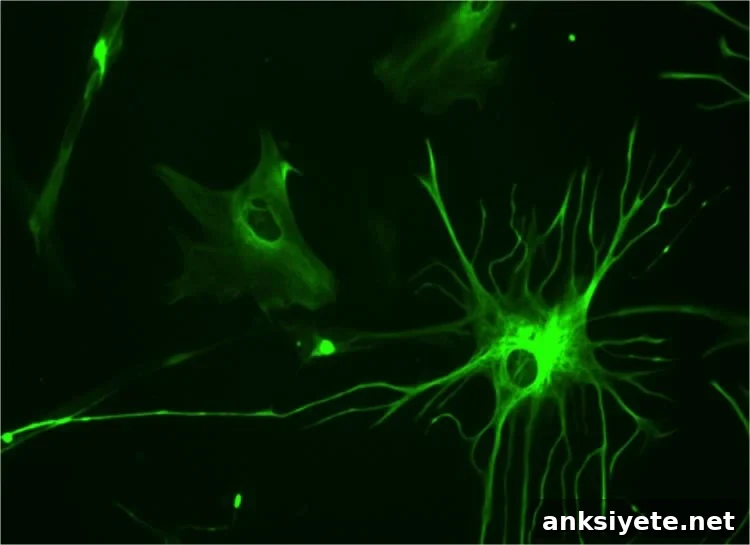
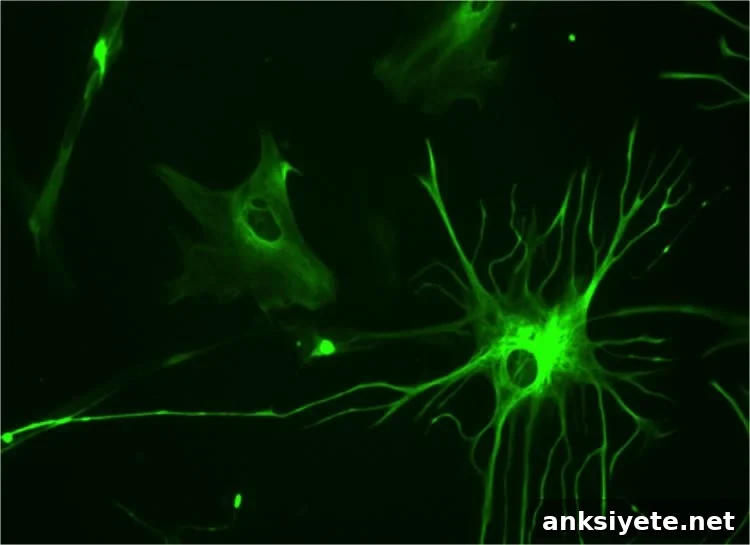
A star-shaped brain cell known as an astrocyte helps maintain stable blood pressure and blood flow within the brain, researchers report.
Astrocytes have finger-like extensions called endfeet that wrap around the brain’s delicate blood vessels. These endfeet continuously monitor conditions inside and around the vessels, functioning much like a clinician watching a patient’s blood pressure, said Dr. Jessica A. Filosa, a neurovascular physiologist in the Department of Physiology at the Medical College of Georgia at Georgia Regents University.
Filosa describes astrocytes as “housekeepers.” The new findings indicate that when astrocytes detect changes in pressure within parenchymal arterioles — the small, fragile arteries embedded in brain tissue — they release signals that cause the vessels to dilate or constrict as needed to preserve a healthy baseline.
“This is the first direct evidence that astrocytes contribute to pressure-induced myogenic tone, which helps keep vascular function regular,” Filosa said, noting the study was published in The Journal of Neuroscience.
Astrocytes simultaneously monitor blood vessels and nearby neurons, positioning them as key intermediaries that balance neuronal demand and cerebral blood flow. “They are perfect bridges between neuronal activity and the blood-flow changes that supply energy and oxygen to the brain,” Filosa explained.
Importantly, the study shows astrocytes do more than respond to neuronal demand: they actively maintain baseline vascular tone even when neurons do not request extra blood. In other words, astrocytes continuously respond to pressure changes in parenchymal arterioles to prevent the brain from receiving excessive blood. “Maintaining a constant tone actually requires active astrocytes,” Filosa said.
Astrocyte activity is driven by fluctuations in intracellular calcium concentrations: an increase in calcium typically indicates increased astrocyte signaling. Researchers used a brain-slice model that allowed them to perfuse and control pressure in parenchymal arterioles. Raising the pressure triggered normal constriction of the vessels and produced a corresponding rise in astrocytic calcium. That calcium rise enabled astrocytes to support the vessel’s ability to sustain a healthy vascular tone. When astrocytic calcium was reduced by chelation with BAPTA, arterioles still responded to changes in pressure but could not maintain a consistent tone without the support provided by astrocyte endfeet.
“The goal is to keep pressure and flow within normal ranges,” Filosa said. This basal control operates continuously and is distinct from region- and task-specific increases in blood flow that occur when, for example, you memorize a poem or perform complex mental work. Nevertheless, most of the brain’s energy supports ongoing, resting activity that underlies basic functions such as breathing and walking, and astrocyte-mediated tone contributes to that energy balance.
Parenchymal arterioles are effectively coated with astrocyte endfeet — roughly 99 percent of their outer surface is covered by these web-like structures. Filosa emphasized that because these vessels are so fragile, their astrocytic covering is essential to prevent damage.
Chronic stressors such as long-term hypertension can damage multiple protective layers around cerebral vessels, making parenchymal arterioles rigid and impairing the supportive, responsive grip of astrocytes. Excessive cerebral blood flow or high pressure can cause swelling, hemorrhage, or stroke and increase the brain’s vulnerability to ischemia and infection. Conversely, abnormal increases in astrocytic calcium have been associated with neurodegenerative conditions like Alzheimer’s disease.
Future experiments will examine how astrocyte activation affects neuronal activity. Dr. Ki Jung Kim, a postdoctoral fellow and the study’s first author, is recording neuronal responses while manipulating pressure inside blood vessels to clarify how glial and neuronal signaling interact.
The brain is one of the most vascular organs in the body. The carotid arteries on either side of the neck feed blood to the base of the brain and form the Circle of Willis. From this arterial circle, muscular extracerebral vessels branch outward and across the brain’s surface. Those resistance vessels branch repeatedly and eventually shed most of their smooth muscle layers as they dive into the tissue and become parenchymal arterioles. Astrocytes form connections that reach back toward these extracerebral vessels, linking the entire vascular tree to the neurovascular unit.
These larger extracerebral vessels play a key role in protecting the brain from rapid systemic pressure changes. For example, during sudden surges in blood pressure due to fear or anger, surface vessels constrict to prevent abrupt increases in cerebral blood flow from reaching fragile parenchymal arterioles. Even routine postural changes, such as standing up quickly, require coordinated adjustments by smooth muscle cells and astrocytes; failure to adjust rapidly can contribute to transient dizziness.
Funding: The research was supported by the National Institutes of Health and the American Heart Association.
Source: Toni Baker – Georgia Regents University
Image Credit: Image credited to Bruno Pascal, licensed Creative Commons Attribution-ShareAlike 3.0 Unported.
Original Research: Abstract for “Astrocyte Contributions to Flow/Pressure-Evoked Parenchymal Arteriole Vasoconstriction” by Ki Jung Kim et al., Journal of Neuroscience. Published online May 27, 2015. DOI: 10.1523/JNEUROSCI.4486-14.2015
Abstract
Astrocyte Contributions to Flow/Pressure-Evoked Parenchymal Arteriole Vasoconstriction
Basal and activity-dependent cerebral blood flow changes are coordinated by processes including cerebral autoregulation, endothelial signaling, and neurovascular coupling. This study evaluated whether astrocytes influence parenchymal arteriole (PA) tone in response to hemodynamic stimuli (pressure and flow). Using an in vitro rat and mouse brain-slice model of perfused, pressurized PAs and in vivo astrocytic calcium imaging, the authors found that astrocytes increase intracellular Ca2+ when PA flow or pressure rises. In vivo, systemic phenylephrine-induced blood-pressure increases also elevated astrocytic Ca2+.
In vitro, flow/pressure-evoked vasoconstriction was reduced when the astrocytic syncytium was loaded with the Ca2+ chelator BAPTA and was enhanced when astrocytic calcium or ATP levels were raised. Application of the TRPV4 channel blocker HC067047 or the purinergic receptor antagonist suramin blunted flow/pressure-evoked vasoconstriction, while blockade of K+ or 20-HETE signaling did not affect the response. Notably, TRPV4 expression was found primarily in astrocytes rather than PA endothelium.
The data support a novel role for astrocytes in PA flow/pressure-induced vasoconstriction, implicating astrocytic TRPV4 channels as molecular sensors of hemodynamic stimuli and a purinergic, glial-derived signal as a contributor to adjustments in PA tone. Overall, these results highlight bidirectional signaling within the neurovascular unit and identify astrocytes as important modulators of microvascular tone.