
Summary: A recent study published in the Proceedings of the National Academy of Sciences (PNAS) identifies a drug already approved by the FDA that interferes with a toxic protein interaction, and shows it may offer a promising new approach to treating Parkinson’s disease.
Source: Northwestern University
Researchers report new insights into Parkinson’s disease mechanisms and provide preclinical evidence that Tacrolimus, an FDA-approved drug, could be repurposed to reduce alpha-synuclein toxicity by modulating the calcineurin–FKBP12 interaction.
Gabriela Caraveo Piso, PhD, assistant professor of Neurology in the Division of Movement Disorders, is the first and corresponding author of the study.
Parkinson’s disease is a progressive neurodegenerative disorder characterized primarily by the loss of dopaminergic neurons in the brain. There is no cure, and current treatments focus on symptom management for tremor, slowed movement, rigidity and balance problems. Understanding the molecular drivers of neuronal damage is essential to develop therapies that can alter disease progression.
Longstanding evidence implicates dysfunction of the protein alpha-synuclein in Parkinson’s disease and related synucleinopathies. Prior work from Caraveo Piso and collaborators had linked elevated activity of the calcium-dependent phosphatase calcineurin to the toxic effects of alpha-synuclein. The new study builds on those findings by identifying FKBP12, a 12-kDa proline isomerase, as a critical endogenous regulator of calcineurin activity and, consequently, of alpha-synuclein toxicity.
“Our mechanistic data indicate that FKBP12 is the protein that tunes calcineurin activity,” Caraveo Piso explained. “Like a Goldilocks effect, both excessive and absent calcineurin activity are harmful in the context of alpha-synuclein; an intermediate level of activity appears to be protective.”
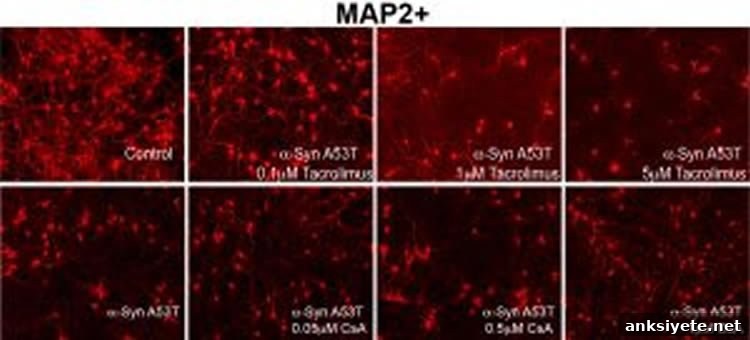
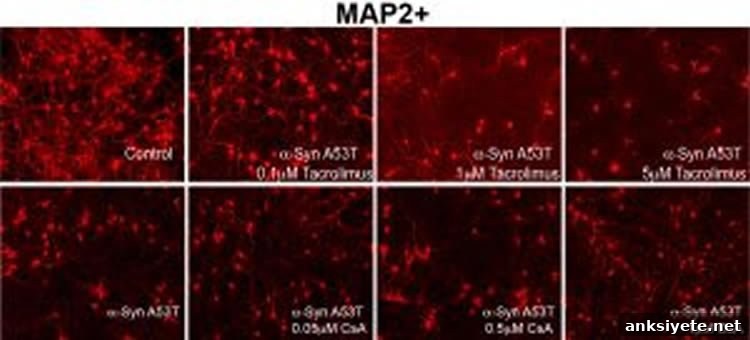
The team evaluated whether reducing the functional interaction between calcineurin and FKBP12 might protect neurons from alpha-synuclein–induced damage in living animals. To test this, they used Tacrolimus, a well-established FDA-approved compound known to inhibit calcineurin by recruiting FKBP12. Clinically, Tacrolimus is used at high doses as an immunosuppressant to prevent transplant rejection, but the researchers tested much lower, sub-immunosuppressive doses aimed at partially reducing calcineurin activity in the brain.
In a validated animal model of Parkinson’s disease, low-dose Tacrolimus attenuated the harmful effects linked to alpha-synuclein. Partial inhibition of the calcineurin–FKBP12 interaction improved functional measures of dopaminergic neurons and led to measurable improvements in behavior. These results suggest that modest, carefully controlled reduction of calcineurin activity can be neuroprotective without producing the systemic immunosuppression associated with higher Tacrolimus doses.
Caraveo Piso emphasized the translational potential of these findings. “We provide robust animal evidence that repurposing Tacrolimus at low, sub-immunosuppressive doses could be a feasible therapeutic strategy for Parkinson’s disease,” she said. “Tacrolimus penetrates the brain well and has an established safety profile, so testing it in a clinical trial for patients with early-stage Parkinson’s is a realistic next step.”
The authors also note that the calcineurin–FKBP12 axis may be relevant to other neurodegenerative conditions in which calcineurin signaling is implicated, including Alzheimer’s disease. Further research will be needed to determine how broadly this mechanism applies across disorders and to define safe, effective dosing strategies for humans.
Sofia Zaichick, MD, PhD, a research associate in Caraveo Piso’s laboratory, is listed as a co-author. Susan Lindquist, PhD, the senior author, was formerly a professor at the Massachusetts Institute of Technology and director of the Whitehead Institute for Biomedical Research; much of the work was completed while Caraveo Piso was a postdoctoral associate at that institution before joining Northwestern.
Funding: This study was supported by the Jeffry M. and Barbara Picower Foundation, the RJG Foundation–Judy Goldberg, a Howard Hughes Medical Institute (HHMI) Collaborative Innovation Award, National Institutes of Health grant 5P50NS38372, WIBR funds for regenerative biology research, and a gift from Ofer Nemirovsky.
Source: Anna Williams — Northwestern University
Publisher: Organized by NeuroscienceNews.com
Image source: NeuroscienceNews.com image is in the public domain.
Original research: The full open-access article is “FKBP12 contributes to α-synuclein toxicity by regulating the calcineurin-dependent phosphoproteome” by Gabriela Caraveo, Martin Soste, Valentina Cappelleti, Saranna Fanning, Damian B. van Rossum, Luke Whitesell, Yanmei Huang, Chee Yeun Chung, Valeriya Baru, Sofia Zaichick, Paola Picotti, and Susan Lindquist, published in PNAS (online December 11, 2017). DOI: 10.1073/pnas.1711926115
FKBP12 contributes to α-synuclein toxicity by regulating the calcineurin-dependent phosphoproteome
Calcineurin is a critical Ca2+-dependent phosphatase. Elevated calcineurin activity has been associated with alpha-synuclein (α-syn) toxicity, a key factor in Parkinson’s disease and other neurodegenerative disorders. Tacrolimus inhibits calcineurin by recruiting FKBP12, but whether FKBP12 and calcineurin form a physiologically relevant complex in the absence of drugs was unclear. Using α-syn as a model of neurotoxicity, the authors show that FKBP12 strongly influences the calcineurin-dependent phosphoproteome and promotes dephosphorylation of a specific subset of proteins that contributes to α-syn toxicity. In a rat model of Parkinson’s, partial disruption of the FKBP12–calcineurin interaction with low doses of Tacrolimus blocked calcineurin activity toward those proteins and protected against α-syn–linked pathological features. These results indicate that FKBP12 can endogenously regulate calcineurin activity and highlight therapeutic implications for treating Parkinson’s disease.
Please feel free to share this summary of the research. When discussing or citing the work, reference the authors and the original PNAS publication to ensure accurate attribution.