
Summary: Researchers have identified a specific neuronal circuit in the brain’s central amygdala that promotes anxiety. The findings highlight dynorphin signaling as a potential target for new treatments for anxiety-related disorders.
Source: Cold Spring Harbor Laboratory.
Neuroscientists at Cold Spring Harbor Laboratory (CSHL) have mapped a neural pathway in the amygdala that drives anxiety and identified a key signaling molecule, dynorphin, which may offer a new avenue for treating anxiety-related conditions, including post-traumatic stress disorder (PTSD).
Fear and anxiety are related but distinct processes: fear is typically a short-term response to an immediate threat, while anxiety is a more prolonged state that can persist after a dangerous event. Intense, life-threatening experiences can be strongly encoded by the brain and lead to persistent, maladaptive anxiety. Anxiety disorders are among the most common psychiatric conditions, affecting a large portion of the adult population and creating a major public health burden.
Prior research has implicated two neighboring regions of the extended amygdala—the central amygdala (CeA) and the bed nucleus of the stria terminalis (BNST)—in coordinating rapid and sustained responses to threats. However, the cellular and circuit mechanisms that generate anxiety within these regions were not well understood. The CSHL team, led by Professor Bo Li, set out to identify the specific cells and molecular signals responsible for turning normal threat responses into prolonged anxiety.
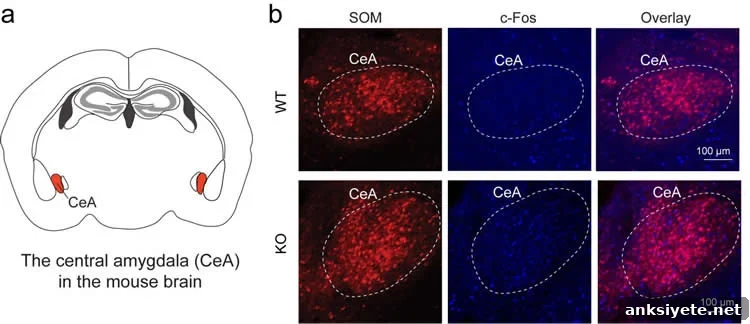
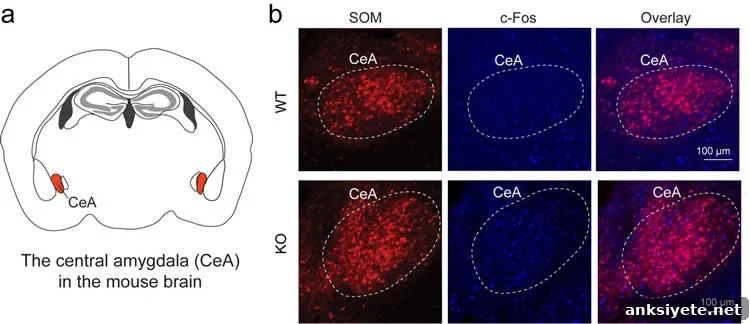
The investigators focused on a defined class of inhibitory neurons in the central amygdala that express the peptide somatostatin, referred to as SOM+ neurons. Previous work from the Li laboratory had shown that SOM+ neurons are essential for the formation of fear memories. In the current study, researchers selectively disrupted a gene called Erbb4 in SOM+ neurons. Erbb4 has been linked in genetic studies to several neuropsychiatric disorders.
Postdoctoral researcher Sandra Ahrens led behavioral and circuit-mapping experiments demonstrating that deletion of Erbb4 from SOM+ neurons produced heightened anxiety-like behavior in mice. To trace the origin of this effect, the team examined the connections between the CeA and the BNST. They found that SOM+ neurons in the CeA form strong inhibitory projections to the BNST and that perturbing Erbb4 alters the balance of excitation and inhibition across this pathway.
The mechanistic sequence began with increased excitation of SOM+ neurons in the central amygdala. That initial increase drove elevated release of dynorphin, an endogenous opioid peptide produced by SOM+ neurons. Excess dynorphin signaling disrupted normal inhibitory control over SOM+ neurons in the BNST, allowing those BNST neurons to become hyperactive. The overall effect of this altered circuit activity was an increase in anxiety-like behaviors in the experimental animals.
Importantly, dynorphin’s role as a driver of anxiety emerged not only in animals with the Erbb4 genetic manipulation but also in genetically unmodified mice exposed to stress. This convergence suggests the CeA→BNST circuit and its dynorphin signaling component operate in both genetically induced and stress-induced forms of anxiety, underscoring the circuit’s broader relevance.
Professor Li commented that these results indicate dynorphin can actively promote anxiety and therefore represents a plausible cellular and molecular target for interventions aimed at reducing stress-induced anxiety. The team emphasized that further work is needed to determine precisely where dynorphin receptors are expressed—whether on SOM+ neurons within the central amygdala itself or on other inputs to the BNST—and to clarify how receptor localization shapes circuit responses.
Funding: National Institutes of Health; NARSAD/Brain and Behavior Research Foundation; Louis Feil Trust; Stanley Family Foundation; Simons Foundation; Human Frontier Science Program; Wodecroft Foundation; CSHL and Northwell Health Affiliation; CSHL Cancer Center Support Grant.
Source: Peter Tarr, Cold Spring Harbor Laboratory.
Publisher: Organized by NeuroscienceNews.
Image Source: Image credited to Li Lab, CSHL.
Original Research: The study is scheduled to appear in the Journal of Neuroscience.
Cold Spring Harbor Laboratory. “How a Brain Circuit Generates Anxiety.” NeuroscienceNews. May 29, 2018.