
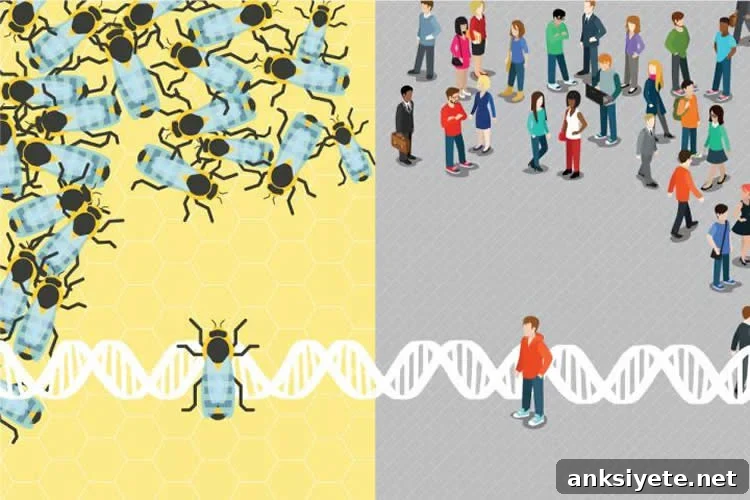
Summary: A University of Illinois study finds that honey bees that are consistently unresponsive to social cues show differences in brain gene regulation that parallel genes associated with autism spectrum disorder in humans. The research offers new insight into shared genetic pathways that may influence social behavior across species.
Source: University of Illinois
Honey bees that fail to respond to clear social signals show molecular patterns that overlap with human autism-linked genes, a new study reports. Researchers found that genes most strongly associated with autism spectrum disorder (ASD) in humans are regulated differently in socially unresponsive bees compared with their more socially engaged nestmates.
The findings, published in the Proceedings of the National Academy of Sciences (PNAS), indicate that the overlap is specific to genes tied to autism-related traits and does not extend to gene sets associated with other psychiatric conditions.
Scientists describe the results as an early glimpse into the genetic toolkit that different animals use to shape social behavior, and they say the work suggests conserved molecular mechanisms may contribute to social responsiveness across distant species.
Researchers led by entomology professor Gene Robinson at the University of Illinois observed natural variation in honey bee behavior. Some bees are highly alert and respond energetically to threats or to care-related stimuli, while others remain relatively unresponsive. That behavioral spectrum is a normal part of colony life: individuals adopt different roles at different life stages, and not every bee acts as a guard or a nurse at all times.
However, the team noticed a subset of bees that were consistently “on” or “off” across multiple social contexts. In addition to failing to respond to intruders, some of the unresponsive bees also ignored the presence of queen larvae—stimuli that normally provoke strong caregiving responses from nurse bees. This consistent lack of social responsiveness suggested an underlying biological difference.
To explore the molecular basis for these behavioral differences, the researchers tested bees from seven genetically distinct colonies. They examined 246 groups of bees and measured brain gene expression after carefully characterizing individual behavior in several social contexts. The analysis revealed more than 1,000 genes showing different regulation across unresponsive bees, nurse bees and guards.
Next, the team compared the bee gene-expression profiles with curated lists of human genes and gene-expression patterns associated with autism. A new statistical method developed by the researchers allowed an unbiased test of whether the overlap between a human gene list and a honey bee gene list exceeded what would be expected by chance. The statistical analysis, led by postdoctoral researcher Michael Saul in collaboration with statistics professor Sihai D. Zhao, identified a significant overlap between genes differentially regulated in unresponsive bees and genes closely linked to ASD in humans.
Importantly, further analyses found no significant overlap between the unresponsive bee gene profile and human gene lists associated with depression, schizophrenia or several other mental disorders. The overlap was specific to autism-related gene sets and was not evident when comparing other bee gene lists or alternative human psychiatric gene lists.
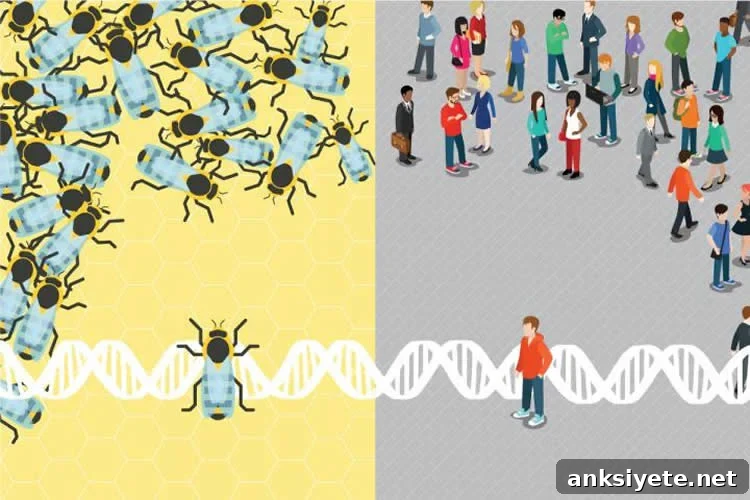
The authors emphasize important caveats. Humans and bees are evolutionarily distant, and social responsiveness has very different expressions and contexts across species. Autism spectrum disorder in humans is complex and involves many behaviors beyond social unresponsiveness. The study does not equate bee behavior with human autism, but rather highlights shared molecular elements that may contribute to how social behavior is regulated.
Robinson and colleagues describe the result as evidence that diverse animals can use similar molecular “building blocks” when shaping social functions. The study points to conserved biological pathways that may influence social engagement, and it identifies specific genes and regulatory patterns that deserve further study in both insects and vertebrates.
“Our data indicate that social unresponsiveness has some common molecular characteristics in these distantly related species,” the research team notes, while also stressing that more work is needed to determine how these gene-expression patterns map onto behavior across taxa.
Funding: This research was supported by the Simons Foundation and the National Science Foundation.
Institutional source: University of Illinois. The study appears in the Proceedings of the National Academy of Sciences (PNAS).
University of Illinois. Parallels Between Unresponsive Honey Bees and Human Autism. Proceedings of the National Academy of Sciences (PNAS), published 2017.