
Summary: New findings identify a critical cellular quality-control mechanism in the hypothalamus that governs production of the appetite-regulating prohormone POMC. The discovery points to potential therapeutic targets for obesity, including genetically driven forms.
Source: University of Michigan
Deep in the center of the brain sits a small cluster of neurons that powerfully influence hunger, food intake, and body weight. These neurons continually produce a precursor molecule, pro-opiomelanocortin (POMC), which is processed into multiple hormones that regulate appetite and metabolism.
A research team at the University of Michigan Medical School has uncovered how cells ensure POMC is correctly processed and what happens when that system fails. Published in the Journal of Clinical Investigation, the study reveals a protein quality-control pathway that determines whether POMC matures properly or is removed—finding that disruptions in this pathway can lead to overeating and obesity.
ERAD: the endoplasmic reticulum quality-control pathway
POMC is made in hypothalamic neurons and then cleaved into smaller peptides that influence appetite and energy balance. The new research demonstrates that each newly made POMC molecule must pass an inspection inside the cell’s endoplasmic reticulum (ER) before it can be forwarded for processing and secretion. This inspection is carried out by the ER-associated degradation system, commonly known as ERAD.
ERAD prevents accumulation of misfolded POMC
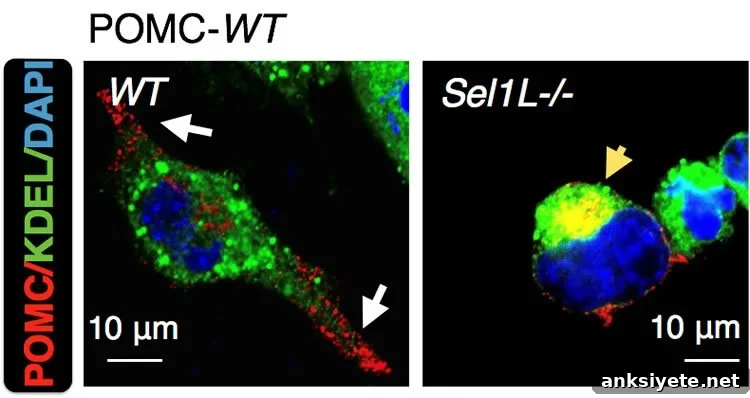
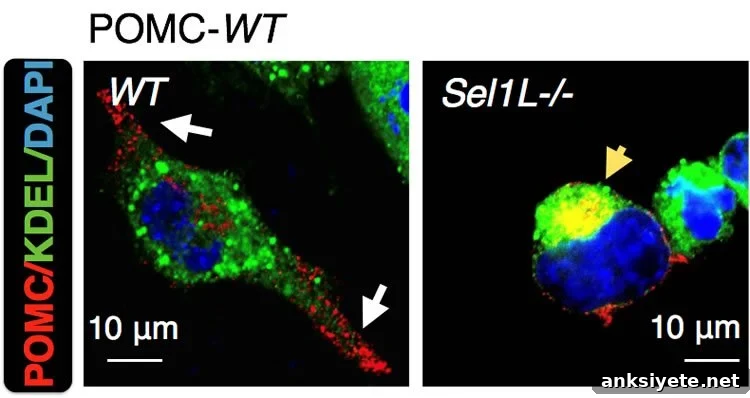
The research team found that the ERAD machinery—specifically the Sel1L-Hrd1 complex—tags a portion of nascent POMC molecules for ubiquitination and proteasomal degradation, removing defective copies and preventing them from aggregating with properly folded POMC. If ERAD function is lost in POMC neurons, misfolded POMC accumulates and forms aggregates inside the cell, reducing the amount of properly processed prohormone available for secretion.
In mouse models where ERAD was specifically disrupted in POMC neurons, animals developed hyperphagia (increased eating) and age-associated obesity despite being fed a low-energy diet. The results show that ERAD is essential to maintain normal POMC maturation, regulate appetite, and prevent excessive weight gain.
Implications for human genetic obesity
The team also investigated a rare human mutation in the POMC gene, known as C28F, which causes severe, early-onset obesity. Patients with this mutation experience relentless hunger and rapid weight gain in childhood. The study found that mutant POMC molecules evade normal ERAD processing and aggregate inside the ER, interfering with production of normal POMC. Both the ERAD-deficient mice and individuals carrying the POMC-C28F mutation share a common mechanism: accumulated, misfolded POMC blocks proper hormone production without causing cell death.
Researchers explain that properly functioning ERAD provides a protective environment in which the cell can complete posttranslational processing of prohormones while preventing defective proteins from poisoning the production line. The discovery clarifies how defective protein folding and clearance in the ER can lead to hypothalamic dysfunction and obesity.
Targeting ERAD for obesity therapies
Because ERAD plays a decisive role in POMC maturation, the researchers propose that pharmacological strategies to enhance ERAD activity in POMC-producing neurons could restore proper prohormone handling and reduce hyperphagia. The group is exploring small-molecule approaches to boost the Sel1L-Hrd1 pathway and testing other ways to manipulate ER proteostasis as a therapeutic avenue for metabolic disease.
Broader relevance: ERAD and other prohormones
The investigators previously showed that ERAD dysfunction also affects maturation of pro-vasopressin (proAVP) in vasopressin-producing neurons, producing diabetes insipidus–like symptoms in mice. Together, these studies indicate that ERAD is a general regulator of prohormone maturation in the hypothalamus and other neuroendocrine tissues. When ERAD is compromised, the resulting ER retention and aggregation of prohormones can produce clinically relevant endocrine and metabolic disorders.
The research team included Ling Qi, Ph.D., Geun Hyang Kim, Ph.D., Guojun Shi, Leena Haataja, Diane R.M. Somlo, Soobin Song, Malcolm J. Low, M.D., Ph.D., Eduardo A. Nillni, Ph.D., Qiaoming Long, Ph.D., Peter Arvan, M.D., Ph.D., and Martin G. Myers Jr., M.D., Ph.D. The work was conducted at the University of Michigan and in collaboration with colleagues from other institutions, and is part of a broader Protein Folding Disease Initiative.
Funding: This research was supported by grants from the National Institutes of Health and the American Diabetes Association.
Abstract (rewritten)
Pro-opiomelanocortin (POMC) neurons are central regulators of metabolism because they produce a prohormone that is processed into multiple neuropeptides with distinct physiological effects. This study identifies the Sel1L-Hrd1 complex of endoplasmic reticulum–associated degradation (ERAD) as a critical regulator of POMC maturation. Loss of Sel1L in POMC neurons causes ER retention and aggregation of POMC, leading to increased food intake and age-related obesity in mice. The Sel1L-Hrd1 complex selectively targets a subset of nascent POMC molecules for ubiquitination and proteasomal degradation, preventing misfolded protein accumulation and enabling proper processing and secretion of the remaining POMC. The human disease-associated POMC-C28F mutant evades ERAD and aggregates due to an unpaired cysteine, explaining its dominant-negative effect and link to early-onset obesity. These findings establish ERAD as a vital quality-control mechanism for prohormone maturation and provide insights into monogenic forms of obesity caused by defective protein folding.