
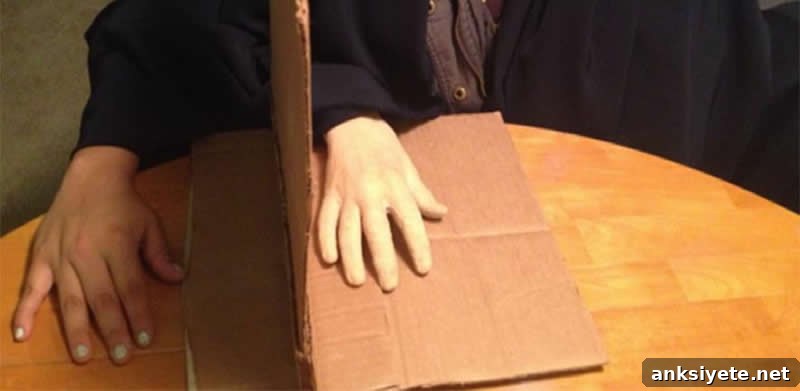
Summary: The rubber hand illusion could offer a low-stress alternative to traditional exposure therapy for people with obsessive-compulsive disorder (OCD), especially those with contamination fears.
Source: University of Cambridge
Overview: Obsessive-compulsive disorder (OCD) affects up to one in 50 people worldwide. A common presentation, experienced by nearly half of patients, involves intense contamination fears—sometimes triggered by everyday objects such as doorknobs—and leads to excessive handwashing and avoidance. These symptoms can severely impact daily functioning, relationships, employment and overall mental health.
Treatment for OCD typically combines medication such as selective serotonin reuptake inhibitors (SSRIs) and cognitive behavioural therapy (CBT). A leading CBT approach is exposure and response prevention (ERP), where patients are gradually exposed to feared stimuli and prevented from performing compulsive responses like washing. While ERP is effective for many, it can provoke extreme anxiety that some patients find intolerable, limiting access to this evidence-based treatment.
Baland Jalal, a neuroscientist in the Department of Psychiatry at the University of Cambridge, highlights this barrier: “Exposure therapy can be very stressful and so is not always effective or even feasible for many patients.” To address this, researchers in the UK and the United States investigated whether an indirect method—contaminating a fake hand during the rubber hand illusion—could reduce contamination fears while avoiding the full stress of in vivo exposure. They call this approach “multisensory stimulation therapy.”
The method builds on the well-known rubber hand illusion (RHI). In the RHI, a person’s real hand is hidden from view while a visible fake hand is placed in front of them. When an experimenter strokes both the hidden real hand and the visible rubber hand in synchrony, many people begin to feel as if the rubber hand is their own, experiencing touch sensations as though they arise from the artificial limb. Asynchronous stroking typically weakens or abolishes the illusion.
Previous work by Jalal and VS Ramachandran showed that healthy volunteers can experience disgust as if their own hand had been contaminated when a rubber hand is smeared with fake feces while the RHI is active. Building on that finding, Jalal and Ramachandran teamed with researchers at Harvard University—Richard J. McNally, Jason A. Elias and Sriramya Potluri—to test the technique in people diagnosed with OCD.
The new study, published in Frontiers in Human Neuroscience, recruited 29 OCD patients from a residential treatment program. Sixteen patients underwent synchronous stroking of their hidden real hand and the visible rubber hand (the experimental condition), while 13 patients received asynchronous stroking as a control. After five minutes of tactile stimulation, researchers asked participants how much the rubber hand felt like their own. The experimenter then smeared fake feces on the rubber hand while simultaneously dabbing a damp towel on the participant’s real hand to mimic contamination, and participants rated their disgust, anxiety and urge to wash. Investigators also rated facial expressions of disgust.
Unexpectedly, both groups reported a strong and rapidly emerging sense that the rubber hand belonged to them—even when stroking was asynchronous. Consequently, initial contamination responses were similar across groups. The team then continued stroking for an additional five minutes while leaving the fake feces on the rubber hand. At that point, facial expressions of disgust were more common in the synchronous group: 65% showed disgust compared to 35% in the asynchronous group, suggesting the illusion strengthened with continued stimulation.
When the illusion was discontinued and the fake feces were placed on participants’ real hands for in vivo exposure, differences were more pronounced. Average ratings for disgust, anxiety and urge to wash were approximately 9 in the synchronous group versus about 7 in the control group—a roughly 23% higher contamination response among participants who had experienced sustained synchronous stroking. Jalal explains that extended synchronous stimulation appears to deepen the illusion to the point that contamination reactions intensify before they decline, mirroring the early stages of conventional exposure where distress initially rises prior to habituation.
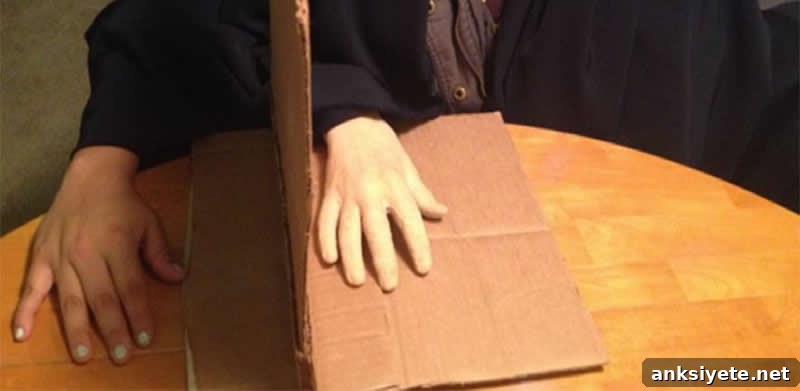
Jalal suggests that, given prior evidence, continued exposure to the contaminated rubber hand would likely lead to a decline in disgust and contamination ratings over time—similar to the habituation that occurs in traditional ERP. He proposes that multisensory stimulation therapy could serve as a less distressing bridge to standard exposure therapy or potentially as an alternative, particularly in settings where full in vivo exposure is not feasible.
The approach has practical advantages: it is inexpensive, portable and more immersive than some indirect methods such as smartphone apps, yet simpler and cheaper than virtual reality solutions. The rubber hand illusion also often elicits laughter and curiosity initially, which can help lower anxiety and engage patients more readily than direct contamination tasks.
Researchers emphasize that these results are promising but preliminary. The authors call for larger randomized clinical trials to compare multisensory stimulation therapy directly with established treatments and to refine methodology. If validated, the technique could expand treatment options for patients who avoid or cannot tolerate conventional exposure, and could also be adapted for other fears—such as needle phobia—by using a fake hand for repeated simulated injections rather than puncturing a real arm.
Source: University of Cambridge
Media contacts: Craig Brierley – University of Cambridge
Original research: Baland Jalal et al., “‘Fake it till You Make it’! Contaminating Rubber Hands (‘Multisensory Stimulation Therapy’) to Treat Obsessive-Compulsive Disorder.” Published in Frontiers in Human Neuroscience (open access).