
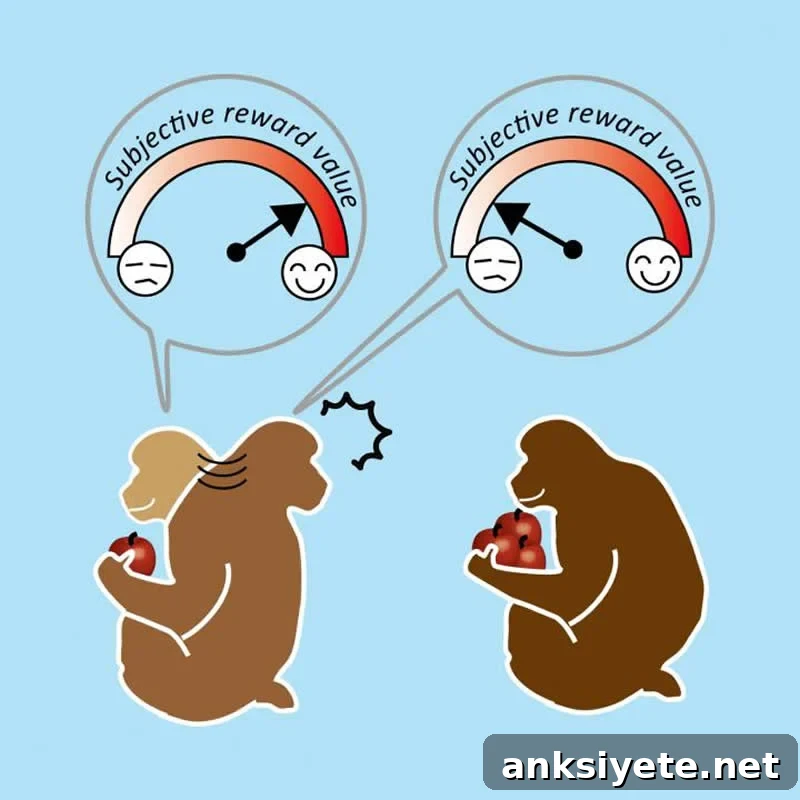
Summary: The lateral hypothalamus is a key subcortical node in social brain networks. It influences socially motivated choices by integrating information about rewards for oneself and for others, and it coordinates with cortical regions to shape behavior.
Source: National Institutes of Natural Sciences
How we value things is often shaped by what others receive. You may desire the latest trend until everyone owns it, or a modest prize may feel less satisfying if someone else wins a far greater reward. Scientists in Japan have identified a brain region in monkeys that plays a central role in these social comparisons.
In research published in Proceedings of the National Academy of Sciences, investigators at the National Institutes of Natural Sciences in Okazaki examined how monkeys adjust their motivation when they observe potential rewards for themselves versus others. The team found that monkeys’ expressed anticipation — measured by how much they licked their lips while awaiting a reward — rose with the likelihood of receiving a reward themselves and fell when another monkey was expected to receive it.
Lead author Atsushi Noritake and colleagues recorded neuronal activity while monkeys viewed visual cues that signaled different probabilities of reward for themselves or for a partner. They discovered a clear relationship between neural signals in the lateral hypothalamus and the licking behavior that indexed the animals’ subjective valuation. Specific lateral hypothalamus neurons increased firing as the chance of a self-reward went up and decreased firing as the likelihood of the other monkey receiving a reward increased.
To test whether the lateral hypothalamus is necessary for these social valuation effects, the researchers conducted a second experiment in which they temporarily suppressed activity in this region using an inhibitory drug. Under normal conditions, licking scaled with the probability of a self-reward. When the lateral hypothalamus was inactivated, licking behavior in anticipation of a self-reward remained intact. Crucially, however, the usual decrease in anticipatory licking that occurred when another monkey was likely to receive the reward disappeared. In other words, disabling lateral hypothalamus function removed the influence of another’s potential reward on the subject’s motivational response.
That change in behavior resembled situations in which the other monkey could not receive the reward or was absent entirely. “Without a functioning lateral hypothalamus, it was as if the monkeys no longer processed what they were seeing as a social situation,” said team leader Masaki Isoda. The authors propose that the lateral hypothalamus is required for transforming socially relevant information into motivated behavior, working in concert with cortical regions such as the medial prefrontal cortex.
The study also reports coordinated activity and a top-down information flow from the medial prefrontal cortex — a cortical hub of social cognition — to the lateral hypothalamus. This interaction suggests that cortical social signals are integrated by the lateral hypothalamus to represent agent-specific reward variables, allowing the brain to adjust motivation depending on whether rewards are available to oneself or to others.
Source:
National Institutes of Natural Sciences
Media Contacts:
Masaki Isoda – National Institutes of Natural Sciences
Image Source:
The image is credited to Atsushi Noritake.
Original Research: Closed access
“Representation of distinct reward variables for self and other in primate lateral hypothalamus”. Atsushi Noritake, Taihei Ninomiya, and Masaki Isoda.
PNAS doi: 10.1073/pnas.1917156117.
Abstract
Representation of distinct reward variables for self and other in primate lateral hypothalamus
The lateral hypothalamus (LH) has long been associated with maintaining behavioral homeostasis that supports individual survival. Recent findings, however, point to a broader role for the LH in coordinating behavior within a social context. The neuronal and circuit mechanisms by which the LH processes social information were previously unclear. This study demonstrates that the LH encodes separate reward-related variables for “self” and for “other,” and that LH activity is causally involved in shaping socially motivated behavior. Using a Pavlovian conditioning paradigm that included social elements—where rewards given to others influenced the subject’s motivation—the authors found LH neurons that represented the subjective value of self-rewards and the probabilities of rewards for self or other. Importantly, coding of other-reward was specific to the availability of rewards to the other individual rather than merely reflecting the other’s presence. Coherent interactions and top-down signaling from the medial prefrontal cortex contributed to these LH signals. Deactivating LH cells abolished the motivational effect of others’ rewards. Together, these results position the LH as a subcortical component of social brain networks that integrates cortical, agent-specific reward information to shape motivation.