
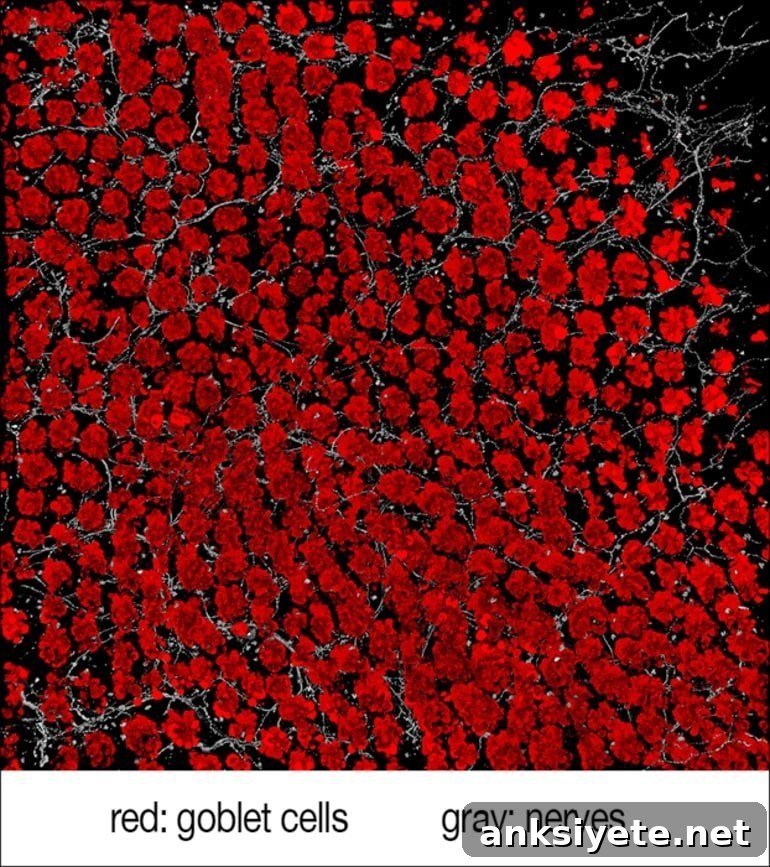
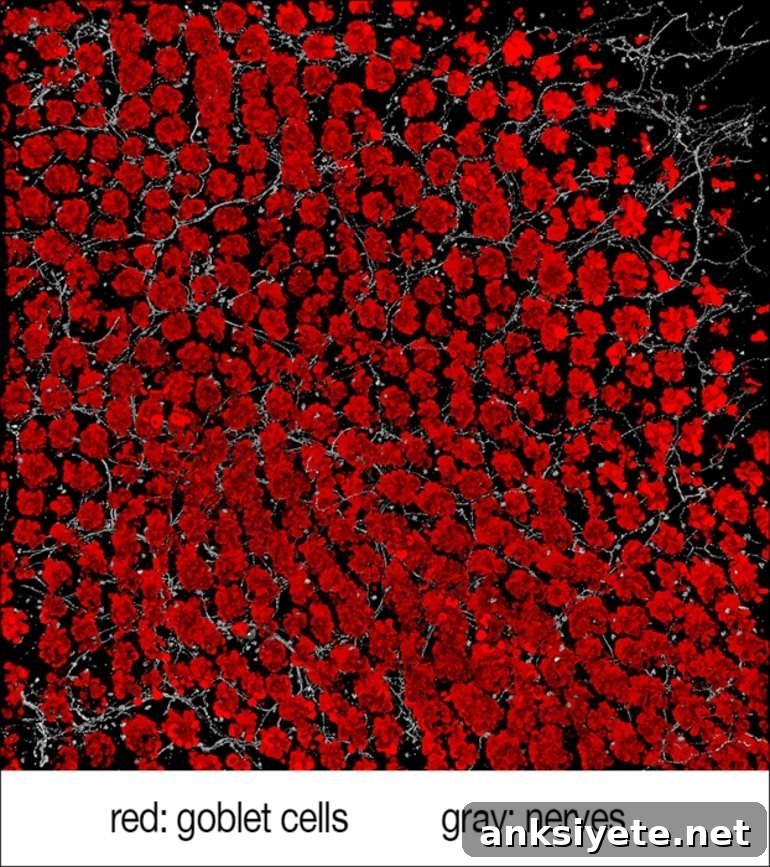
Summary: Pain-sensing neurons directly communicate with goblet cells—the mucus-producing epithelial cells of the intestine. During inflammation and even at baseline, these neurons stimulate goblet cells to release protective mucus. The findings highlight an active role for the nervous system in maintaining the gut barrier and initiating protective responses during inflammatory stress.
Source: Harvard
Pain has long been viewed as an evolutionary warning system—a signal that something in the body requires attention.
But recent research suggests pain can do more than warn us: in the gut, pain-sensing neurons appear to play a direct protective role.
A study led by researchers at Harvard Medical School, published Oct. 14 in Cell, shows that nociceptor neurons in the mouse intestine regulate baseline mucus levels and trigger rapid mucus release during inflammation. The work maps a signaling cascade in which pain neurons communicate directly with goblet cells, the epithelial cells that secrete mucus.
“It turns out that pain may protect us in ways beyond its classic role of detecting harm and sending signals to the brain,” said Isaac Chiu, associate professor of immunobiology in the Blavatnik Institute at HMS and senior author of the study. “Our results show that gut pain-sensing nerves talk to neighboring epithelial cells, revealing a major role for the nervous system in gut barrier maintenance and protection during inflammation.”
A direct conversation
Goblet cells, named for their goblet-like shape, are scattered throughout the lining of the intestine and other mucosal surfaces. They produce a gel-like mucus composed of proteins and sugars that coats and protects the epithelial surface from mechanical damage, pathogens, and chemical insult. The new study demonstrates that intestinal goblet cells release this protective mucus in response to direct signals from adjacent pain-sensing neurons.
In experiments where nociceptor neurons were absent, mice showed a thinner mucus layer and developed an altered gut microbial community—a condition known as dysbiosis. To investigate the mechanism, the researchers examined goblet cell behavior with and without nearby pain neurons.
They discovered that goblet cells express a receptor called RAMP1, which allows them to respond to a neuropeptide called CGRP released by activated nociceptors. RAMP1 was detected on goblet cells from both mice and humans, indicating that the neuron-to-goblet cell signaling pathway is conserved across species.
Further experiments revealed that normal gut microbes stimulate CGRP release from nociceptors, contributing to baseline mucus secretion and mucosal homeostasis. “This shows these nerves are not just activated during acute injury or infection,” Chiu explained. “Commensal microbes continuously engage these sensory circuits and prompt goblet cells to secrete mucus.”
Dietary inputs also activated this pathway: administering capsaicin—the active compound in chili peppers—rapidly activated pain neurons and provoked robust mucus secretion from goblet cells.
Mice lacking either nociceptors or goblet cell RAMP1 were more susceptible to colitis, an inflammatory condition of the colon. This vulnerability suggests a mechanistic link between dysbiosis, impaired mucus production, and increased inflammation. When researchers supplied CGRP to mice that lacked nociceptors, mucus production rebounded quickly and the animals were protected from colitis, demonstrating that CGRP signaling alone can restore this protective mucus response.
These results identify CGRP as a central mediator of the neuron-to-goblet cell signaling axis that drives mucus secretion and gut barrier protection.
A possible downside to suppressing pain
Because pain is a common symptom of chronic inflammatory bowel disease, patients frequently receive treatments that reduce pain signaling. The study raises important questions about the consequences of broadly blocking nociceptor activity or interfering with CGRP signaling in the gut. Mice lacking pain receptors suffered worse damage from colitis, suggesting that some elements of the pain response can be directly protective rather than solely harmful.
The researchers also noted concern for migraine medications that target CGRP: long-term blockade of this pathway might inadvertently affect mucosal integrity or the microbiome by disrupting normal neuron-driven mucus secretion. “If CGRP mediates goblet cell function and mucus production, chronic interruption of that signal could have unforeseen effects on the mucosal lining,” Chiu said.
Beyond mucus secretion, goblet cells play additional roles in gut immunity: they form conduits for antigen sampling and secrete antimicrobial factors that limit pathogen growth. The team plans to investigate whether pain fibers regulate these other goblet cell functions as well, and whether defects in the CGRP-RAMP1 pathway contribute to genetic susceptibility in inflammatory bowel disease.
“Given that CGRP is a mediator of goblet cell function and mucus production, what are the long-term effects of chronically blocking this pathway in patients who take CGRP-targeting drugs?” Chiu asked. “Could these drugs interfere with the mucosal barrier or alter the microbiome?”
The authors note that additional studies are needed to assess how neuronal regulation influences the full range of goblet cell activities and whether disruptions in CGRP signaling contribute to human inflammatory bowel diseases.
Co-authorship, funding, disclosures
Co-authors included Amanda Jacobson, Kimberly Meerschaert, Joseph Sifakis, Meng Wu, Xi Chen, Tiandi Yang, Youlian Zhou, Praju Vikas Anekal, Rachel Rucker, Deepika Sharma, Alexandra Sontheimer-Phelps, Glendon Wu, Liwen Deng, Michael Anderson, Samantha Choi, Dylan Neel, Nicole Lee, Dennis Kasper, Bana Jabri, Jun Huh, Malin Johansson, Jay Thiagarajah, and Samantha Riesenfeld.
The work was supported by the National Institutes of Health (grants R01DK127257, R35GM142683, P30DK034854, and T32DK007447); the Food Allergy Science Initiative; the Kenneth Rainin Foundation; and the Digestive Diseases Research Core Center under grant P30 DK42086 at the University of Chicago. Jacobson is an employee of Genentech Inc.; Chiu serves on scientific advisory boards of GSK Pharmaceuticals and Limm Therapeutics. His lab receives research support from Moderna Inc. and Abbvie/Allergan Pharmaceuticals.
About this pain research news
Author: Ekaterina Pesheva
Source: Harvard Medical School
Contact: Ekaterina Pesheva – Harvard
Image: The image is credited to Chiu Lab/Harvard Medical School
Original Research: Closed access. “Nociceptor neurons direct goblet cells via a CGRP-RAMP1 axis to drive mucus production and gut barrier protection” by Daping Yang et al., Cell.
Abstract
Nociceptor neurons direct goblet cells via a CGRP-RAMP1 axis to drive mucus production and gut barrier protection
Highlights
- Nav1.8+ CGRP+ nociceptors are positioned next to goblet cells and can induce rapid mucus secretion.
- Commensal microbes stimulate CGRP release, which signals to RAMP1 receptors expressed by goblet cells.
- Ablation of nociceptors or loss of RAMP1 reduces mucus levels and leads to microbial dysbiosis.
- Neuron-to-goblet cell signaling through the CGRP-RAMP1 axis protects against experimentally induced colitis.
Summary
Neuro-epithelial communication is essential for gut health, but the mechanisms by which sensory neurons influence epithelial barrier function have been unclear. This study identifies Nav1.8+ CGRP+ nociceptors as direct regulators of intestinal goblet cells. Nociceptor ablation decreased mucus thickness and altered the microbiome, while nociceptor activation or capsaicin exposure increased mucus production. Goblet cells express RAMP1, the receptor for CGRP, and respond to neuron-derived CGRP by rapidly emptying mucus stores. Commensal bacteria drive baseline CGRP release, forming a feedback loop in which microbes engage neurons, neurons regulate mucus, and mucus supports a healthy microbiome. Loss of this axis increases epithelial stress and susceptibility to colitis, whereas CGRP administration can rescue mucus secretion and protection in nociceptor-deficient animals. The findings define a neuron-goblet cell axis that coordinates mucosal barrier defense.