
An automated speech-analysis program successfully distinguished between young people at clinical high risk who later developed psychosis and those who did not over a two-and-a-half year follow-up. In a proof-of-principle study conducted by researchers at Columbia University Medical Center, the New York State Psychiatric Institute, and the IBM T. J. Watson Research Center, computerized analysis of free speech outperformed standard clinical ratings in classifying later psychosis onset. The study, “Automated Analysis of Free Speech Predicts Psychosis Onset in High-Risk Youths,” was published in NPJ-Schizophrenia.
Approximately one percent of people aged 14 to 27 are considered clinical high risk (CHR) for psychosis. CHR individuals may show symptoms such as unusual or tangential thinking, subtle perceptual changes, and increased suspiciousness. While around 20% of CHR individuals progress to a full psychotic episode, predicting who will develop psychosis has remained a major clinical challenge. Early, reliable prediction could guide interventions that delay, reduce, or possibly prevent the onset of severe mental illness.
Speech offers a unique, noninvasive window into thought processes and mental state. In this study, participants completed open-ended narrative interviews in which they described their subjective experiences. Transcripts of these interviews were analyzed by automated natural language processing tools that quantified patterns in both semantics (meaning) and syntax (structure).
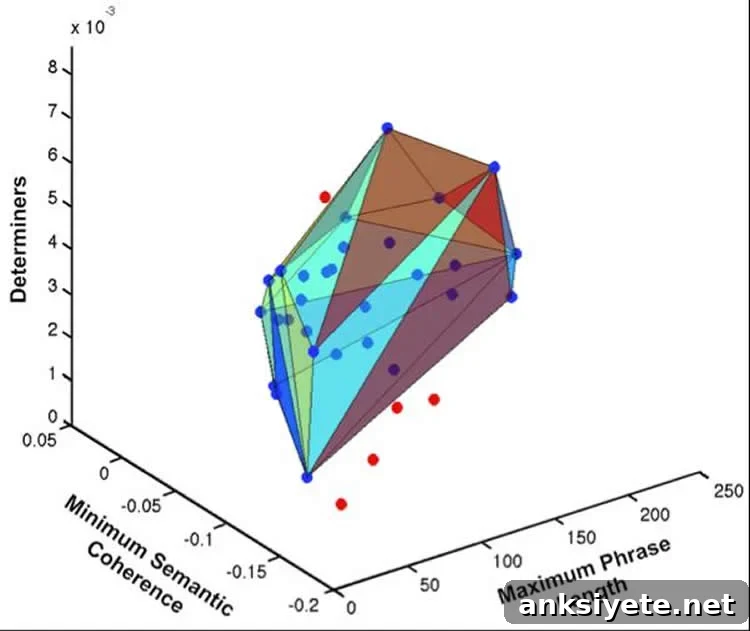
The automated analysis measured semantic coherence—how smoothly meaning flows from one sentence to the next—and syntactic features such as maximum phrase length and the frequency of determiner words (for example, “that,” “which,” “what”). While a trained psychiatrist can detect signs of disorganized thinking in a traditional interview, the computerized approach precisely quantifies these speech variables and can detect subtle changes that may be difficult to assess reliably by human raters. Participants were followed for up to 2.5 years after their baseline interviews to determine clinical outcomes.
Key speech features that predicted transition to psychosis included breaks in semantic coherence and patterns of simpler speech characterized by shorter phrases and reduced use of linking determiners. The machine-learning classifier used a convex-hull algorithm with leave-one-subject-out cross-validation to evaluate the predictive value of these features. In this cohort, the automated classifier distinguished the five individuals who later developed psychosis from the 29 who did not with perfect accuracy.
The findings highlight the potential for automated speech analysis to become an affordable, portable, fast, and noninvasive tool that complements clinical interviews and symptom ratings. For schizophrenia research and psychiatry more broadly, these methods offer a promising path for developing objective prognostic and diagnostic tools and for monitoring treatment response. Automated language analysis can provide reproducible measurements of thought disorder, a central but historically hard-to-quantify component of schizophrenia-spectrum illnesses.
Despite these promising results, the study authors emphasize the need for replication in larger, independent cohorts to confirm the robustness and generalizability of the predictive signals. Combining automated speech metrics with neuroimaging or other biological measures may further clarify the neural and cognitive mechanisms underlying early thought disorder and help guide development of preventative or therapeutic strategies.
The study cohort included 34 CHR youths (11 females) who underwent baseline narrative interviews and were assessed quarterly for up to 2.5 years; five participants transitioned to psychosis. Automated analysis derived a Latent Semantic Analysis measure of semantic coherence and two syntactic markers of speech complexity: maximum phrase length and use of determiners. These features, entered into a convex-hull classification algorithm with leave-one-subject-out cross-validation, predicted later psychosis onset with perfect accuracy in this sample and were significantly correlated with prodromal symptom ratings.
Authors: Gillinder Bedi, Facundo Carrillo, Guillermo A. Cecchi, Diego Fernández Slezak, Mariano Sigman, Natália B. Mota, Sidarta Ribeiro, Daniel C. Javitt, Mauro Copelli, and Cheryl M. Corcoran.
Funding: Supported by the National Institute of Mental Health, the National Center for Advancing Translational Sciences, the New York State Office of Mental Hygiene, the National Institute on Drug Abuse, and the FAPESP Research, Innovation and Dissemination Center for Neuromathematics (grant 2013/07699-0).
The authors declared no conflicts of interest.
Abstract
Automated analysis of free speech predicts psychosis onset in high-risk youths
Background: Psychiatry has few objective tests equivalent to those used in other medical specialties. Automated methods that characterize complex behaviors such as speech could provide objective markers to identify and predict psychiatric illness.
Objective: This proof-of-principle study tested whether automated speech analysis combined with machine learning can predict later psychosis onset in youths at clinical high risk.
Methods: Thirty-four CHR youths completed baseline narrative interviews and were followed quarterly for up to 2.5 years; five transitioned to psychosis. Transcripts were analyzed for semantic coherence and syntactic complexity. Speech features were entered into a convex-hull classifier with leave-one-subject-out cross-validation, and canonical correlations with prodromal symptom ratings were computed.
Results: A Latent Semantic Analysis measure of semantic coherence and two syntactic markers—maximum phrase length and use of determiners—predicted later psychosis onset with 100% accuracy in this sample, outperforming classification based on clinical interviews. Speech features correlated significantly with prodromal symptoms.
Conclusions: Automated speech analysis can detect subtle, clinically relevant changes in thought and language that precede psychosis. Advances in natural language processing and machine learning may support development of objective clinical assessments in psychiatry and help identify individuals who could benefit from early intervention.