
Summary: The brain’s default mode network is functionally split: different subnetworks support constructing imagined scenes and evaluating their emotional quality.
Source: SfN
New research published in Journal of Neuroscience shows that two key components of imagination — building mental scenarios and judging their emotional value — are supported by distinct subnetworks within the brain’s default mode network (DMN).
Even at rest, the brain remains active. The default mode network, a collection of brain regions that become engaged during inward-focused thought, is associated with daydreaming, future planning, and imagining experiences. Prior work suggested that the DMN can be subdivided into ventral and dorsal subsystems, but the specific roles of these subsystems were not resolved.
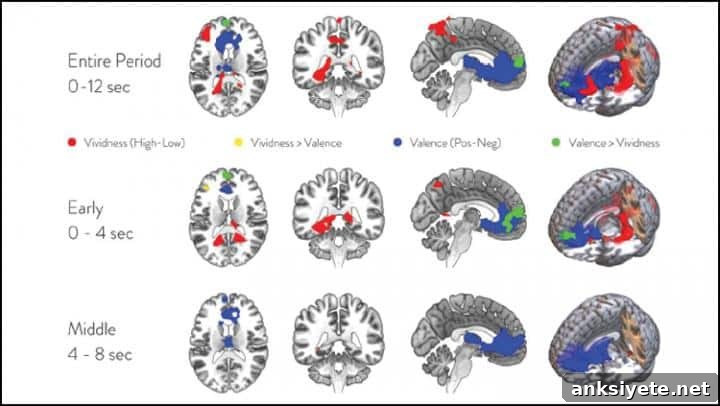
To clarify these roles, Lee and colleagues used functional magnetic resonance imaging (fMRI) while participants imagined short scenarios prompted by statements such as “Imagine you win the lottery.” The experimental design systematically varied two qualities of each imagined event: vividness (how detailed and sensory-rich the image was) and valence (whether the scenario was positive or negative).
Analysis showed a clear double dissociation between the two DMN subsystems. Activity in the ventral DMN—also described as the medial temporal lobe subsystem—tracked the vividness of imagined events: more vivid images produced stronger responses in this network. In contrast, the dorsal or core DMN responded selectively to the valence of imagined events, increasing activity for either positive or negative emotional content independent of vividness.
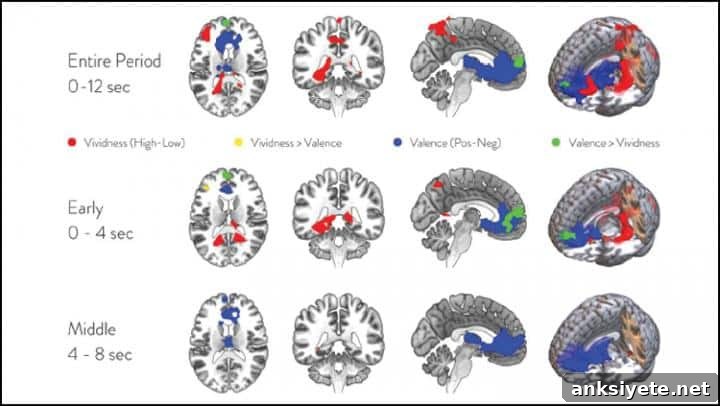
Temporal analysis revealed that these modulations were most prominent during the early and middle portions of the imagination period, with little reliable effect in the late phase. This timing is consistent with the idea that constructing an event (assembling sensory and episodic details) occurs first and is followed by evaluative processes that assign emotional significance.
Taken together, the findings provide strong neural evidence for a functional split within the DMN: the ventral subsystem supports construction of detailed, sensory-rich mental scenes, while the dorsal subsystem supports evaluation of those scenes’ desirability or emotional valence. This dissociation helps explain how the brain can both generate novel imagined events from memory fragments and assess their potential implications for behavior and decision-making.
These results refine our understanding of imagination at the neural level and offer clear targets for future research. Follow-up studies can probe how these subnetworks interact during more complex tasks such as planning, episodic simulation, or therapeutic interventions that rely on mental imagery. Clarifying the neural machinery of imagination may also prove useful for investigating conditions in which internal thought or emotional evaluation is altered, including mood disorders and certain memory impairments.
About this neuroscience research news
Source: SfN
Contact: Calli McMurray – SfN
Image: The image is credited to Lee et al., JNeurosci 2021
Original Research: Closed access.
“The Ventral and Dorsal Default Mode Networks Are Dissociably Modulated by the Vividness and Valence of Imagined Events” by Sangil Lee, Trishala Parthasarathi and Joseph W. Kable. Journal of Neuroscience
Abstract
The Ventral and Dorsal Default Mode Networks Are Dissociably Modulated by the Vividness and Valence of Imagined Events
Previous research has established that the brain’s default mode network becomes engaged when people imagine future events. The present study tested whether imagination can be fractionated into two separable cognitive processes that map onto different DMN subsystems. While recording fMRI in human participants, the investigators manipulated event vividness to increase demands on scene construction and manipulated event valence to increase demands on emotional evaluation.
Results showed a clear dissociation: the ventral DMN (medial temporal lobe subsystem) was sensitive to vividness but not valence, whereas the dorsal/core DMN was sensitive to valence but not vividness. This pattern supports a neurocognitive separation between (1) constructing imagined events by assembling elements from memory and perception and (2) evaluating those constructed events in terms of desirability or emotional valence.
SIGNIFICANCE STATEMENT
This study provides robust neural evidence that different components of imagination recruit distinct DMN subsystems. The vividness of imagined events selectively modulates the ventral DMN, while event valence selectively modulates the dorsal DMN. These findings support the view that constructing and evaluating imagined futures are dissociable processes within the brain’s default mode network.