
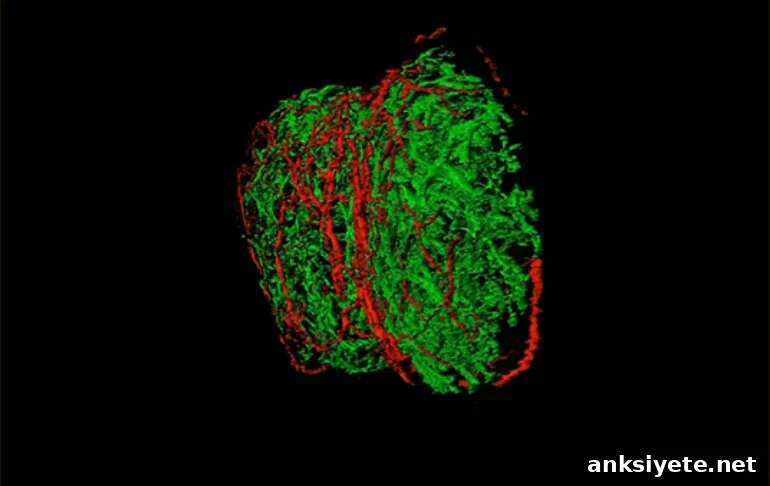
Summary: Researchers have identified a direct cellular interaction between the nervous system and the immune system. Pain-sensing neurons around lymph nodes can actively modulate lymph node activity.
Source: Broad Institute
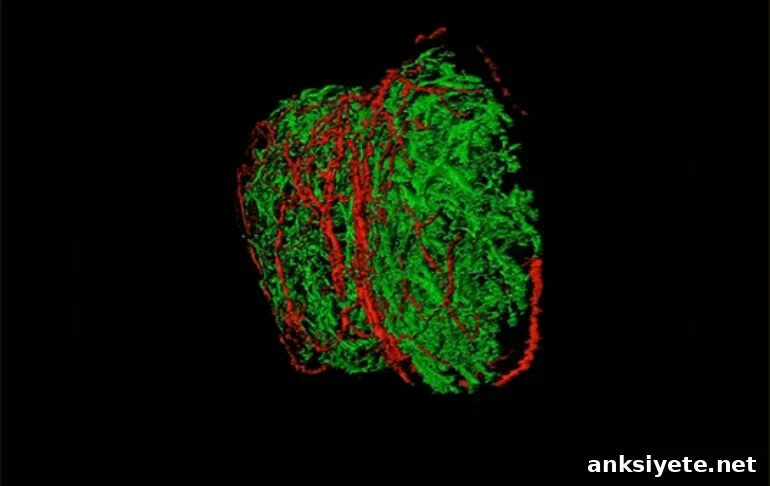
New research reveals a clear, physical connection between the nervous and immune systems. Scientists from Harvard Medical School, the Broad Institute of MIT and Harvard, MIT, and the Ragon Institute of MGH, MIT and Harvard report that pain-sensing sensory neurons form networks around lymph nodes in mice and can influence lymph node behavior—organelles essential to coordinating immune responses.
Published in Cell, this work maps the cellular interactions that mediate neuro-immune crosstalk and opens the door to studying how neuronal input shapes immune responses during infection, inflammation, and other immune events.
“Understanding how these systems are structured and how they communicate creates new opportunities to modulate those interactions for therapeutic benefit,” said Alex Shalek, co-senior author of the study and a member of Broad and the Ragon Institute, and an associate professor at MIT.
Ulrich von Andrian, professor of immunopathology at Harvard Medical School and program leader at the Ragon Institute, is co-senior author. Siyi Huang, a postdoctoral fellow in von Andrian’s lab, is a co-first author of the study.
ILLUMINATING THE LYMPH NODE
Earlier studies suggested possible interactions between neurons and lymphoid tissues. Using advanced imaging, viral tracing, single-cell RNA sequencing, and optogenetics, the team created a detailed map of neural and immune connectivity in mouse lymph nodes. They discovered that sensory neurons originating in the dorsal root ganglion produce a meshwork that innervates the lymph node periphery.
Although the dorsal root ganglion houses thousands of sensory cells, only a small subset—roughly a few dozen—project to an individual lymph node. “We found the 20 or so needles in a haystack that are innervating a lymph node,” said Carly Ziegler, co-first author and graduate student in Shalek’s lab. Identifying these specific neuronal cell bodies among a diverse neuronal population required careful, targeted approaches.
Single-cell RNA sequencing showed that the lymph node-targeting neurons are predominantly nociceptors—pain-sensing neurons. These lymph node-innervating nociceptors express distinct synaptic proteins and surface molecules compared with sensory neurons that target the skin, suggesting they communicate with immune and stromal cells via unique molecular interfaces.
To test whether sensory neurons actively respond to immune events, researchers induced local immune activation and observed that nociceptor fibers increased their density within the enlarging lymph node. This inflammation-induced plasticity indicates these sensory fibers can detect changes in lymph node state and adapt their innervation accordingly.
Importantly, signaling is bidirectional: sensory neurons can also shape lymph node cellular behavior. Optogenetic activation of these fibers triggered rapid transcriptional responses in specific lymph node cell populations, notably endothelial cells, stromal cells, and innate leukocytes. These results suggest nociceptors can directly modulate the lymph node microenvironment and selectively influence immune cell gene expression.
“These neurons are not passive bystanders,” Ziegler added. “They change the local environment of the lymph node and appear to influence particular cells and structures.” The team is now characterizing the molecular signals that mediate this interaction, determining which immune pathways are mobilized by neuronal input, and assessing the impact when these neuro-immune circuits are disrupted.
Beyond lymph nodes, the study establishes experimental toolsets—combining imaging, transcriptomics, tracing, and optogenetics—that can be applied to dissect how other organ systems are integrated with the nervous system. “By building toolkits from multiple fields, we can gain new insights into how the body functions as an integrated system,” Shalek said.
Funding: This research was supported in part by the National Institutes of Health, the Searle Scholars Program, the Beckman Young Investigator Program, the Pew-Stewart Scholars Program for Cancer Research, a Sloan Fellowship in Chemistry, the Ragon Institute, and the HHMI Damon Runyon Cancer Research Foundation Fellowship.
About this neuroscience research news
Source: Broad Institute
Contact: Press Office – Broad Institute
Image: Image credit: Siyi Huang, John Austin, Najat Mannoun
Original Research: Closed access. “Lymph nodes are innervated by a unique population of sensory neurons with immunomodulatory potential” by Alex Shalek et al., Cell. DOI: 10.1016/j.cell.2020.11.028
Abstract
Lymph nodes are innervated by a unique population of sensory neurons with immunomodulatory potential
Highlights
- • Anatomical and molecular identification of lymph node-innervating nociceptors
- • Demonstration of inflammation-induced plasticity of sensory innervation of lymph nodes
- • Transcriptome-based identification of nociceptor target cells within the lymph node
- • Optogenetic validation showing nociceptor activity modulates specific lymph node cell types
Summary
Nociceptors help regulate immune responses at barrier tissues, and their ablation alters local immune outcomes both at peripheral sites and in draining lymph nodes. This study uses high-resolution imaging, viral tracing, single-cell transcriptomics, and optogenetics to define a sensory neuro-immune circuit that senses lymph-borne inflammatory signals and exerts local control over lymph node gene expression. Multiple sensory neuron subsets, predominantly peptidergic nociceptors, innervate lymph nodes and are molecularly distinct from skin-innervating neurons. A lymph node single-cell transcriptomics atlas nominated endothelial, stromal, and innate leukocyte populations as likely neuronal targets. Optogenetic stimulation of lymph node-innervating sensory fibers triggered rapid transcriptional responses in these predicted interacting cell types, supporting a model in which a specialized population of sensory neurons monitors peripheral lymph nodes and can locally regulate immune and stromal gene programs.