
Summary: Excitatory neurons in the visual cortex encode images, while two distinct types of inhibitory interneurons work together in a circuit that improves the stability and reliability of those visual representations.
Source: Picower Institute for Learning and Memory
Visual processing in the brain is inherently noisy. As signals travel from the eye through multiple brain areas, the same visual scene can activate different groups of cells in the visual cortex on different occasions. This variability threatens the brain’s ability to represent images consistently. Researchers at the Picower Institute for Learning and Memory at MIT investigated how the brain enforces reliable visual representations by monitoring neural activity in mice as they watched natural movies.
The team found that while populations of excitatory neurons represent images by responding to visual stimuli, two types of inhibitory interneurons—parvalbumin-expressing (PV) and somatostatin-expressing (SST) cells—interact in a coordinated circuit that regulates the fidelity of those representations. By observing these interactions and by manipulating the inhibitory neurons, the researchers were able to show how the circuit controls whether excitatory neurons respond reliably to the same visual input.
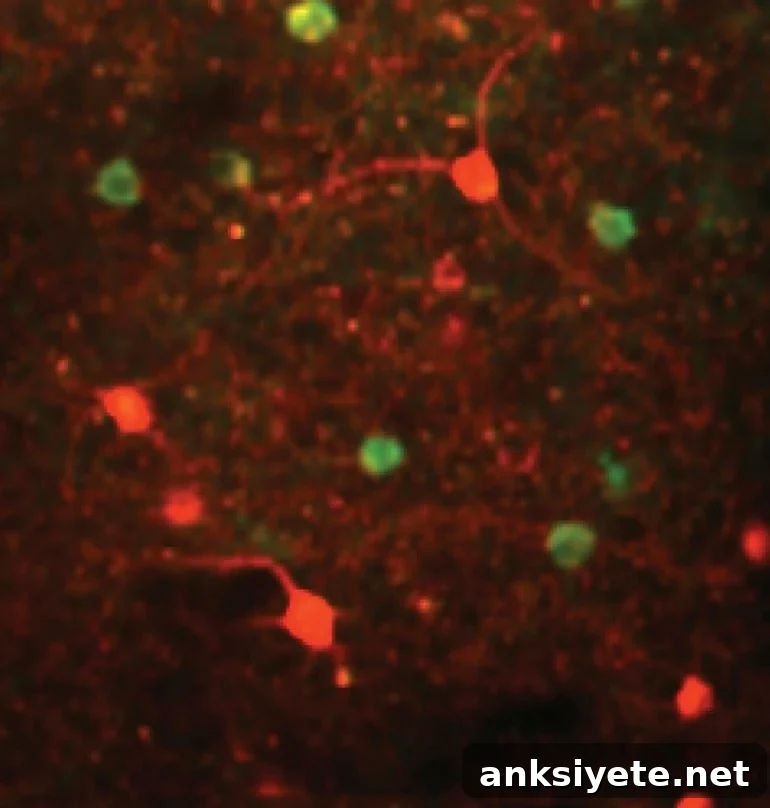
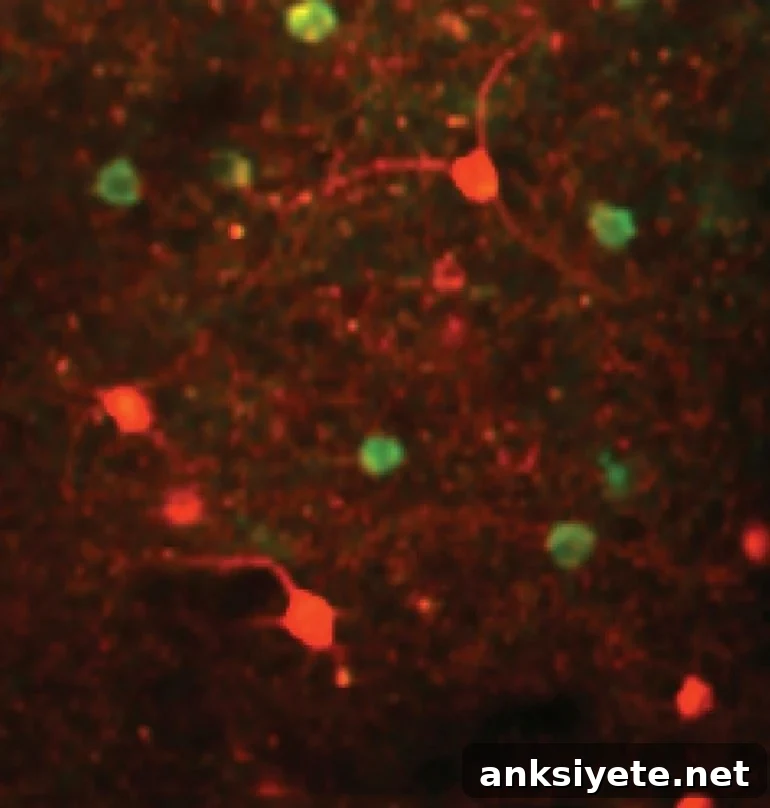
Murat Yildirim and Rajeev Rikhye led the experimental work, which required several technical advances. To image hundreds of excitatory neurons alongside both PV and SST interneurons, the team used dual-color calcium imaging so different cell types could be distinguished under a two-photon microscope. They combined this with optogenetic tools to selectively activate or inhibit specific interneuron classes, and they built a computational model of the circuit to interpret the observed dynamics.
“Reliability is crucial for encoding sensory information,” said Mriganka Sur, Newton Professor of Neuroscience and the study’s senior author. “For perception to be useful, the same neurons should respond in the same way each time we view the same object or scene.”
Circuit dynamics that control reliability
When mice viewed the same movies repeatedly, the researchers measured how consistently excitatory neurons represented the images and compared that consistency to activity patterns in PV and SST interneurons. They observed a clear relationship: epochs of low reliability in excitatory responses coincided with high PV activity and low SST activity. Conversely, epochs of high reliability showed low PV activity and elevated SST activity. Notably, SST activity tended to follow PV activity in time after excitatory responses had become unreliable, consistent with an inhibitory feedback arrangement in which SST cells regulate PV cell activity.
PV interneurons control the gain of excitatory cells by inhibiting activity at the cell body (soma), preventing saturation in response to strong input. However, this gain control can increase trial-to-trial variability, reducing the chance that the exact same excitatory neurons will fire the same way each time a stimulus repeats. SST interneurons, which inhibit other cells via dendritic synapses, can suppress PV activity and thereby permit greater somatic spiking in excitatory neurons. In this way, SST cells help improve the signal-to-noise ratio: they reduce noisy synaptic input at the dendrites while disinhibiting the soma to allow reliable spiking.
The team’s computational model of the three-part circuit—excitatory cells plus PV and SST interneurons—recapitulated these dynamics, showing that SST inhibition of PV neurons becomes active when excitatory responses are unreliable. Optogenetic manipulations confirmed the causal role of this circuit: driving SST neurons increased the reliability of excitatory responses by suppressing PV activity, while increasing PV activity reduced reliability. Importantly, SST cells alone could not enforce reliability without PV cells present; the two interneuron types act cooperatively.
The authors propose that this cooperative SST→PV interaction serves a biophysical function: it maximizes the signal-to-noise ratio of excitatory neurons by minimizing noisy dendritic inputs and maximizing somatic spiking. In other words, the circuit balances inhibition at dendrites and the soma to promote consistent, high-fidelity sensory coding.
SST activity is not determined solely by local feedback within the circuit. The researchers note that top-down inputs from other brain regions could modulate SST neurons as well—for example, when attention or behavioral relevance increases the need for reliable representation, higher brain centers might engage SST cells to sharpen cortical coding.
In addition to Sur, Yildirim and Rikhye, the paper’s authors include Ming Hu and Vincent Breton-Provencher. Funding for the study came from the National Eye Institute, the National Institute of Biomedical Imaging and Bioengineering of the National Institutes of Health, and the JPB Foundation.
About this visual neuroscience research news
Author: David Orenstein
Source: Picower Institute for Learning and Memory
Contact: David Orenstein – Picower Institute for Learning and Memory
Image: The image is credited to Murat Yildirim/MIT Picower Institute
Original Research: Closed access. “Reliable sensory processing in mouse visual cortex through cooperative interactions between somatostatin and parvalbumin interneurons” by Rajeev V. Rikhye, Murat Yildirim, Ming Hu, Vincent Breton-Provencher and Mriganka Sur. Journal of Neuroscience.
Abstract
Reliable sensory processing in mouse visual cortex through cooperative interactions between somatostatin and parvalbumin interneurons
Neuronal variability constrains information encoding in primary visual cortex (V1), yet neurons can also respond with high precision to the same visual stimulus across trials. This suggests circuit mechanisms exist to dynamically regulate trial-to-trial variability. The study examined how different inhibitory interneurons contribute to reliable coding in mouse V1 using dual-color calcium imaging to monitor SST and PV ensembles simultaneously while awake mice passively viewed natural movies. SST neurons were more active during reliable epochs of pyramidal neuron firing, whereas PV neurons were more active during unreliable epochs, and SST activity lagged PV activity consistent with an inhibitory SST→PV circuit.
Temporally targeted optogenetic activation and inactivation of SST and PV interneurons during periods of reliable and unreliable pyramidal cell firing demonstrated that transient activation of SST neurons increased pyramidal neuron reliability by suppressing PV neurons, a finding supported by a rate-based model of V1. These results identify a cooperative role for the SST→PV circuit in modulating the reliability of pyramidal neuron activity.
SIGNIFICANCE STATEMENT
Cortical neurons often exhibit large variability to identical sensory stimuli, though they can respond reliably under certain conditions. Using dual-wavelength calcium imaging and temporally selective optical perturbations, the study identifies an inhibitory circuit in visual cortex that modulates pyramidal neuron reliability to naturalistic stimuli. Computational models support the conclusion that somatostatin interneurons enhance reliability by suppressing parvalbumin interneurons through the SST→PV pathway, revealing a novel circuit mechanism that improves the fidelity of neural coding essential for visual perception.