
Summary: Researchers have identified a neural circuit in fruit flies that converts sensory inputs of different intensities into a binary decision about whether to act.
Source: University of Michigan
Fruit flies offer fresh insight into how nervous systems make simple yes-or-no decisions.
Biologists at the University of Michigan and their collaborators have discovered a neural circuit in Drosophila melanogaster larvae that converts graded sensory information into a categorical “respond” or “don’t respond” decision. The work, published in Current Biology, illuminates how a developing nervous system transforms continuously varying inputs into a discrete behavioral choice and suggests principles that could inform machine learning and artificial intelligence.
Consider an everyday example: you sit by an open window and hear noise from outside. When the sound level is low, you barely notice it. As it increases, you become more aware, and at some point your brain makes a decision—whether to get up and close the window. The authors asked how nervous systems perform that graded-to-binary transformation: how a steadily rising input becomes a clear yes-or-no action.
“That’s a really big question,” said neuroscientist Bing Ye, senior author on the study and a faculty member at the University of Michigan Life Sciences Institute. “Between the sensory input and the behavioral output there is a bit of a black box. With this study, we wanted to open that box.”
Human and mammalian brain imaging can reveal regions that respond to stimuli, but those methods don’t easily show how neurons convert linear signals into nonlinear decision thresholds. To get a detailed, quantitative view of the process, the researchers used Drosophila larvae, a model organism that allows precise genetic targeting of individual neurons.
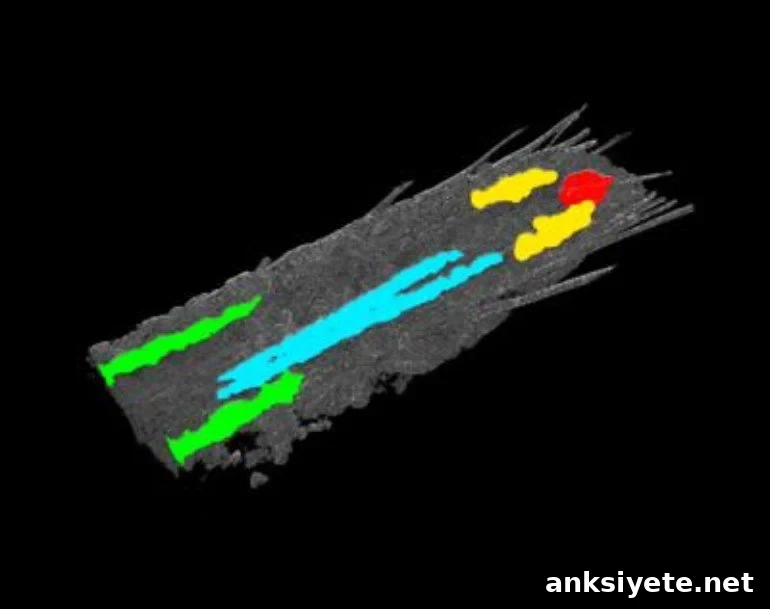
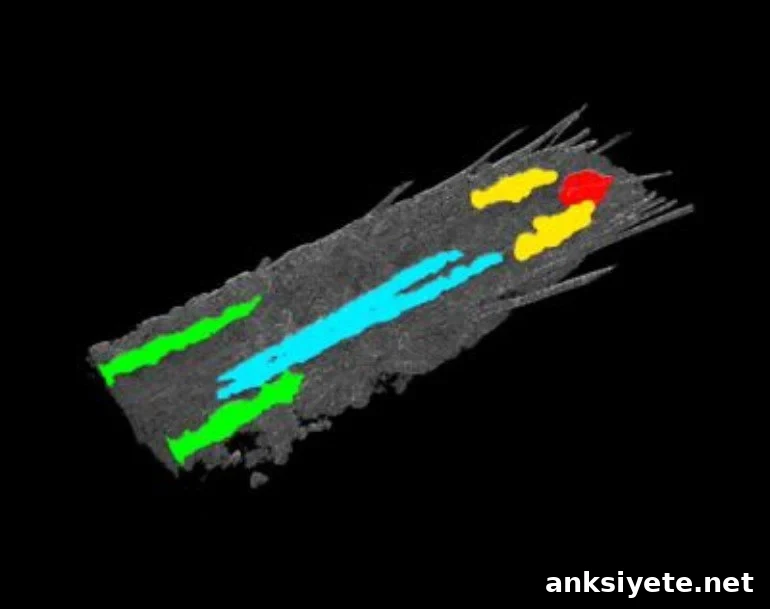
The team applied whole-central-nervous-system 3-D imaging that detects neuronal activity via calcium signals. This approach let them visualize, in three dimensions, which regions of the larval CNS light up when sensory neurons detect harmful or noxious stimuli.
“When we stimulate sensory neurons that detect harmful input, many brain regions become active within seconds,” said Yujia Hu, a research investigator at the Life Sciences Institute and a lead author. “Different regions play different roles: some process raw sensory information, some drive motor output, and some appear to perform the transformation that converts graded signals into a decision.”
They identified a specific decision-related region, which they call the posterior medial core, that sits between sensory-processing and motor-related areas. This region categorizes incoming signals by either muting weaker, less harmful inputs or amplifying stronger, harmful inputs. In effect it converts a continuous gradient of stimulus intensities into discrete categories: “respond” or “don’t respond.”
Amplification occurs through recruitment of additional second-order neurons as stimulus intensity increases—an effect the authors term escalated amplification. For example, a mild noxious stimulus might activate only a couple of second-order neurons, while a stronger stimulus recruits many more. Once a larger subset of the network is engaged, the circuit is capable of driving an escape or avoidance behavior.
Equally important is the circuit’s ability to suppress weak inputs. The researchers found that the sensory neurons do detect low-intensity stimuli, but the posterior medial core filters those signals via inhibitory mechanisms that reduce neuron-to-neuron communication. This gating prevents unnecessary responses to negligible stimuli and keeps the system from amplifying every minor input.
The combined action of inhibitory gating and escalated amplification increases detection accuracy by reducing false responses to mild, irrelevant stimuli while enhancing responses to truly harmful inputs. The authors describe how peptidergic downstream neurons decode the decision-related activity in the posterior medial core to enable binary escape behaviors.
“Our sensory system detects far more information than we consciously act on,” said Ye, who is also a professor of cell and developmental biology. “You need a mechanism to silence unimportant signals; otherwise activity would just escalate unchecked.”
Beyond basic neuroscience, the team notes that this circuit architecture—categorizing graded inputs without an extended evidence-accumulation period—might inspire new approaches in artificial intelligence for faster categorization and decision-making. Instead of relying on slow accumulation of evidence, a network wired to gate and escalate inputs could reach accurate binary decisions more quickly.
The study was supported by the National Institutes of Health. Authors include Limin Yang, Geng Pan, Hao Liu, Congchao Wang and Guoqiang Yu, in addition to Ye and Hu.
Abstract
A Neural Basis for Categorizing Sensory Stimuli to Enhance Decision Accuracy
Highlights
- •Graded nociceptive encodings become binary in a decision-related region of the larval CNS
- •A gated amplification mechanism transforms graded encodings into categorical ones
- •Peptidergic neurons decode decision-related activity to drive escape behaviors
- •This graded-to-binary conversion improves detection accuracy
Summary
Sensory inputs that vary in intensity often require a yes-or-no decision about whether to respond. How the central nervous system implements that conversion from graded signals to binary outcomes has been unclear. This study shows that in Drosophila larvae, graded encodings of noxious stimuli are categorized in a decision-associated CNS region and then decoded by peptidergic neurons to execute escape decisions. GABAergic inhibition gates weak nociceptive encodings to prevent inappropriate responses, while escalated amplification recruits additional second-order neurons to boost mid-range inputs into actionable signals. These two mechanisms together reduce responses to negligible stimuli and enhance responses to dangerous ones, providing a circuit-level explanation for accurate detection of harmful stimuli.
Source: University of Michigan
Contact: Jim Erickson, University of Michigan
Image credit: Yujia Hu, U-M Life Sciences Institute
Original Research: A Neural Basis for Categorizing Sensory Stimuli to Enhance Decision Accuracy, by Yujia Hu et al., Current Biology (open access).