
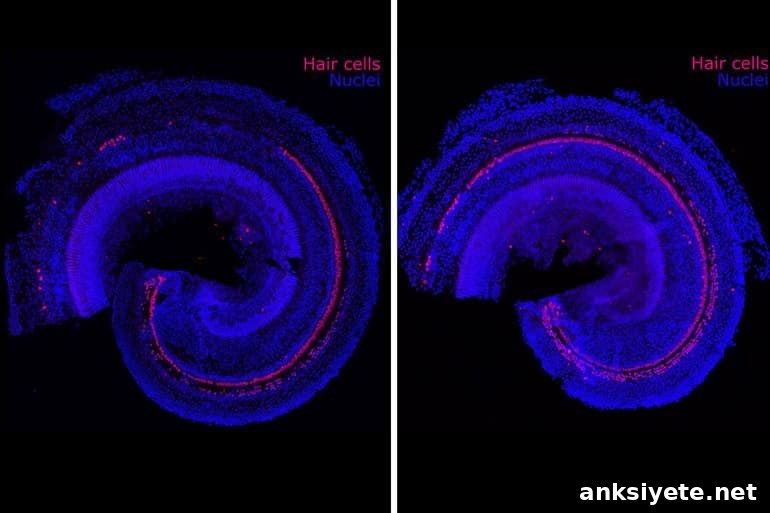
Summary: A novel regenerative therapy uses small molecules to instruct progenitor cells derived from inner-ear stem cells to produce new sensory hair cells in the cochlea, with the goal of restoring hearing.
Source: MIT
Hearing loss affects millions of people worldwide and brings more than reduced sound perception. It can cause social isolation, increased frustration, persistent tinnitus (ringing in the ears), and is linked to a higher risk of cognitive decline and dementia.
Frequency Therapeutics, a biotechnology company co-founded by researchers from MIT and Harvard, is developing a regenerative drug aimed at reversing certain types of sensorineural hearing loss. Instead of relying on hearing aids or cochlear implants, their approach uses small-molecule drugs injected directly into the inner ear to reactivate local progenitor cells—cells related to stem cells—and coax them to become the sensory hair cells essential for hearing.
Sensory hair cells in the cochlea are fragile: loud noise, some antibiotics, and certain chemotherapy drugs can kill them. Once lost, these hair cells do not naturally regenerate in adults, leaving permanent hearing damage. Frequency’s therapy is designed to stimulate dormant progenitor cells already present in the inner ear to regenerate functional hair cells, restoring auditory function at its biological source.
In early clinical studies, the company has reported measurable improvements in speech perception, which is the ability to understand and recognize words in everyday listening situations. According to Frequency, some trial participants experienced significant gains in speech perception after a single injection, with effects that in some cases persisted for nearly two years.
To date, Frequency has treated more than 200 patients across multiple clinical studies. The company reports clinically meaningful improvements in speech perception in three separate trials, while acknowledging that one study failed to show benefit against placebo—an outcome the team attributes to limitations in that specific trial’s design. Frequency is currently enrolling patients in a larger 124-person study, with preliminary results expected early next year.
“Speech perception is the top priority for people seeking better hearing,” says Frequency co-founder and Chief Scientific Officer Chris Loose, Ph.D. Improving the ability to hear and understand speech in noisy environments is a primary patient need, and it has been a central endpoint in the company’s trials.
The company’s founding team includes scientists and entrepreneurs with deep ties to MIT: Institute Professor Robert Langer, CEO David Lucchino, Senior Vice President Will McLean, Ph.D., and Jeff Karp, affiliated faculty in Harvard–MIT Health Sciences and Technology. They view their work as addressing a widespread public health problem—more than 40 million people in the U.S. and hundreds of millions globally live with disabling hearing loss—and as advancing a potentially broader regenerative platform.
“Hearing connects people to their communities and shapes identity,” says Karp, who is also a clinical professor at Brigham and Women’s Hospital. “The ability to restore hearing could have profound social and personal impact.”
From laboratory discovery to a clinical candidate
The idea behind Frequency grew from collaborations at MIT. In 2005, David Lucchino and Chris Loose met through MIT entrepreneurship programs and later worked with Robert Langer on separate biomedical ventures. Years later, Langer and Jeff Karp investigated how the gut’s rapidly renewing epithelium is regulated and discovered signaling molecules that control stem cell behavior. With MIT postdoc Xiaolei Yin, they identified that similar small-molecule pathways could activate progenitor cells—cells that can differentiate into specialized cell types—in other tissues.
Progenitor cells in the inner ear produce hair cells during fetal development but become dormant before birth in humans. Each cochlea contains roughly 15,000 hair cells at birth, and those cells decline with age or after injury. In 2012, the research team showed in the lab that small molecules could reprogram inner-ear progenitor cells to generate thousands of new hair cells in vitro—an achievement the researchers considered a major breakthrough and a foundation for Frequency’s therapeutic approach.
The founders believe that locally delivered small molecules offer practical advantages compared with some gene- or cell-based therapies that require cell harvesting, ex vivo manipulation, and targeted delivery. By activating progenitor cells already in place, their approach aims to simplify treatment while leveraging the body’s innate regenerative capacity.
Expanding regenerative medicine beyond hearing
While advancing its lead program for hearing, Frequency is also exploring applications in other neurological conditions. One notable program targets remyelination for multiple sclerosis (MS). In MS, immune attacks damage myelin—the protective sheath around nerve fibers—and native progenitor cells that normally generate myelin-producing cells do not keep pace with damage. Frequency’s early preclinical work has shown substantial increases in myelin in mouse models, and the company plans to submit an investigational new drug application for the MS program in the coming year.
The founders describe their small-molecule platform as broadly applicable: by modulating local cellular programs, it may be possible to induce regeneration in a range of tissues where progenitor cells exist but remain inactive or insufficiently productive after injury or disease.
For the team, seeing clinical improvements in trial participants has been emotionally powerful. “Some people couldn’t hear well for decades, and then after treatment they can hear their family in a noisy restaurant,” Langer says. Those individual transformations underscore the potential social and quality-of-life benefits of regenerative hearing therapies.
Karp envisions continued progress over the next decade or two. “With growing investment and scientific advances, restoring hearing could become a routine, rapid procedure—comparable to how refractive eye surgery transformed vision care,” he says. “The science is moving quickly, and the possibilities are exciting.”
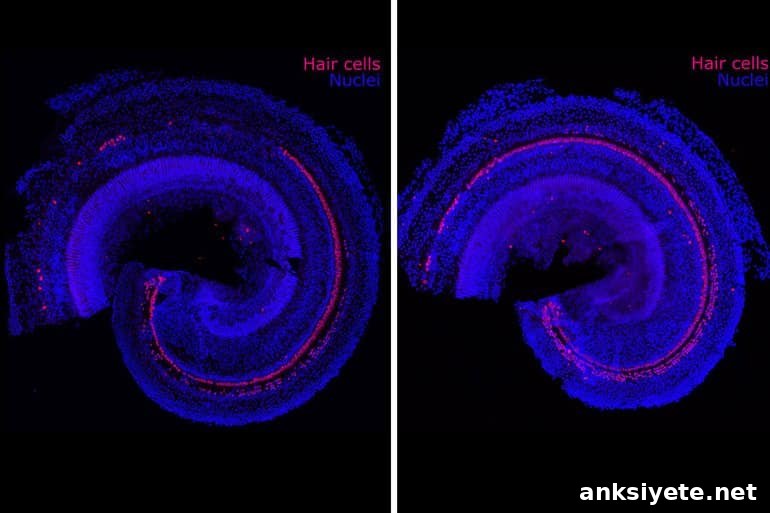
About this auditory neuroscience and genetics research news
Author: Zach Winn
Source: MIT
Contact: Zach Winn – MIT
Image: The image is credited to Hinton AS, Yang-Hood A, Schrader AD, Loose C, Ohlemiller KK, McLean WJ