
Summary: New research links a specific speech sound—the trilled “/r/”—with words for rough textures across many of the world’s languages.
Source: University of Birmingham
Researchers report that words for rough surfaces in many languages are far more likely to include a trilled /r/ sound—a pattern that their evidence suggests has persisted for millennia.
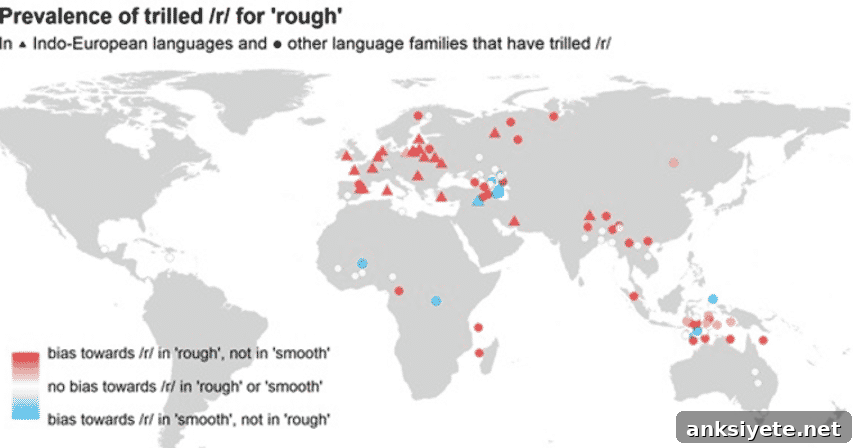
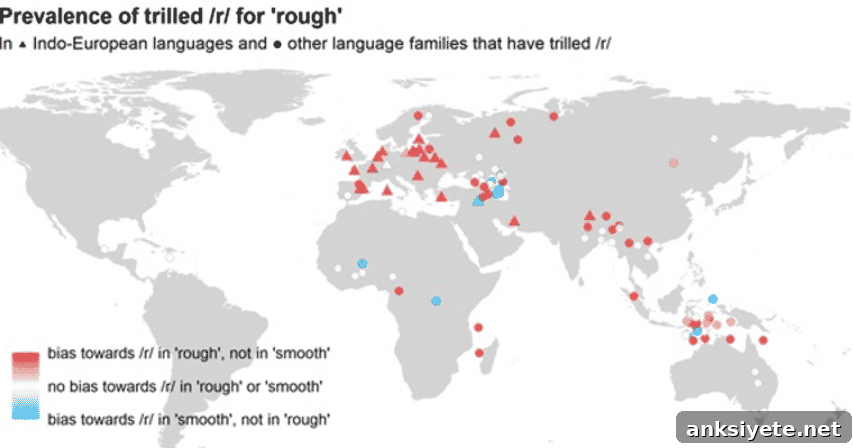
The study began with a wide survey of vocabulary for texture. Language scientists examined words meaning “rough” and “smooth” in a global sample of 332 spoken languages and discovered a clear relationship between the sounds used in those words and the human sense of touch. Compared with words for “smooth,” words that convey roughness were almost four times more likely to include a trilled /r/—the kind of rolled “r” an Italian speaker uses in “arrivederci.”
Examples span unrelated language families: Basque zakarra, Mongolian barzgar, Dutch ruw, and Hungarian durva all illustrate the recurring presence of an /r/ pronounced as a trill. The pattern is not isolated to a few languages; subsequent analyses show that the association between /r/ and roughness appears across sensory vocabularies in 38 contemporary Indo-European languages and can be traced back to reconstructed Proto-Indo-European roots, suggesting this sound-meaning link has been stable for at least 6,000 years.
The team also compared individual languages. In both English and Hungarian—languages that are not closely related—roughness-related words such as “rough,” “coarse,” and “gnarled” (English) and “durva,” “érdes,” “göcsörtös” (Hungarian) contain an /r/ sound in roughly 60% of cases. That frequency is more than twice what the researchers observed for words describing smoother textures like “smooth,” “silky” and “oily” (English) or “sima,” “selymes,” “olajos” (Hungarian).
The international research team, based at the University of Birmingham, Radboud University, and the University of British Columbia, presents these results in Scientific Reports. Their work documents one of the most widespread examples yet of cross-modal iconicity in spoken languages—an instance where a particular speech sound consistently mirrors a perceptual quality from another sense, in this case touch.
Co-author Dr Mark Dingemanse, Associate Professor in Language and Communication at Radboud University, said the combined results are striking: “On their own, any of these patterns would be quite striking, but taken together, they demonstrate a deep-rooted and widespread association between the sounds of speech and our sense of touch.” He adds that this association “comes naturally to us, making the association more likely to surface and to stick around as words evolve over time.”
Dr Bodo Winter, Senior Lecturer in Cognitive Linguistics at the University of Birmingham and co-author, emphasises how the finding illustrates cross-modal links: “This is one of the most widespread examples so far of cross-modal iconicity in spoken languages—linking the sounds of speech to the sense of touch. Such cross-modal associations can play a significant role in shaping the forms of spoken words in natural languages.”
Not every language participates in this pattern. Around three-quarters of the world’s languages include some kind of /r/ sound, and the trilled variant is the most common rhotic globally. However, some languages lack trilled /r/ or lack rhotics entirely, and the /r/-for-rough pattern is strongest where a true trilled /r/ exists. The authors note that the pattern is absent in regions where trilled /r/ is rare, such as many languages of the Americas.
About this language research news
Author: Tony Moran
Source: University of Birmingham
Contact: Tony Moran – University of Birmingham
Image: The image is credited to University of Birmingham
Original Research: Open access.
“Trilled /r/ is associated with roughness, linking sound and touch across spoken languages” by Bodo Winter, Márton Sóskuthy, Marcus Perlman & Mark Dingemanse. Scientific Reports
Abstract
Trilled /r/ is associated with roughness, linking sound and touch across spoken languages
This research examines how cross-modal connections between sound and tactile texture shape spoken language. By analysing words for texture across a large, diverse set of languages and numerous sensory terms within languages, the authors identify a robust statistical tendency: words that denote roughness are highly likely to include a trilled /r/, the most common type of rhotic consonant.
The evidence comes from multiple complementary studies that together document this as a widespread pattern of iconicity—where the form of a word bears a perceptual resemblance to its meaning—across global languages and within language families. Historical analysis of Indo-European languages and reconstructed Proto-Indo-European roots suggests that this sound-meaning association has remarkable longevity, possibly extending back at least 6,000 years.