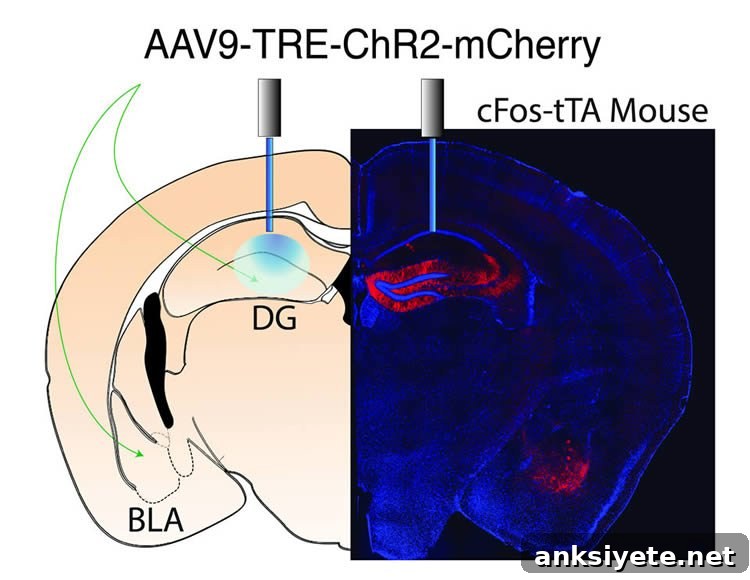
Researchers at MIT have shown that altering specific neural connections in mice can change the emotional meaning attached to a memory, turning a negative memory into a positive one and vice versa.
In work led by Howard Hughes Medical Institute investigator Susumu Tonegawa at the Massachusetts Institute of Technology, scientists demonstrated that the connections between the hippocampus—the brain region that encodes contextual information about an event—and the amygdala—the region that encodes the emotional valence of that event—are flexible. Their findings, published in the August 28, 2014 issue of Nature, reveal that these circuits can be rewritten to switch a memory’s emotional value.
Every memory carries two basic components: the context (where and when something happened) and the emotional response it evokes. The hippocampus stores the contextual “where” and “when,” while the amygdala stores the emotional “good” or “bad.” Tonegawa’s team used targeted, light-driven manipulation of the very cells that store an individual memory—cells often called an engram—to explore whether the emotional side of that memory could be reassigned.
In previous work the group demonstrated that turning on the small set of hippocampal cells that represent a safe environment while giving a mouse a mild shock in a different setting caused the animal to falsely fear the original safe context. Building on that approach, the new experiments asked a tougher question: once a memory already carries an emotion, can that emotion be reversed?
To test this, the team first created a fear memory. Male mice were placed in a chamber where they received a mild foot shock. As the memory formed, the researchers used a genetic method to make the particular cells activated during encoding light-sensitive. A few days later, shining light into the brain selectively reactivated the same engram cells and triggered the expected fear response: the mice froze and stopped exploring.
Next, the scientists attempted to overwrite the fear memory with a positive experience. The mice were moved to a different environment where they could interact with female mice—a naturally rewarding experience for the males. While the animals enjoyed those interactions, the researchers reactivated the engram cells that represented the original fearful context by shining light on them. They reactivated either the hippocampal context cells or the amygdala emotion cells but never both at the same time, then measured how the mice responded to the original chamber when later tested.
The results were revealing. Reactivating the amygdala cells that encoded fear while the mice experienced something pleasurable did not change the animals’ fear. In contrast, reactivating the hippocampal context cells during the positive experience caused the mice to form a new, positive association with that context. After this manipulation, animals actively sought out environments that triggered the reactivated hippocampal memory instead of avoiding them. Returning the mice to the original shock chamber showed substantially reduced fear and an increase in exploratory and reward-seeking behavior, indicating that the original fear memory had been meaningfully altered.
The team also reversed a positive memory into a negative one. Mice first developed a pleasurable association with a context, and then the researchers reactivated the hippocampal context cells while the mice were given a mild shock. The pleasurable response linked to those hippocampal engram cells was replaced by fear.
These experiments support the idea that the contextual engram in the hippocampus forms flexible, changeable links to two distinct populations of amygdala neurons: one set that mediates positive valence and another that mediates negative valence. According to Tonegawa, the hippocampal context cells can connect to either amygdala population, and the competition between those circuits determines whether a memory is experienced as positive or negative.
Commenting on the work in an accompanying News & Views piece in Nature, Tomonori Takeuchi and Richard G. M. Morris note that the study dissects a place memory into network components and uses selective reactivation of the “where” component to change the “what” association without re-exposing animals to the original training conditions.
Tonegawa stresses that these results in mice do not yet translate into a clinical therapy for people. The methods used—genetically targeting engram cells and manipulating them with light—are not available for humans. Still, the experiments highlight the malleability of hippocampus–amygdala circuits and suggest they could be explored as targets for new treatments to modify maladaptive emotional memories in psychiatric disorders.
Contact: Jim Keeley – HHMI press office
Source: HHMI press release
Image Source: Image credited to Redondo et al., adapted from the HHMI press release
Original Research: “Bidirectional switch of the valence associated with a hippocampal contextual memory engram” by Roger L. Redondo, Joshua Kim, Autumn L. Arons, Steve Ramirez, Xu Liu and Susumu Tonegawa, Nature. Published online August 27, 2014. DOI: 10.1038/nature13725
Accompanying article: News & Views “Neuroscience: Shedding light on a change of mind” by Tomonori Takeuchi and Richard G. M. Morris, Nature. Published online August 27, 2014. DOI: 10.1038/nature13745