Summary: Researchers at RIKEN identify the posterior inferior parietal lobe (pIPL) as a key hub that combines confidence signals from different sources during decision-making and wagering tasks in macaques.
Source: RIKEN
Three neuroscientists at the RIKEN Center for Brain Science have identified a specific region in the macaque brain—the posterior inferior parietal lobe (pIPL)—that integrates confidence from multiple information sources during decision making.
Published in Cell Reports, this study sheds light on how the brain forms integrated self-evaluations (metacognition) and has implications for understanding psychiatric conditions in which introspection and self-monitoring are impaired.
When we make decisions we often rely on both current sensory evidence and stored memories. For example, we may try to decipher a hastily written note while simultaneously recalling the events that prompted the note. To reach a reliable choice, the brain must estimate the confidence of each information source and combine those confidence estimates into a single judgment that guides action.
Metacognition—the capacity to evaluate one’s own knowledge and memory—is central to planning, learning, and flexible behavior. Until now, the neural site where confidence signals from different conceptual domains converge and are integrated for action selection remained unclear.
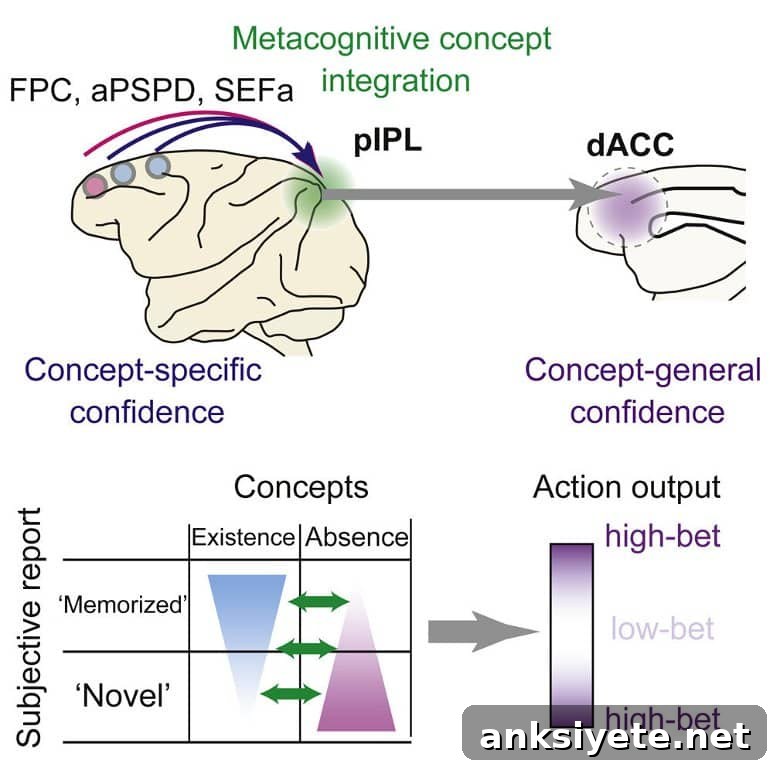
Kentaro Miyamoto, Rieko Setsuie and Yasushi Miyashita used a wagering paradigm in macaque monkeys to trace how concept-specific confidence signals are translated into an integrated introspective judgment. In each trial, monkeys viewed an image and judged whether it had been seen previously. After making that mnemonic decision, the animals expressed their confidence by choosing between a high-risk/high-reward or a low-risk/low-reward bet.
Behavioral results showed that monkeys selected the high-risk option more frequently when their memory judgments were correct, demonstrating effective metacognitive behavior: their bets reflected internal estimates of confidence based on the preceding decision.
Functional magnetic resonance imaging recorded during the task identified the pIPL as selectively active when monkeys successfully integrated memory-based confidence into the wagering choice. Rather than simply encoding the bet itself, the pIPL responded more strongly when the animal chose the optimal betting option in accordance with its memory performance—indicating an integrative metacognitive role.
Surprisingly, the region implicated is located toward the back of the brain. Miyamoto notes that many researchers have emphasized prefrontal regions as central to rule-based decision-making and metacognitive oversight, yet the whole-brain mapping in this study highlighted a posterior parietal area as the site of integration.
Further analysis showed that the pIPL receives confidence-related signals from multiple prefrontal regions previously associated with reading out confidence in memory. In other words, while the prefrontal cortex contributes concept-specific confidence estimates, the pIPL appears to combine those separate confidence readouts into an overall introspective assessment. Once the pIPL forms this integrated signal, it then communicates with the dorsal anterior cingulate cortex to implement the selected wagering strategy.
The researchers also observed that longer response times during post-decision wagering were related to compensatory processes: when frontal disruption impaired performance, allowing more time for wagering reduced that impairment. This suggests a time-consuming integrative mechanism that the pIPL may mediate when confidence signals are uncertain or when additional processing is needed.
Looking ahead, Miyamoto and colleagues plan to investigate the neuronal-level mechanisms that underlie metacognitive integration in the pIPL and to explore how disruptions in this circuitry might contribute to psychiatric conditions in which individuals act against their own intentions or lack reliable introspection.
About this decision-making research news
Author: Press Office
Source: RIKEN
Contact: Press Office – RIKEN
Image: The image is credited to RIKEN
Original Research: Open access.
“Conversion of concept-specific decision confidence into integrative introspection in primates” by Kentaro Miyamoto et al., Cell Reports
Abstract
Conversion of concept-specific decision confidence into integrative introspection in primates
Highlights
- Metacognitive, time-consuming compensatory processes operate in macaques for integrating uncertain evidence.
- The posterior inferior parietal lobe (pIPL) encodes the interaction between objective performance and subjective confidence.
- The pIPL integrates confidence signals that are specific to different conceptual domains, such as experience and novelty.
- The pIPL influences the dorsal anterior cingulate cortex to execute strategic actions based on the integrated introspective judgment.
Summary
Introspection that depends on combining uncertain evidence from distinct sources is essential for abstract reasoning and imagining future scenarios. This study addresses how confidence readouts arising from concept-specific processes are converted into a unified introspective signal that can guide behavior.
Using a wagering task that followed a mnemonic decision, the researchers showed that animals’ betting choices reflected their internal estimates of decision confidence. Longer post-decision wagering times attenuated impairments caused by frontal disruption, indicating a compensatory processing period for metacognitive integration.
Neuroimaging and behavioral analyses identified the pIPL as a candidate site for this integration. The pIPL did not simply represent whether the animal selected a high or low bet; instead, it became more active when the animal’s betting choice matched the optimal strategy given its memory performance. After integrating concept-specific confidence signals, the pIPL engaged the dorsal anterior cingulate cortex to carry out the chosen wagering action. These findings support a model in which the pIPL plays a central role in integrating multiple confidence signals into an actionable introspective judgment.