
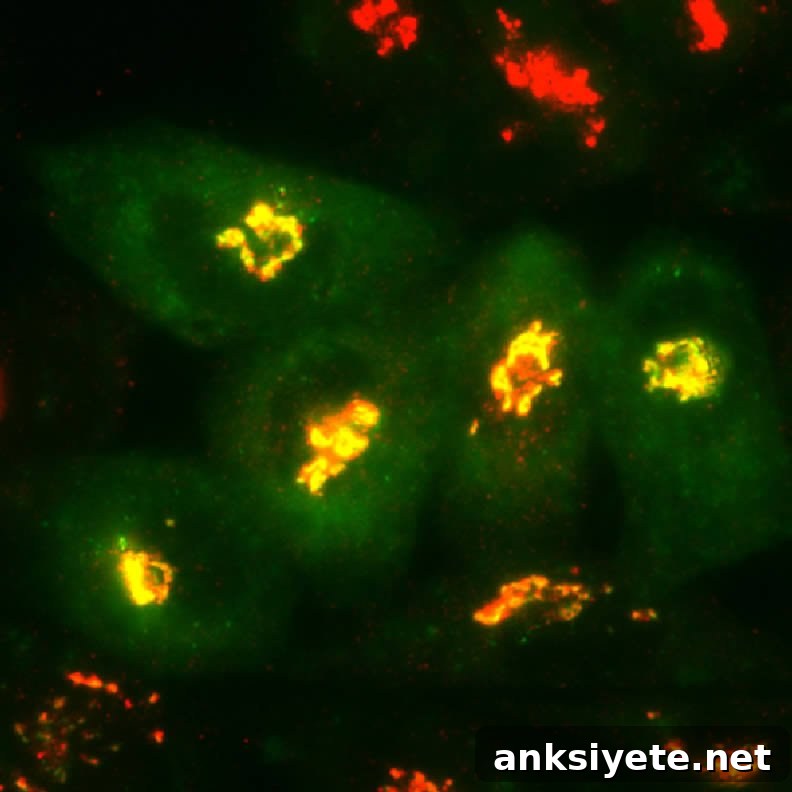
Researchers at the University of Michigan have uncovered how to repair a key cellular structure called the Golgi apparatus, which becomes fragmented in the neurons of all Alzheimer’s patients and appears to play a central role in disease progression.
The team reports that by understanding the molecular events that cause Golgi fragmentation, they can better explain how amyloid plaques form in Alzheimer’s brains—plaques that destroy neurons and are strongly linked to memory loss and other cognitive symptoms.
Investigators identified the biochemical pathway that leads to Golgi disassembly and developed two experimental approaches that restore Golgi integrity and markedly reduce the harmful secretion of amyloid beta (Aβ) peptide.
“We plan to use this as a strategy to delay disease development,” said Yanzhuang Wang, associate professor of molecular, cellular and developmental biology at the University of Michigan. “These findings give us a clearer picture of why plaques form rapidly in Alzheimer’s and point to a way to slow that process.”
The study appears in an upcoming issue of the Proceedings of the National Academy of Sciences. Gunjan Joshi, a research fellow in Wang’s laboratory, is the lead author on the paper.
For years scientists have observed that the Golgi apparatus becomes fragmented in neurons affected by Alzheimer’s disease, but the underlying cause and consequences of that fragmentation were not well understood. The Golgi plays a vital role in processing and routing proteins and lipids so that cells function properly; it is often compared to a cellular post office. When the Golgi becomes fragmented, this sorting and distribution system fails, causing misdirection or loss of important cellular components.
University of Michigan researchers demonstrated that accumulation of the Aβ peptide—the peptide widely implicated in plaque formation—initiates a cascade that activates an enzyme called cyclin-dependent kinase 5 (cdk5). Active cdk5 then modifies structural Golgi proteins such as GRASP65, leading to fragmentation of the Golgi stacks.
Restoring Golgi structure reduced Aβ secretion substantially. The researchers used two complementary strategies: pharmacological inhibition of cdk5 and expression of a GRASP65 mutant that cannot be modified by cdk5. Both approaches were effective in rescuing Golgi architecture and reduced harmful Aβ secretion by approximately 80 percent in their experimental systems.
These results suggest that Golgi fragmentation is not merely a bystander effect of Alzheimer’s pathology but may actively contribute to increased production and release of amyloidogenic peptides. By preventing the Golgi from breaking apart, the researchers were able to interrupt a self-reinforcing cycle that promotes plaque formation.
The next steps described by the team include testing whether Golgi fragmentation can be delayed or reversed in animal models of Alzheimer’s disease. This work is being pursued in collaboration with the Michigan Alzheimer’s Disease Center at the University of Michigan Health System, involving neurologists and neuroscientists who will assess the impact of Golgi rescue on plaque accumulation and cognitive outcomes in mice.
The collaboration was supported in part by MCubed, a two-year seed funding program designed to catalyze interdisciplinary research among University of Michigan faculty, and by pilot funding from the Michigan Alzheimer’s Disease Center. These funding mechanisms helped bring together molecular biologists, neurologists and behavioral neuroscientists to address a pressing societal challenge.
Contact: Laura Bailey – University of Michigan
Source: University of Michigan press release
Image Source: Images credited to Yanzhuang Wang and adapted from the University of Michigan press release.
Original Research: The research paper titled “Aβ-induced Golgi fragmentation in Alzheimer’s disease enhances Aβ production” by Joshi G., Y. Chi, Z. Huang and Y. Wang will appear in the Proceedings of the National Academy of Sciences (PNAS).
This work sheds new light on how cellular organelle dysfunction can amplify proteinopathies in neurodegenerative disease and provides a potential mechanistic target—Golgi stabilization—for therapies aimed at slowing the progression of Alzheimer’s disease. Further studies in animal models and eventual translational research will be required to determine whether targeting the Golgi or the cdk5–GRASP65 pathway can be developed into safe and effective treatments for people.