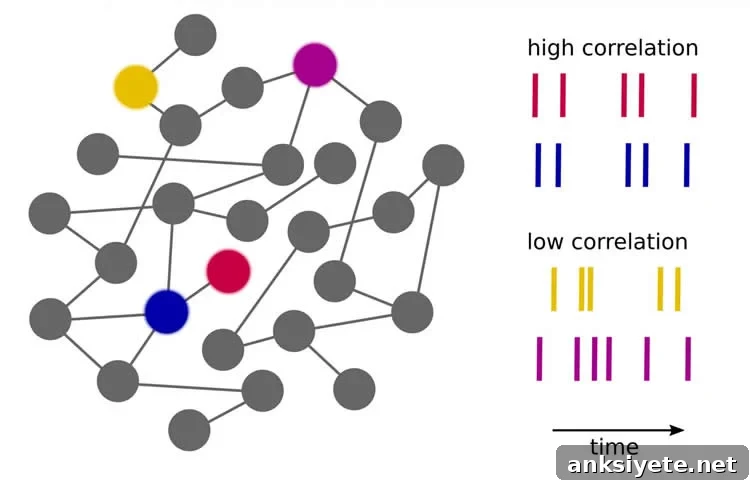
Simulating the brain on supercomputers aims to uncover how our minds work. This is an enormous undertaking: roughly 100 billion neurons and their vast network of synapses must be represented. Historically, even the world’s most powerful computers could model only a small fraction of these cells because of memory limits, so researchers commonly reduce model size. A recent study from Forschungszentrum Jülich, published in PLOS Computational Biology, shows that this downscaling introduces critical inaccuracies, particularly in preserving neuronal correlations.
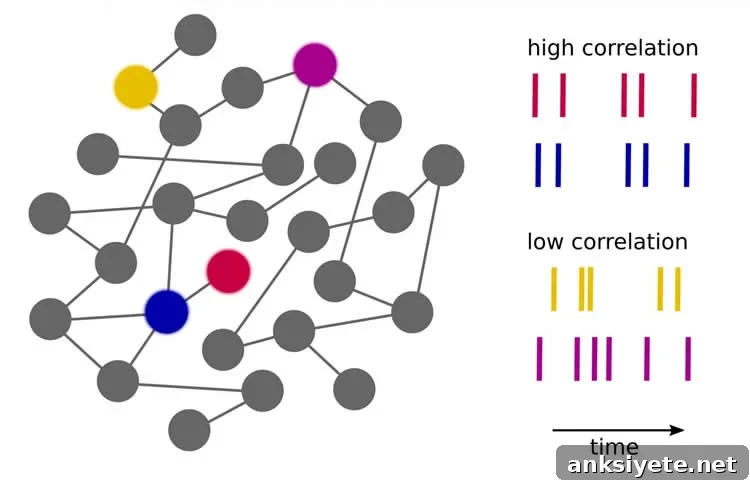
“A core difficulty in brain simulation is that neurons form transient, task-dependent relationships with one another,” explains Prof. Dr. Markus Diesmann, director of the Institute for Computational and Systems Neuroscience (INM-6) at Jülich. Each neuron connects to about 10,000 other neurons, and these connections synchronize activity to varying degrees. The strength and timing of these interactions—known as correlations—depend on the specific task and brain region. Using mathematical analysis, Dr. Sacha van Albada, Dr. Moritz Helias, and Markus Diesmann demonstrated that when the number of synaptic connections in a model falls below a critical threshold, the model can no longer correctly reproduce these correlations. That matters because correlations underlie measurable brain signals such as the electroencephalogram (EEG) and the local field potential (LFP).
Each neuron links to roughly 10,000 others
The human brain’s information flow is extraordinarily complex. Neurons communicate via electrical signals transmitted across synapses, and each neuron maintains around 10,000 synaptic connections. Much like a highway system that only defines possible routes without directing individual cars, brain signals take different paths depending on the task. Current computers cannot store or process the full scale of these connections, so many brain models deliberately reduce the number of synapses to save memory and computation time. However, downsizing breaks essential aspects of network dynamics, particularly the second-order statistics that describe how pairs of neurons co-vary over time.
The Human Brain Project pursues full-scale detailed simulations
Despite these challenges, the long-term objective of detailed, whole-brain simulation remains central to large-scale collaborations. The EU-funded Human Brain Project (HBP) brings together neuroscientists, physicists, computer scientists, clinicians, and mathematicians from more than 80 institutions to develop models and technologies for brain research. “Our findings reinforce that accurately simulating brain circuits at their natural scale is necessary to obtain reliable insights,” says Diesmann.
One major component of the Human Brain Project is developing next-generation supercomputers capable of running these complex simulations. The Jülich Supercomputing Centre (JSC) plays a leading role in building exascale systems that boost computing power by orders of magnitude compared to today’s hardware. In parallel with theoretical work, scientists at Jülich develop simulation software tailored for this new generation of machines. Teams at the Institute for Advanced Simulation’s Theoretical Neuroscience group (IAS-6) and the Neural Simulation Technology Initiative contribute open simulation tools such as NEST, which are freely available to the research community.
Source: Tobias Schloesser – Forschungszentrum Jülich
Image Source: Image credited to Forschungszentrum Jülich
Original Research: Open-access research article: “Scalability of Asynchronous Networks Is Limited by One-to-One Mapping between Effective Connectivity and Correlations” by Sacha Jennifer van Albada, Moritz Helias, and Markus Diesmann, published in PLOS Computational Biology (September 1, 2015). DOI: 10.1371/journal.pcbi.1004490
Abstract
Scalability of Asynchronous Networks Is Limited by One-to-One Mapping between Effective Connectivity and Correlations
Computational models of neural networks are frequently downscaled relative to biological systems—fewer neurons or synapses—due to limited computational resources, often without a clear statement of the constraints this imposes. Although established methods can preserve first-order statistics (such as mean firing rates) when scaling models, this study demonstrates that preserving second-order statistics (pairwise correlations) introduces fundamental limits. The temporal structure of pairwise-averaged correlations in recurrent networks is determined by the network’s effective population-level connectivity. Generally, the converse also holds: effective connectivity can be inferred from the temporal correlation structure, except in certain degenerate cases. Because of this one-to-one mapping, any network scaling that aims to keep pairwise-averaged correlations unchanged must preserve effective connectivity. Altering effective connectivity can shift a network from a stable state to an unstable, oscillatory regime or the reverse. From these principles, the authors derive conditions under which mean population activities and pairwise-averaged correlations can be preserved when the numbers of neurons or synapses change, focusing on the asynchronous activity characteristic of cortical networks. They show that appropriate rescaling of synaptic weights can maintain mean activity and correlation structure only within a restricted range of synapse numbers, limited by the variance of external inputs. These results indicate a fundamental boundary to how much asynchronous networks can be reduced while retaining faithful correlation statistics.
Article: “Scalability of Asynchronous Networks Is Limited by One-to-One Mapping between Effective Connectivity and Correlations” by Sacha Jennifer van Albada, Moritz Helias, and Markus Diesmann, PLOS Computational Biology, DOI: 10.1371/journal.pcbi.1004490