Scientists discover neural communication pathways for prosody
Researchers at the Max Planck Institute for Human Cognitive and Brain Sciences in Leipzig have mapped, for the first time, the neural pathways that link brain regions involved in perceiving subtle changes in a speaker’s tone of voice. The Otto Hahn Group led by Daniela Sammler identified a complex right-hemisphere network and found evidence that the motor system contributes to how we perceive prosody. These findings clarify how the brain decodes vocal melody and have implications for understanding interpersonal communication and disorders of social and emotional speech perception.
Many languages capture the idea that meaning comes from more than words. In French, for example, the saying goes, “c’est le ton qui fait la musique” — the tone makes the music. Tone of voice often reveals a speaker’s intention more clearly than lexical content alone. In scientific terms, this set of vocal cues—accent, intonation, timing and pauses—is called prosody.
Modern neuroimaging has shown how left-hemisphere networks support lexical and syntactic aspects of language, emphasizing that speech processing relies on linked brain regions rather than isolated modules. Yet comparable neural-pathway models for prosody have been lacking. To fill that gap, the “Neural Bases of Intonation in Speech” research group designed an experiment to reveal how prosodic information is routed through the brain.
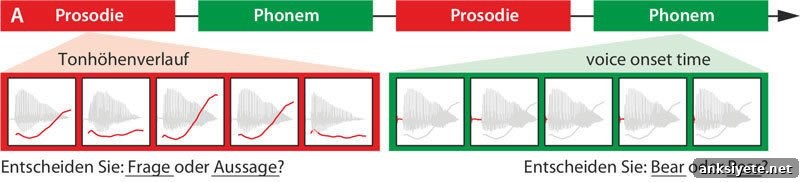
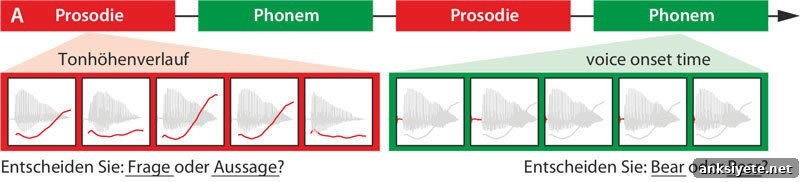
Native English-speaking volunteers performed two tasks while undergoing functional magnetic resonance imaging (fMRI). Using headphones, participants either categorized whether heard words were spoken as a question or a statement (the prosody task) or identified initial letters of words as a non-prosodic control task. This design allowed the researchers to isolate brain activation specifically related to perceiving intonation.
fMRI results revealed two distinct clusters of activity in the right hemisphere during the prosody task. The first cluster included posterior and anterior regions of the superior temporal sulcus (pSTS and aSTS). These temporal areas appear to extract pitch information and abstract it into an intonation contour—helping the listener recognize whether an utterance is a question or a statement.
The second cluster involved regions in the inferior frontal lobe and the premotor cortex near the laryngeal representation. The inferior frontal area appears to evaluate the emotional or communicative relevance of tone, while the premotor cortex—normally associated with controlling vocal fold movements and pitch—was active even though participants only listened. This finding indicates that listeners engage a motor representation of speech production when decoding prosody.
In other words, the brain seems to translate what is heard into an internal movement plan: listeners simulate the laryngeal adjustments a speaker would make to produce a given intonation contour. Previously, motor involvement in speech perception had been emphasized mainly for left-hemisphere, non-prosodic processing. These results suggest a parallel motor contribution in the right hemisphere during prosodic perception.
To trace the anatomical routes connecting these activated regions, the team used diffusion-weighted imaging and fiber tractography to identify white-matter pathways. The analysis revealed both dorsal and ventral fronto-temporal streams in the right hemisphere. The ventral pathway follows a medial temporal course, while the dorsal pathway corresponds to fibers running along the arcuate or superior longitudinal fasciculus—pathways already known to link language regions in the left hemisphere.
The presence of both dorsal and ventral routes indicates that prosodic information travels along multiple channels in the right hemisphere. These streams can likely be flexibly combined to serve different aspects of prosody perception—extracting acoustic features, mapping them to motor representations, and evaluating communicative intent. Such flexibility helps listeners detect subtle emotional and pragmatic cues in another person’s voice.
Source: Daniela Sammler, Max Planck Institute for Human Cognitive and Brain Sciences
Image Credit: MPI for Human Cognitive and Brain Sciences / Sammler
Original Research: Sammler, D., Grosbras, M.-H., Anwander, A., Bestelmeyer, P. E. G., & Belin, P. (2015). “Dorsal and ventral pathways for prosody,” Current Biology. Published online November 5, 2015. DOI: 10.1016/j.cub.2015.10.009
Abstract
Dorsal and ventral pathways for prosody
Highlights
• fMRI categorization of prosody reveals a right-hemisphere neural network
• Diffusion imaging and tractography show dual right fronto-temporal streams for prosody
• Brain stimulation implicates a motor contribution to prosody perception via the right dorsal stream
Summary
Prosody—the tone and melody of speech—conveys crucial information about a speaker’s intention and emotion beyond word meaning. Using an experimental paradigm that parametrically morphed pitch contours between statement and question, combined with multimodal neuroimaging and brain stimulation, the study demonstrates that prosody perception follows dual processing streams in the right hemisphere. One route is a ventral auditory pathway along the superior temporal lobe that extracts acoustic features and converts them into perceptual contours. The other is an auditory-motor dorsal pathway connecting posterior temporal regions with inferior frontal and premotor areas; inhibitory stimulation of the right premotor cortex reduced prosody categorization performance, supporting a motor-role hypothesis. Together, these data support a dual-stream model for prosodic processing that mirrors left-hemisphere language architecture but with rightward dominance.