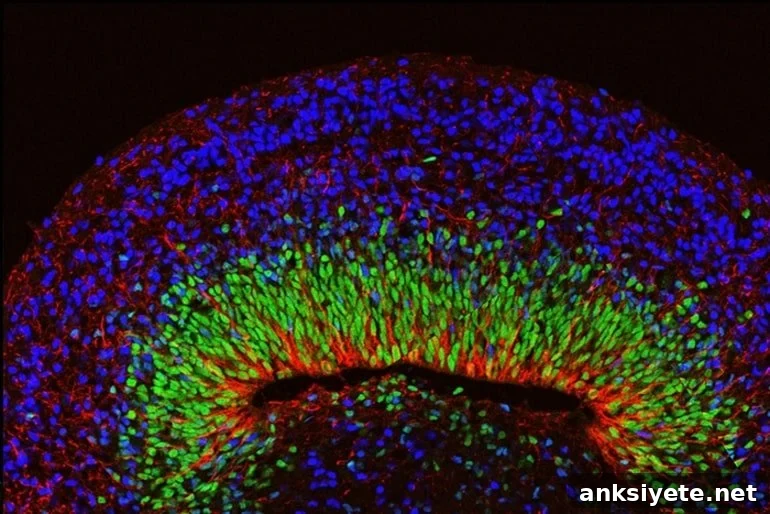
Summary: Newly developed brain organoids grown from human stem cells exhibit organized waves of neural activity that resemble the brainwaves seen in living human brains.
Source: UCLA
Researchers at the Eli and Edythe Broad Center of Regenerative Medicine and Stem Cell Research at UCLA have created three-dimensional brain organoids from human stem cells that display organized patterns of electrical activity comparable to those recorded in human brains.
Using the same approach with stem cells derived from individuals with Rett syndrome — a genetic neurodevelopmental disorder characterized by developmental delays, repetitive movements and a high prevalence of seizures — the research team observed abnormal, seizure-like electrical patterns in the Rett organoids. These findings were reported in the journal Nature Neuroscience and expand the range of neurological conditions that can be modeled with human cell–based organoids.
Over the last decade, scientists have learned to reprogram a person’s somatic cells (for example, skin or blood cells) into induced pluripotent stem (iPS) cells. Those iPS cells can then be guided to become virtually any cell type in the body, including diverse neuronal cell types. Advances in three-dimensional culture techniques have allowed these cells to self-organize into organoids that more closely resemble miniature human organs than traditional two-dimensional cell cultures on flat dishes.
Organoids enable investigation of how an individual’s cells may differ from typical development and allow experiments that are not possible in living people, such as genetic manipulations or testing how pathogens interact with human tissues. However, modeling the human brain presents unique challenges: beyond forming the correct cellular architecture, neural tissues must establish functional connections and coordinated electrical activity to model brain function and disease accurately.
Healthy human brains generate not only localized electrical signals but also coordinated oscillatory patterns — brainwaves or neural oscillations — that reflect network-level dynamics associated with states like learning, attention and sleep. Disruptions in these oscillations can be an early or primary sign of neurological disorders even when the brain’s macroscopic anatomy appears normal.
To characterize the organoids’ network behavior, the UCLA team produced brain organoids from healthy donor-derived iPS cells and applied two complementary methods: extracellular probe recordings to capture electrical signals analogous to those measured by electroencephalography (EEG), and live imaging with calcium sensors to visualize population activity across cells. These approaches revealed a surprising diversity of neural oscillation patterns within the organoids.
“We did not expect to observe such a wide range of oscillatory dynamics,” said Bennett Novitch, senior author and a member of the Broad Stem Cell Research Center. “Learning how to evoke and control different oscillation patterns in organoids may let us model distinct brain states in vitro.”
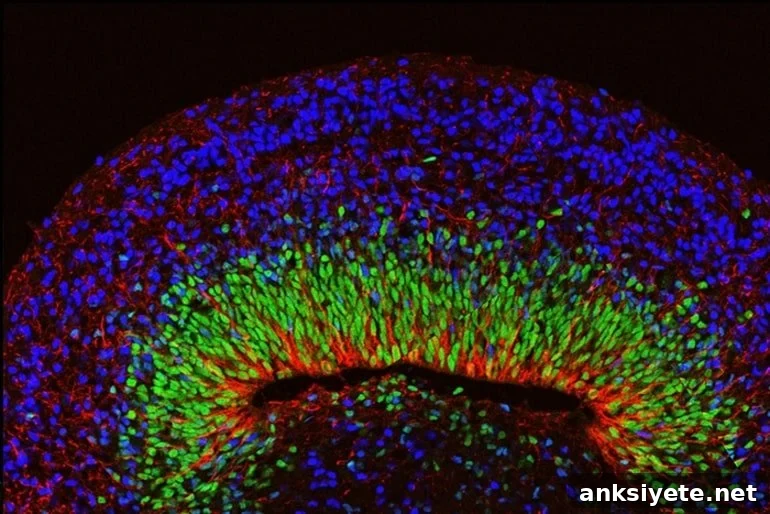
When the same assays were applied to organoids made from iPS cells of individuals with Rett syndrome, the researchers noted that, despite appearing structurally normal, these organoids lacked the diversity of oscillatory patterns seen in controls. Instead, the Rett organoids displayed rapid, disorganized electrical activity resembling epileptiform discharges observed in patient EEGs.
Importantly, treating the Rett organoids with an experimental compound, Pifithrin-alpha, suppressed the seizure-like activity and restored more typical patterns of neural oscillation. While this result is preclinical and exploratory, it demonstrates how organoids can be used to screen candidate neuroregulatory treatments and probe mechanisms underlying dysfunctional network activity.
The investigators emphasize the limitations of organoid models: they do not reproduce every feature of a mature human brain — for example, they lack fully developed blood vessels and immune components and more closely resemble early developmental stages than adult tissue. Nevertheless, the study shows that organoids can capture essential aspects of neural network formation and dysfunction, making them a valuable tool for studying disease processes and for early-stage drug discovery.
“This work provides one of the clearest demonstrations that brain organoids can model not only anatomical features but also functional network properties that matter for human disease,” said Ranmal Samarasinghe, first author and assistant professor of neurology. “We hope these results guide further research into human brain biology and therapeutic development.”
Funding: The research received support from the National Institutes of Health, the California Institute for Regenerative Medicine, the Simons Foundation Autism Research Initiative, the American Epilepsy Society, the Ablon Scholars Program, the Paul G. Allen Family Foundation Frontiers Group, the March of Dimes Foundation and UCLA’s Broad Stem Cell Research Center, including the Steffy Family Trust and The Rose Hills Foundation Innovator Grant.
A potential therapeutic strategy described in the study is the subject of a patent application filed by the UCLA Technology Development Group on behalf of the Regents of the University of California, with Samarasinghe, Novitch and William Lowry listed as co-inventors. The treatment reported was tested only in preclinical organoid models and has not been evaluated in humans or approved by regulatory authorities.
About this neuroscience research news
Author: Tiare Dunlap
Source: UCLA
Contact: Tiare Dunlap – UCLA
Image: Image credit: UCLA Broad Stem Cell Research Center/Nature Neuroscience
Original Research: Closed access. “Identification of neural oscillations and epileptiform changes in human brain organoids” by Ranmal A. Samarasinghe, Osvaldo A. Miranda, Jessie E. Buth, Simon Mitchell, Isabella Ferando, Momoko Watanabe, Thomas F. Allison, Arinnae Kurdian, Namie N. Fotion, Michael J. Gandal, Peyman Golshani, Kathrin Plath, William E. Lowry, Jack M. Parent, Istvan Mody & Bennett G. Novitch. Published in Nature Neuroscience.
Abstract
Identification of neural oscillations and epileptiform changes in human brain organoids
Brain organoids provide a powerful platform to investigate human neurological disorders, especially those that affect development and structure. Yet many conditions manifest primarily through functional or network-level abnormalities rather than clear anatomical defects, raising the question of whether organoids can reproduce complex neural network dynamics.
This study combines calcium imaging and extracellular recordings to reveal sophisticated network behaviors in human brain organoids that resemble dynamics observed in intact brain tissue. Organoids derived from individuals with Rett syndrome exhibit pronounced epileptiform-like electrical activity alongside transcriptomic differences identified through single-cell analyses. Treatment with an unconventional neuroregulatory compound, pifithrin-α, reduced pathological activity in the Rett organoids.
Collectively, these results establish a foundation for using human brain organoids to study both normal and disordered neural network formation and to support therapeutic discovery efforts targeting network dysfunction.