
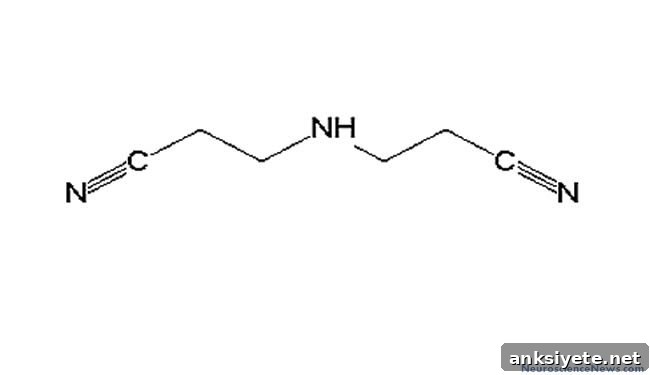
IDPN nitrile poisoning produces neuropathology resembling amyotrophic lateral sclerosis (ALS); study may offer a new experimental model to study disease mechanisms
Researchers at the Bellvitge Biomedical Research Institute (IDIBELL) in collaboration with the University of Barcelona (UB) have examined how exposure to the industrial nitrile compound IDPN (3,3′-iminodipropionitrile) produces neurological changes that closely mirror features of amyotrophic lateral sclerosis (ALS), a progressive neuromuscular disease. Led by Jordi Llorens, the study was published in the journal Neuropathology and Applied Neurobiology and identifies specific effects on neurofilament distribution and neuromuscular junction integrity that could help researchers investigate ALS pathophysiology.
Nitriles are organic compounds characterized by a cyano (-CN) group and are widely found in nature and industrial applications. Natural occurrences include cyanogenic glycosides in certain plants and aminonitriles in some legumes; industrially, nitriles serve as solvents and chemical intermediates in the synthesis of plastics, synthetic fibers, resins, and drug precursors. Some nitriles can produce cyanide or related toxic effects when metabolized, and depending on the compound and rate of cyanide liberation, exposures can lead to acute poisoning or to slower, selective neurotoxic effects that produce long-term neurological syndromes.
A common pathological feature across many neurodegenerative and neurotoxic conditions is an abnormal accumulation of neurofilaments—structural proteins that determine axonal caliber and provide mechanical support to neurons. In ALS specifically, motor neuron axons often show focal swellings and bulbous protrusions packed with neurofilament aggregates. These proximal accumulations are thought to interfere with axonal transport and contribute to motor neuron dysfunction and degeneration.
Using a rat model exposed to IDPN, the investigators observed neurofilament accumulations in motor axons that are strikingly similar to those described in ALS. Both IDPN intoxication and ALS produce a form of proximal axonopathy characterized by disruption of axonal structure. A key novel observation in this study is pronounced depletion of neurofilaments at motor nerve terminals—the region of the neuromuscular junction that interfaces with muscle fibers. The loss of neurofilaments from terminals is relevant because retraction and destabilization of nerve terminals are early and critical events in motor neuron degeneration.
According to the study coordinator, the depletion of neurofilaments at the neuromuscular junction could impair the structural stability or functional performance of the synapse, making the junction prone to retraction. Such retraction undermines neuromuscular transmission and may trigger compensatory responses or progressive degeneration of the motor neuron, a sequence that is central to ALS pathology.
Potential clinical and research implications
Because IDPN exposure reproduces several neuropathological features characteristic of ALS—most notably proximal neurofilament accumulation combined with terminal depletion—the authors propose that analogous neurofilament loss may occur at the neuromuscular junction in ALS patients. If validated in human tissue or additional models, terminal neurofilament depletion could represent a pathogenic mechanism that contributes to early synaptic failure and motor neuron degeneration in ALS.
ALS is increasingly recognized as a multifactorial disorder in which genetic susceptibility and environmental exposures interact to produce selective vulnerability of motor axons. The IDPN model provides an experimentally tractable way to study one pathway to proximal axonopathy and neuromuscular junction disruption. As such, IDPN intoxication may serve as a useful component within multivariate animal model strategies aimed at dissecting how environmental toxins, genetic factors, and cellular processes converge to produce ALS-like degeneration.
Notes about this ALS research
The findings were presented at the symposium “Mechanisms of Neurotoxicity and Implications for Neurological Disorders,” a satellite event of the Federation of European Neuroscience Societies (FENS) Congress held in Barcelona. The work emphasizes the value of comparative toxicology models for revealing cellular mechanisms—such as neurofilament dynamics and terminal vulnerability—that are relevant to human neurodegenerative diseases including amyotrophic lateral sclerosis.
Contact: IDIBELL
Source: Bellvitge Biomedical Research Institute press release
Original research: Abstract for “Loss of neurofilaments in the neuromuscular junction in a rat model of proximal axonopathy” by Soler-Martin C, U Vilardosa, Saldana-Ruiz S, Garcia N, Llorens J., published in Neuropathology and Applied Neurobiology (2012), documents the described observations and interpretations.