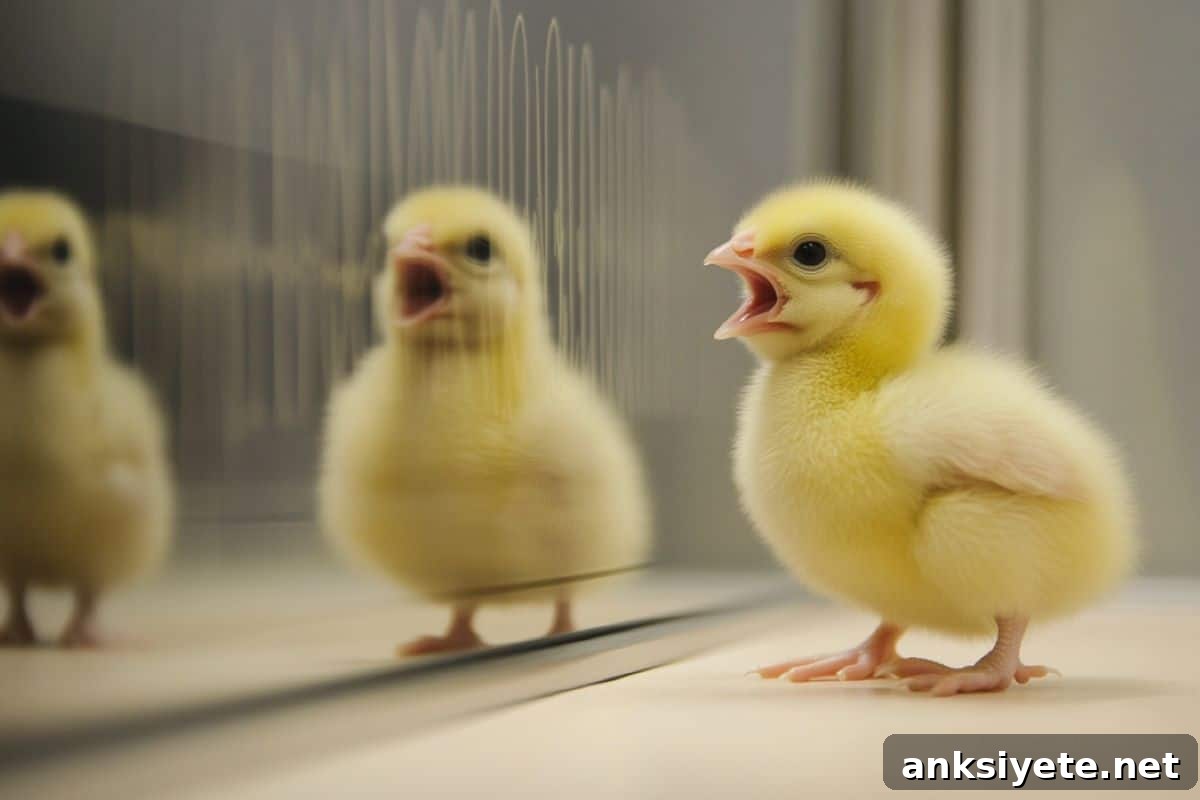
Summary: Researchers have developed a noninvasive way to measure stress in baby chicks by analyzing their vocalizations, offering a practical tool for monitoring animal welfare. The study shows that chicks kept alone produced louder, higher-pitched calls consistent with anxiety-like states, while chicks with a mirror—perceiving a companion—emitted calmer, lower-intensity calls. These acoustic patterns could be used to detect stress in poultry and other livestock, and may also refine early-stage testing for medications that treat anxiety and depression in humans.
This work highlights how vocal analysis can reveal emotional arousal in birds and suggests a path toward more humane management in the poultry industry. By substituting invasive hormone sampling with acoustic monitoring, farmers and researchers may gain continuous, real-time insight into the welfare of animals without handling them.
Key Facts:
- Chick vocalizations reliably reflect anxiety-like states and can be used to monitor welfare.
- Acoustic stress detection offers a noninvasive alternative to blood-based hormone tests.
- Findings may inform poultry industry practices and improve preclinical anxiety research.
Source: University of Mississippi
Decoding animal emotion through sound
Understanding animal emotions has long been a central question in welfare science. Kenneth Sufka, professor of psychology and pharmacology at the University of Mississippi, collaborated with animal welfare researchers in the United Kingdom to investigate whether changes in chick vocalisations can serve as objective indicators of emotional arousal and stress.
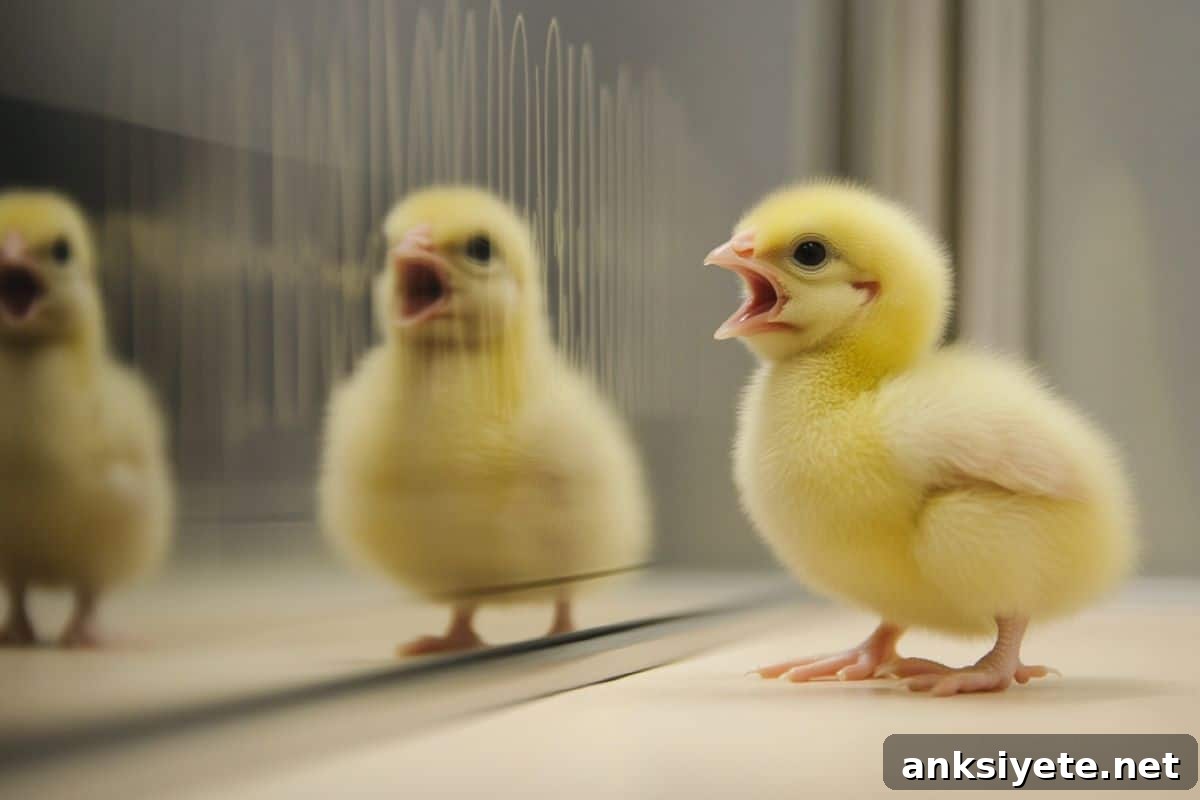
Published in Applied Animal Behaviour Science, the study used a controlled setup in which individual chicks were placed either alone or in the presence of a mirror. The mirror condition simulates social company because chicks respond to their reflection as if another chick were present. Researchers recorded calls with precision acoustic equipment and analyzed how specific parameters—loudness, pitch, duration and clarity—changed under different conditions.
Chicks isolated without a mirror produced calls that were louder, higher in frequency, longer in duration and acoustically more ‘degraded’ (indicating higher entropy and reduced harmonic content). These features are consistent with a higher level of emotional arousal and resemble what the authors describe as an anxiety-like state. In contrast, chicks with a mirror emitted calls reflecting lower arousal and less acoustic degradation, suggesting a calmer state.
The experimental design extended previous paradigms that distinguish between acute, high-arousal distress (described as anxiety-like) and a later, lower-arousal phase that may resemble depression-like behavior in chicks. Although the chicks in this study did not progress into the low-arousal phase within the trial period, the moment-to-moment vocal changes clearly mapped onto periods of higher versus lower arousal across both experimental groups.
Because monitoring vocal parameters is comparatively inexpensive and noninvasive, the approach has immediate practical value. In commercial settings, continuous acoustic monitoring could flag welfare problems early—allowing caretakers to intervene and improve living conditions for animals across production systems, including poultry, cattle and swine.
“The question was whether there is a noninvasive way to capture stress states in freely moving animals,” Sufka said. By focusing on vocal behaviour rather than handling animals for blood samples, the method avoids the confounding stress caused by capture and restraint, which itself alters hormone levels and behavior.
Sarah Collins, coauthor and associate professor of animal behavior at the University of Plymouth, emphasized the broader implication: identifying not only that animals are distressed but how intensely they are experiencing distress provides a finer-grained metric for welfare assessment. This makes it possible to evaluate and compare interventions more precisely.
Beyond agricultural welfare, the research has relevance for biomedical testing. Chicks are often used in early-stage models of human psychiatric conditions. Demonstrating that vocal signatures correspond to anxiety-like states in chicks strengthens the validity of using these models to screen potential anxiolytic or antidepressant treatments. To claim that a drug reduces anxiety-like behavior, researchers first need reliable measures showing that the animal exhibits such a state.
The study also contributes to ongoing ethical discussions about animal sentience and rights. By showing parallels between avian vocal responses and mammalian indicators of negative affect, the findings support the idea that many animals experience negative emotional states, reinforcing the ethical obligation to improve their welfare.
About this emotion and animal psychology research news
Author: Clara Turnage
Source: University of Mississippi
Contact: Clara Turnage – University of Mississippi
Image: The image is credited to Neuroscience News
Original Research: Open access. “Do I sound anxious? Emotional arousal is linked to changes in vocalisations in domestic chicks (Gallus gallus dom.)” by Kenneth Sufka et al., Applied Animal Behaviour Science
Abstract
Do I sound anxious? Emotional arousal is linked to changes in vocalisations in domestic chicks (Gallus gallus dom.)
A major goal in animal welfare science is to develop methods that quantify current affective states in freely behaving animals. In mammals, acoustic changes in vocalisations have been linked to emotional arousal, but there are relatively few studies identifying vocal indicators of valence, and even fewer in birds. This study used a validated paradigm that produces two distinct negative emotional states—anxiety-like high arousal and a lower arousal depression-like phase—to test whether vocal parameters in domestic chicks reflect emotional arousal.
Legbar chicks (4–7 days old) were placed in social isolation for 30 minutes either with or without a mirror. Chicks without a mirror produced louder calls, at higher frequency, that were longer and more acoustically degraded compared to chicks with a mirror. Call rate did not fall below the threshold for a depression-like phase during the trials, but vocalisations recorded at moments of high call rate were consistently louder, longer, higher in frequency and more degraded. These findings align with observations across several mammalian species and suggest vocal parameters reliably reflect changes in emotional arousal in negatively valenced contexts. The results highlight the potential for automated acoustic monitoring to detect shifts in emotion in captive animals and encourage further research across diverse taxa.