Summary: A new study finds that people who follow a more restricted, plant‑rich diet tend to have more diverse gut microbiota, and that prior dietary habits can influence how effectively a new diet changes the microbiome.
Source: Cell Press.
Your existing gut microbiota can shape how well a new diet works. A paper published December 29 in Cell Host & Microbe examines why mice transplanted with human gut communities do not always respond immediately when switched from an unrestricted, typical American diet to a healthier, calorie‑restricted, plant‑based diet. The researchers show that some microbial lineages associated with an unrestricted diet can blunt the response to a healthier diet, and that introducing plant‑diet–associated bacteria from other hosts can restore responsiveness.
“If we want to recommend a diet to improve someone’s health, we need to know which microbes influence those beneficial effects,” says Jeffrey Gordon, Director of the Center for Genome Sciences and Systems Biology at Washington University in St. Louis and senior author of the study. “We have developed an approach to examine the gut microbial communities of different people and to identify organisms that promote a particular diet’s beneficial outcomes.”
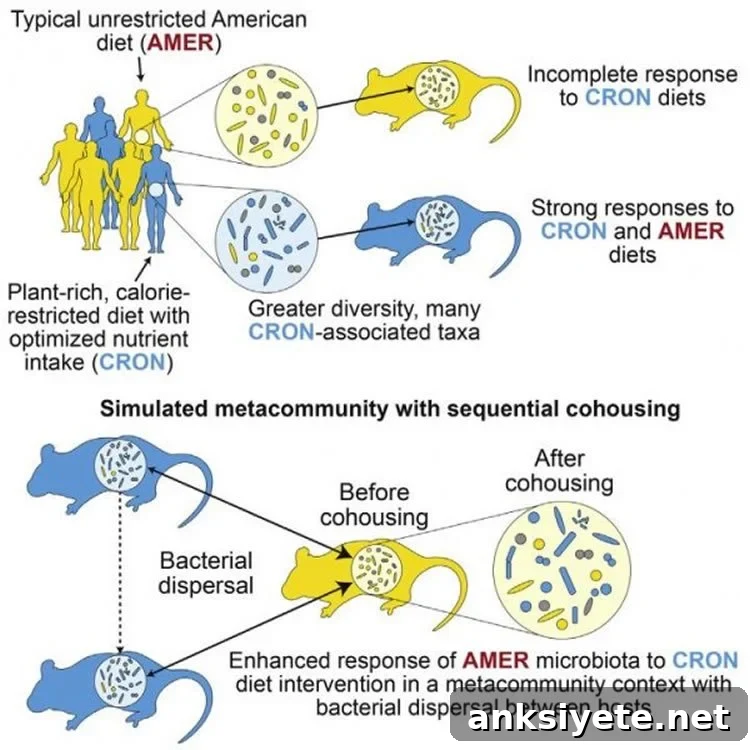
To study how prior dietary patterns shape the gut microbiota and how a microbiota conditioned by one lifestyle reacts to a new prescribed diet, the team first collected fecal samples from people practicing chronic calorie restriction with adequate nutrition (a plant‑rich CRON regimen) and from people following a typical, unrestricted American diet (AMER). The investigators observed that individuals on the calorie‑restricted, plant‑rich diet had greater microbial diversity in their gut communities than those on the unrestricted diet.
Next, the researchers colonized groups of germ‑free mice with the human donor microbiota and fed each group either the donor’s native diet or the other diet type. Both sets of mice mounted microbiota changes when switched to a different diet, but mice harboring the AMER‑conditioned microbiota showed a weaker response when moved to the plant‑rich, calorie‑restricted diet compared with mice originally colonized by CRON microbiota.
To pinpoint which microbes could improve the AMER microbiota’s response, the team designed staged microbial exchange experiments. Mice carrying AMER‑conditioned human gut communities were sequentially co‑housed with mice colonized by microbiota from different long‑term CRON donors. As microbes from CRON communities dispersed into the AMER communities, the AMER microbiota’s responsiveness to the plant‑rich diet increased substantially.
“We should stop viewing our gut communities as isolated islands,” says first author Nicholas Griffin, an instructor at Washington University in St. Louis. “Instead, think of them as part of an archipelago — a metacommunity — where bacteria can move between hosts. Many of the bacteria that migrated into the AMER‑conditioned communities were absent from many people consuming an unrestricted diet.”
The authors are optimistic that identifying diet‑responsive microbes will help design strategies to improve the success of prescribed diets, but they stress that further work is needed to understand the factors that govern microbial exchange between people and the safety and durability of introducing new taxa into established communities.
“We are increasingly aware that the nutritional value of foods and the effects of dietary interventions depend on a consumer’s microbiota,” Gordon adds. “The organisms identified using methods like those in this study might one day be developed as next‑generation probiotics. These findings also highlight how interconnected we are as humans through shared microbial communities.”
Source: Cell Press
Image source: Image credited to Griffin et al. / Cell Host & Microbe.
Original research: Prior Dietary Practices and Connections to a Human Gut Microbial Metacommunity Alter Responses to Diet Interventions — published online December 29, 2016, in Cell Host & Microbe. Authors: Nicholas W. Griffin, Philip P. Ahern, Jiye Cheng, Andrew C. Heath, Olga Ilkayeva, Christopher B. Newgard, Luigi Fontana, and Jeffrey I. Gordon. DOI: 10.1016/j.chom.2016.12.006.
Cell Press (2016). Your Microbiota’s Previous Dining Experiences May Make New Diets Less Effective. NeuroscienceNews. Published December 30, 2016.
Abstract
Prior Dietary Practices and Connections to a Human Gut Microbial Metacommunity Alter Responses to Diet Interventions
Reliable microbiota responses to prescribed dietary interventions are critical for effective nutritional therapy, yet prior dietary practices (DPs) can shape those responses. The study identified gut bacterial taxa associated with chronic calorie restriction and plant‑rich eating (CRON) versus a typical unrestricted American diet (AMER). When transplanted into gnotobiotic mice, both AMER and CRON microbiota responded predictably when animals were fed CRON or AMER diets, but the strength of the response varied. Because an individual’s microbiota is connected to other people’s communities through microbial exchange (a metacommunity), the researchers simulated these effects by sequentially co‑housing AMER‑colonized mice with two different groups of CRON‑colonized mice. This process enhanced the AMER animals’ microbiota response to a CRON diet and altered several metabolic measures, driven by an influx of CRON‑associated bacterial taxa. The results indicate that certain prior dietary practices can impair responses to diet interventions, and that introducing diet‑responsive bacterial lineages present in other individuals may be required to restore full responsiveness.
Authors: Nicholas W. Griffin, Philip P. Ahern, Jiye Cheng, Andrew C. Heath, Olga Ilkayeva, Christopher B. Newgard, Luigi Fontana, and Jeffrey I. Gordon. Published in Cell Host & Microbe (December 29, 2016). DOI: 10.1016/j.chom.2016.12.006.