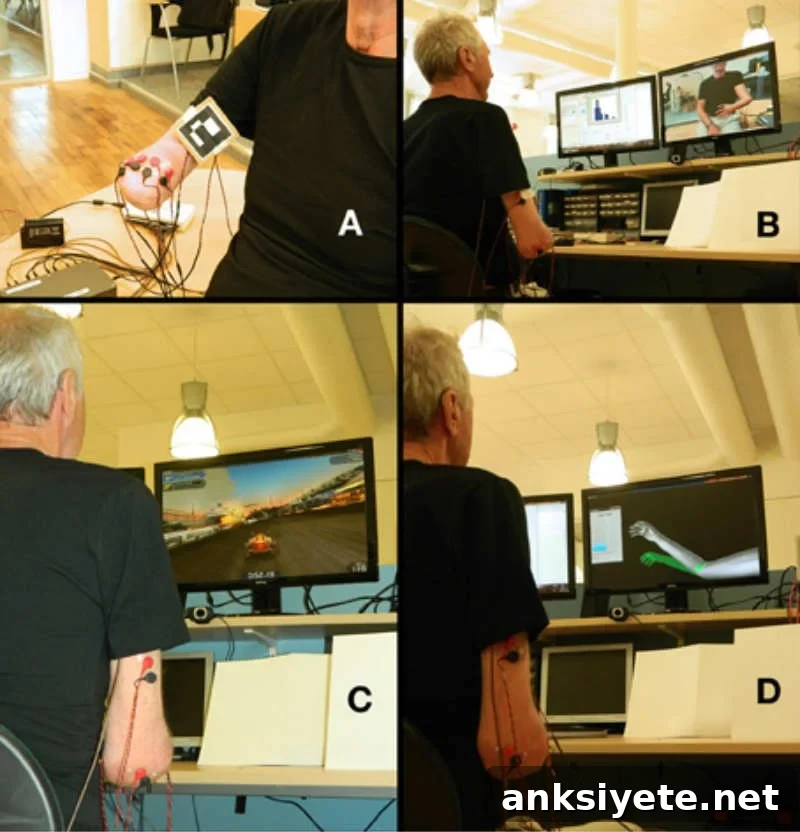
Max Ortiz Catalan, a researcher at Chalmers University of Technology, has developed a new approach to treating phantom limb pain (PLP) following amputation. The method combines myoelectric pattern recognition, augmented reality and interactive gaming, and has been evaluated in an initial case study of a patient who suffered severe phantom limb pain for 48 years. The case report documents a dramatic reduction in pain.
Many people who lose an arm or a leg continue to feel sensations as if the missing limb were still present. Around seventy percent of amputees report pain in the amputated limb even though the limb no longer exists. Phantom limb pain can become chronic and debilitating, severely diminishing quality of life. The precise causes of phantom sensations and phantom limb pain remain unclear, and effective treatments are still limited.
Current treatments for phantom limb pain include mirror therapy, various medications, acupuncture and hypnosis, among other approaches. Although some patients benefit from these methods, many do not achieve lasting relief. That was the situation for the patient chosen for this study: he had endured intermittent to unbearable phantom pain for nearly five decades and had not found a treatment that provided sustained benefit.
The patient in the case study had lost his arm 48 years earlier and had experienced continuous phantom pain since the amputation. After a period of treatment with Ortiz Catalan’s method, the patient reported a substantial and sustained reduction in pain. He now experiences stretches of time without any pain and no longer wakes at night from intense pain episodes as he did previously.
The experimental treatment relies on muscle signals from the residual limb to control an augmented reality environment. Surface electrodes placed on the skin detect electrical activity in the stump muscles when the patient attempts to move the missing limb. Sophisticated pattern-recognition algorithms translate those myoelectric signals into movement commands for a virtual arm that is superimposed over a live camera image. The virtual limb responds in real time to the patient’s neural commands, providing immediate visual feedback and a vivid sense of movement.
Ortiz Catalan explains why this combination may reduce phantom pain: “The motor areas in the brain needed for movement of the amputated arm are reactivated, and the patient obtains visual feedback that tricks the brain into believing there is an arm executing such motor commands. He experiences himself as a whole, with the amputated arm back in place.” Re-engaging motor circuits and restoring the feeling of a complete body through congruent visual and motor feedback are likely important mechanisms behind the observed relief.
Traditional mirror therapy and many virtual reality approaches provide visual feedback by reflecting or animating the intact limb, which limits their use for people with bilateral amputations. By contrast, the new method derives control directly from the affected stump’s muscle activity, so the missing limb itself becomes the source of the control signal. “Our method differs from previous treatment because the control signals are retrieved from the arm stump, and thus the affected arm is in charge,” Ortiz Catalan says. He adds that the promotion of motor execution together with the vivid sensation of completion offered by augmented reality may explain why this patient improved while mirror therapy and medications had failed.
A clinical trial is now planned to evaluate the technique in a larger group of patients. The development effort has been a collaboration between Chalmers University of Technology, Sahlgrenska University Hospital, the University of Gothenburg and Integrum. The multicenter study will include three Swedish hospitals and additional European clinics, and it will focus on patients with chronic phantom limb pain who have not responded to existing treatments.
The research team has also created a version of the system intended for home use, so that patients could potentially continue therapy independently once it has been validated and approved. Beyond phantom limb pain, the approach may be adaptable to other rehabilitation needs that rely on restoring motor control and sensorimotor integration, such as recovery after stroke or for certain spinal cord injury patients.
Notes about this phantom limb pain and neuroprosthetics research
Contact: Max Ortiz Catalan – Chalmers University of Technology
Source: Chalmers University of Technology press release
Image Source: The image is credited Ortiz Catalan et al. and is adapted from the Frontiers in Neuroscience open access research paper.
Original Research: Full open access research for “Treatment of phantom limb pain (PLP) based on augmented reality and gaming controlled by myoelectric pattern recognition: a case study of a chronic PLP patient” by Max Ortiz-Catalan, Nichlas Sander, Morten B. Kristoffersen, Bo Håkansson and Rickard Brånemark in Frontiers in Neuroscience. Published online February 25, 2014. doi:10.3389/fnins.2014.00024
#neuroprosthetics, #phantomlimb, #neurology