Researchers have identified a previously unknown genetic mutation that causes a degenerative, ultimately fatal movement disorder by analyzing genetic data from two unrelated families spanning three generations. Using induced pluripotent stem cell (iPSC) methods, the team also grew neurons from a patient to support future functional studies.
Spinocerebellar ataxia (SCA) is a group of inherited disorders characterized by progressive degeneration of the cerebellum, the brain region that coordinates voluntary movements such as walking, speech and eye control. There is currently no cure for SCA, and roughly 30 percent of cases remain without an identified genetic cause.
Two separate Japanese families affected by SCA, each with multiple affected members across generations, were evaluated after routine genetic tests failed to detect any of the established causal mutations. Genetic samples from the symptomatic individuals were then analyzed by a research team at Hiroshima University.
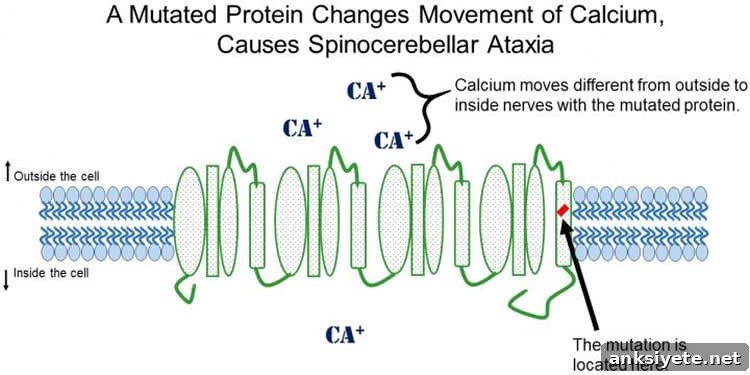
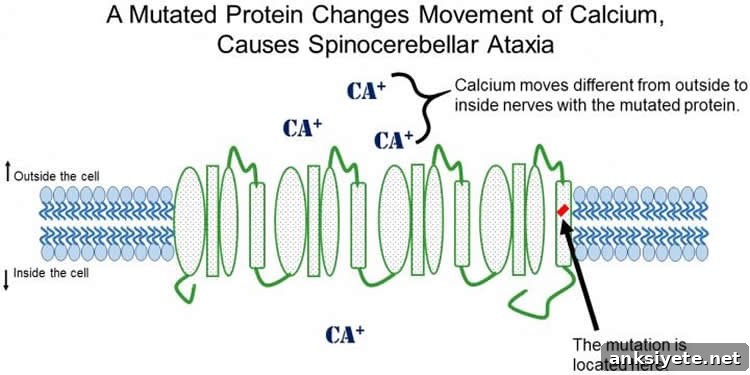
By combining linkage analysis and exome sequencing with statistical comparison against unaffected individuals, the investigators narrowed the candidate region and identified a shared variant that segregated with disease in both families. The responsible gene was located on Chromosome 17: CACNA1G, which encodes the Cav3.1 protein, a low-voltage-activated (T-type) calcium channel abundant in the central nervous system, including the cerebellum.
The mutation reported in these families is a single amino acid substitution in the 2,377–amino-acid Cav3.1 protein (p.Arg1715His). Functional studies of the mutant channel expressed in cultured cells demonstrated that the mutation alters the channel’s electrical properties. Electrophysiological analyses revealed a shifted voltage-dependence of activation for the mutant Cav3.1, changing how calcium ions flow into neurons when the cells are electrically active. These altered biophysical properties are consistent with a pathogenic role for CACNA1G variants in cerebellar dysfunction.
To study patient-specific effects in a neuronal context, researchers reprogrammed skin fibroblasts from a patient into iPSCs and differentiated them into cerebellar neurons, including Purkinje cells. According to the authors, this represents the first successful differentiation of patient-derived iPSCs into Purkinje cells for this condition. In culture, the patient-derived neurons showed no striking structural abnormalities compared with controls, a finding that aligns with the clinical course of many SCAs in which symptoms often emerge in mid-life rather than during early development.
Because SCA is progressive and age-dependent, the investigators note that additional age-related cellular factors may be necessary to recapitulate the full spectrum of disease-related neuronal dysfunction in vitro. The patient-derived neurons provide a valuable model to probe how the CACNA1G mutation disrupts calcium signaling and neuronal physiology over time, and to screen candidate compounds that could correct channel dysfunction.
Identification of CACNA1G as a causative gene for SCA adds to a growing list of channelopathies implicated in cerebellar degeneration. The discovery strengthens the link between dysregulated ion channel activity and SCA pathogenesis and points toward targeted pharmacological strategies: drugs that modulate Cav3.1 channel activity could potentially modify disease course if shown to restore normal channel function without unacceptable side effects.
Funding: Supported by the Ministry of Education, Culture, Sports, Science and Technology of Japan; the Japan Society for the Promotion of Science; and the Core Program for Disease Modeling Using iPS Cells from AMED.
Source: Norifumi Miyokawa, Hiroshima University
Image Source: Hiroshima University.
Original Research: Morino H., Matsuda Y., Muguruma K., Miyamoto R., Ohsawa R., Ohtake T., Otobe R., Watanabe M., Maruyama H., Hashimoto K., Kawakami H. “A mutation in the low voltage-gated calcium channel CACNA1G alters the physiological properties of the channel, causing spinocerebellar ataxia.” Molecular Brain. Published online December 29, 2015. doi:10.1186/s13041-015-0180-4
Abstract (summary)
Background. Spinocerebellar ataxia (SCA) is genetically heterogeneous, with many causative genes and loci already reported, while additional causes remain to be discovered.
Results. Linkage analysis and exome sequencing in a Japanese family with autosomal dominant SCA identified CACNA1G, encoding the CaV3.1 (Cav3.1) T-type calcium channel, as a novel causative gene. The same mutation was found in a second unrelated family. Most affected individuals had primarily cerebellar ataxia; two patients also exhibited prominent resting tremor. The p.Arg1715His mutation is located in the voltage-sensing S4 segment of repeat IV. Electrophysiological studies of the mutant channel expressed in HEK293T cells showed a shift in membrane potential dependence, indicating altered activation properties. Patient fibroblasts were reprogrammed to iPSCs and differentiated into cerebellar neurons, including Purkinje cells, with no major differences in differentiation efficiency compared with controls.
Conclusions. These findings implicate CACNA1G as a causative gene for SCA and provide further evidence that ion channel dysfunction contributes to SCA pathogenesis. Patient-derived neuronal models will support future studies of disease mechanisms and therapeutic screening.