
Summary: Researchers have uncovered the processes that lead to noise-induced hearing loss and demonstrated that a straightforward middle-ear injection of a salt- or sugar-based solution can help protect hearing after exposure to intense blast-like noise.
Source: USC.
Exposure to extremely loud sounds — from explosions and roadside blasts to fireworks and very loud concerts — can cause permanent hearing loss. Despite how common noise-induced hearing loss is (affecting roughly 15 percent of Americans), effective treatments have been limited. New research from the Keck School of Medicine of USC clarifies the mechanisms behind noise-induced hearing loss and shows that a simple osmotic treatment applied to the middle ear after trauma may preserve auditory nerve function. The study’s results were published in PNAS.
Understanding how loud noise damages hearing
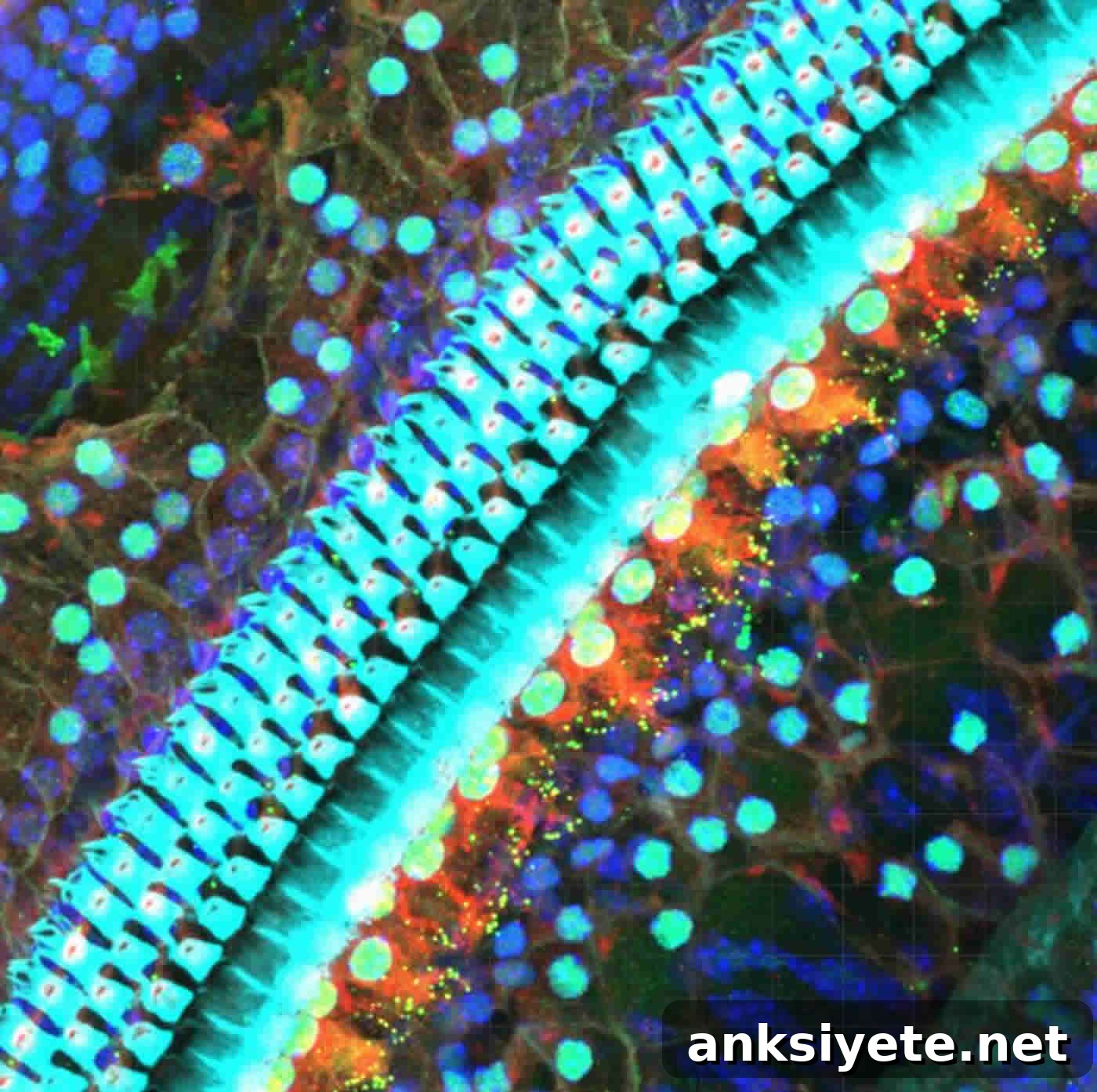
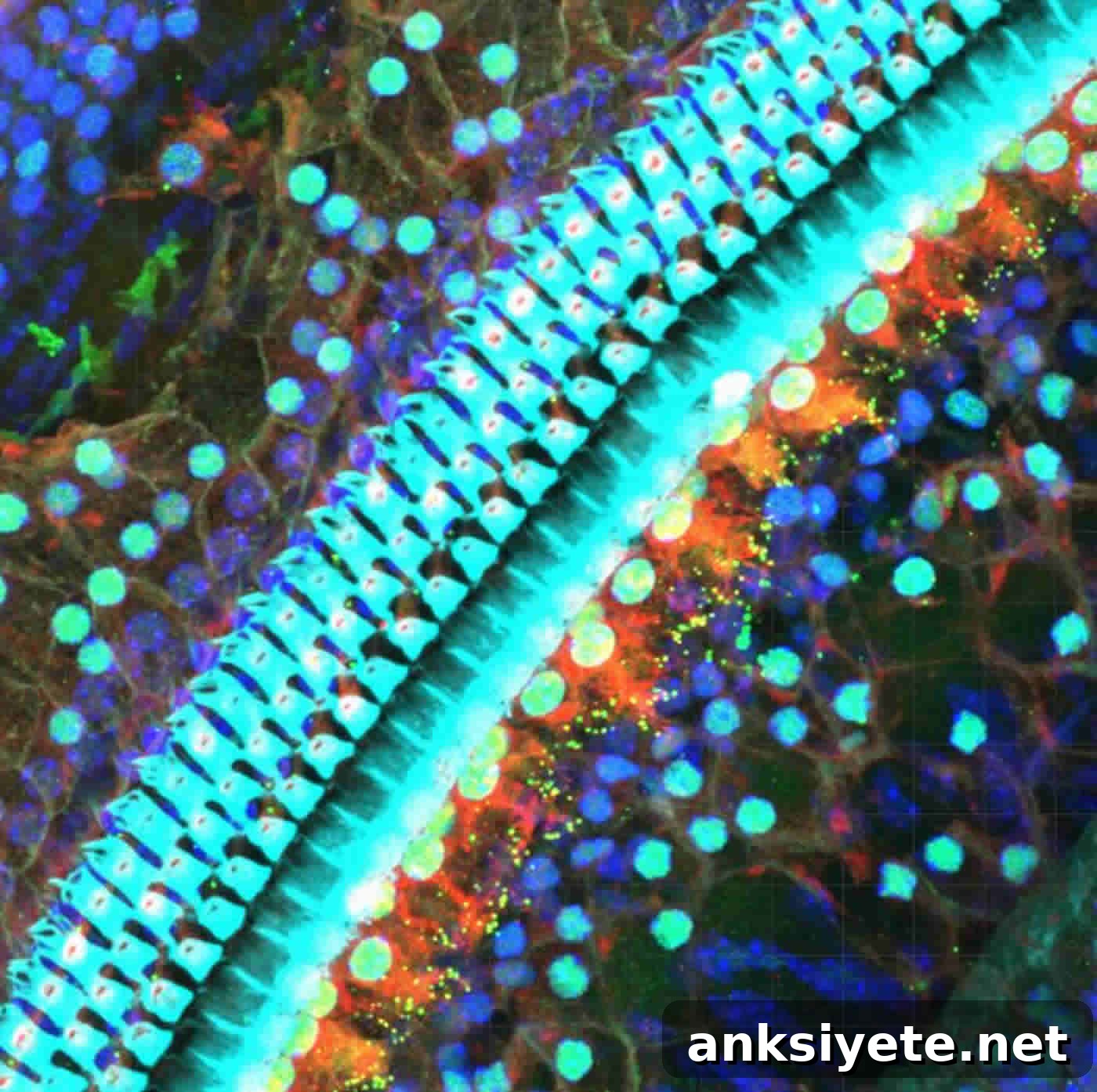
To develop a treatment, the research team first needed to observe what happens inside the cochlea — the spiral-shaped organ of the inner ear responsible for sensing sound. They created a miniature optical imaging tool to visualize cochlear structures in live mice and then exposed those mice to intense acoustic trauma designed to mimic a roadside bomb blast.
The researchers saw two primary pathological events unfold after noise exposure. First, the sensory hair cells that convert sound vibrations into electrical signals died immediately and irreversibly. Second, the inner ear developed an abnormal accumulation of fluid, which reached high potassium levels and, over several hours, led to the degeneration of auditory neurons.
“That feeling of fullness in your ears and the ringing you notice after a loud concert is linked to this fluid buildup,” says the study’s corresponding author John Oghalai, MD, chair and professor of the USC Tina and Rick Caruso Department of Otolaryngology – Head and Neck Surgery. “We observed that when endolymph volume increases, neuronal loss follows.”
The distinction between hair cell death and neuron loss is important: hair cells detect sound, but neurons transmit that information to the brain. If hair cells remain but are disconnected from neurons, hearing remains impaired.
Crucially, while hair cell death occurred immediately and could not be reversed, neuron damage developed more slowly. This delayed onset created a therapeutic window — an opportunity to intervene after noise exposure but before irreversible neural loss.
Osmotic stabilization as a potential treatment
Following loud-noise exposure, the inner ear’s excess fluid (endolymph) accumulated over several hours and contained elevated potassium concentrations. To counteract the ionic imbalance and reduce fluid swelling, the researchers administered a simple saline- or sugar-based solution into the middle ear through the eardrum about three hours after the noise event. This approach increased the osmolality of the perilymphatic space adjacent to the endolymph, drawing water out and stabilizing the ear’s fluid compartments.
Treated animals showed substantially less neuronal loss: the intervention prevented approximately 45–64 percent of auditory neuron degeneration compared with untreated animals. While the osmotic treatment did not rescue the sensory hair cells that had already died, preserving neural connections has clear implications for maintaining hearing function when some hair cells survive.
Potential applications for this approach include immediate field treatment after blast exposure and therapeutic use for inner ear conditions associated with fluid imbalance. “I can imagine soldiers carrying a small vial of this solution to apply after exposure to blast pressure from roadside bombs,” Oghalai notes. “This method may also have potential for treating other disorders of the inner ear linked to fluid buildup, such as Meniere’s disease.”
The team plans to map the precise cascade of events that links endolymphatic hydrops (fluid swelling) to neuronal death and to move toward clinical trials that evaluate safety and effectiveness in humans.
Funding: This study received support from the National Institutes of Health and the U.S. Department of Defense.
Source: Cynthia Smith, USC.
Publisher: Organized by NeuroscienceNews.com.
Image Source: Image credited to Juemei Wang (Oghalai lab).
Original Research: Abstract for “Osmotic stabilization prevents cochlear synaptopathy after blast trauma” by Jinkyung Kim, Anping Xia, Nicolas Grillet, Brian E. Applegate, and John S. Oghalai in PNAS. Published May 7, 2018.
doi: 10.1073/pnas.1720121115
Abstract
Osmotic stabilization prevents cochlear synaptopathy after blast trauma
Traumatic noise produces hearing loss by damaging sensory hair cells and their synapses with auditory nerve fibers. In this study, mice exposed to a blast wave approximating a roadside bomb developed an increase in the volume of endolymph (endolymphatic hydrops) within the scala media. Trauma to the mechanosensitive stereocilia of hair cells initiated endolymphatic hydrops, hair cell loss, and cochlear synaptopathy; these processes were dependent on elevated potassium. Increasing the osmolality of the nearby perilymph treated the endolymphatic hydrops and prevented synaptopathy but did not stop hair cell loss. Conversely, deliberately lowering perilymph osmolality in control mice induced endolymphatic hydrops and caused cochlear synaptopathy that was glutamate-dependent without producing hair cell loss. These findings indicate that endolymphatic hydrops reflects synaptic bouton swelling after hair cells release excitotoxic levels of glutamate. Because osmotic stabilization prevents neural damage, it represents a promising treatment strategy to reduce hearing loss after noise exposure.