
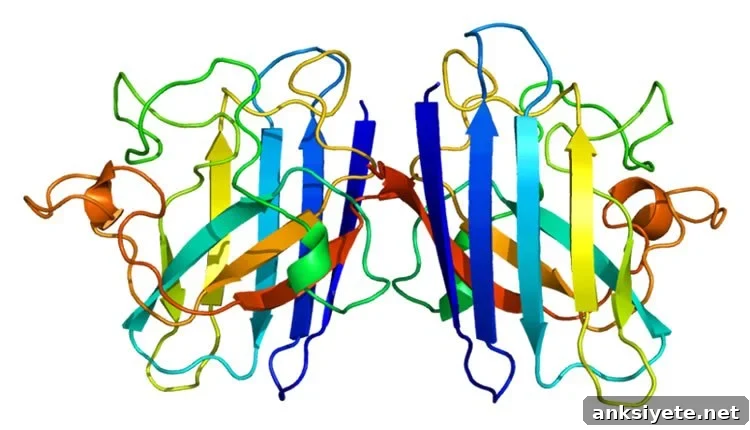
Summary: New research links abnormal SOD1 protein to neuronal loss in both Parkinson’s disease and amyotrophic lateral sclerosis (ALS).
Source: University of Sydney.
Discovery may provide a new therapeutic direction for Parkinson’s disease and ALS
Researchers have identified a specific abnormality in the antioxidant enzyme superoxide dismutase 1 (SOD1) in brain regions affected by Parkinson’s disease, a finding that strengthens the idea that related protein changes underlie multiple neurodegenerative disorders. The study, led by Associate Professor Kay Double and published in Acta Neuropathologica, shows that a distinct SOD1 “fingerprint” appears in areas of neuronal loss in Parkinson’s disease brains.
“We have pinpointed a protein abnormality known as the ‘SOD1 fingerprint’ in regions of neuronal loss in the Parkinson’s disease brain,” said Associate Professor Kay Double. The team proposes that this neuronal loss is driven by a combination of oxidative stress and a local deficiency in copper—two factors that appear to affect vulnerable brain regions in Parkinson’s disease.
This discovery is significant because similar SOD1 abnormalities are already well established in a subset of familial ALS cases. In fALS, mutations in the SOD1 gene lead to protein misfolding and impaired copper binding that promote aggregation. The new results reveal SOD1 misfolding and metal deficiency in Parkinson’s disease brain tissue as well, suggesting common degenerative pathways shared between Parkinson’s disease and ALS.
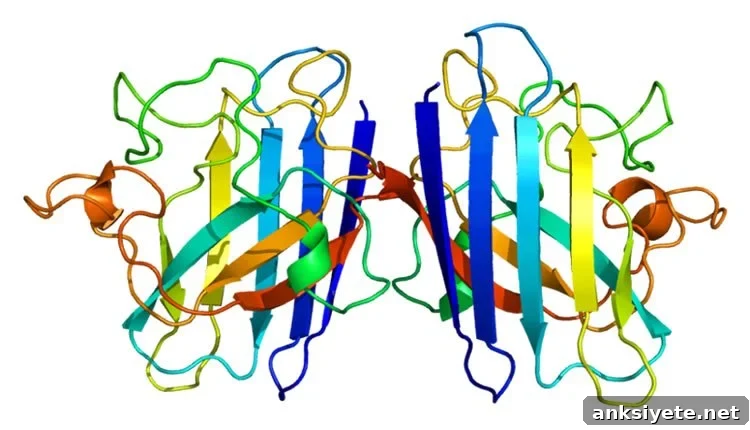
Alterations in SOD1 are known to underlie roughly 20 percent of familial ALS cases, where mutations in the sod1 gene produce functional or structural defects in the enzyme. Those defects include misfolding and reduced ability to bind copper, which together promote toxic aggregation of SOD1 and contribute to motor neuron death in affected ALS patients.
Importantly, therapies that target abnormal SOD1 have shown meaningful benefits in experimental models of ALS, improving motor function and survival time, and have advanced into human clinical trials for that disease. The identification of a similar SOD1 proteinopathy in Parkinson’s disease implies that SOD1-targeted approaches under development for ALS could potentially be repurposed or adapted as disease-modifying treatments for Parkinson’s disease as well.
Source: Danielle Posthuma, University of Sydney.
Image credit: Emw (image used for illustration).
Original research: Trist BG, Davies KM, Cottam V, Genoud S, Ortega R, Roudeau S, Carmona A, De Silva K, Wasinger V, Lewis SJG, Sachdev P, Smith B, Troakes C, Vance C, Shaw C, Al-Sarraj S, Ball HJ, Halliday GM, Hare DJ, Double KL. “Amyotrophic lateral sclerosis–like superoxide dismutase 1 proteinopathy is associated with neuronal loss in Parkinson’s disease brain.” Acta Neuropathologica. Published online May 17, 2017. doi:10.1007/s00401-017-1726-6
The study characterizes a previously undescribed protein aggregate in Parkinson’s disease that is distinct from classic synucleinopathy and is mainly composed of SOD1. The distribution of this SOD1 pathology closely matches regions of neuronal loss, and the aggregates share structural features with SOD1 deposits observed in SOD1-associated familial ALS.
Biochemical analyses indicated that SOD1 in affected Parkinson’s disease brain tissue shows signs of misfolding and metal (copper) deficiency similar to the defects seen in mutant SOD1 in fALS. These similarities support the idea that toxic aggregation of SOD1 can contribute to neuronal death across different neurodegenerative diseases, and not only in genetic forms of ALS.
Clinically, the results point toward a possible broader application of SOD1-focused therapeutics. Treatments designed to reduce SOD1 toxicity or to restore its normal folding and metal-binding properties—which have already produced encouraging results in ALS models—might be evaluated for efficacy in slowing or preventing neuronal loss in Parkinson’s disease. Such cross-disease therapeutic strategies could accelerate development of disease-modifying interventions and expand treatment options for patients.
The researchers describe a Parkinson’s disease–associated proteinopathy predominantly composed of superoxide dismutase 1 (SOD1). This SOD1 pathology, distinct from classic synuclein aggregates, closely reflects the regional pattern of neuronal loss. The aggregates resemble neurotoxic SOD1 deposits seen in familial ALS, and SOD1 in Parkinson’s tissue shows misfolding and a deficiency in metal binding. Together, these findings suggest shared mechanisms of toxic SOD1 aggregation in Parkinson’s disease and ALS and raise the possibility that therapies targeting SOD1 toxicity could translate between these disorders.
For citation: University of Sydney. “Common Protein Abnormality Pinpointed in Parkinson’s and ALS.” Neuroscience News, 22 May 2017.