
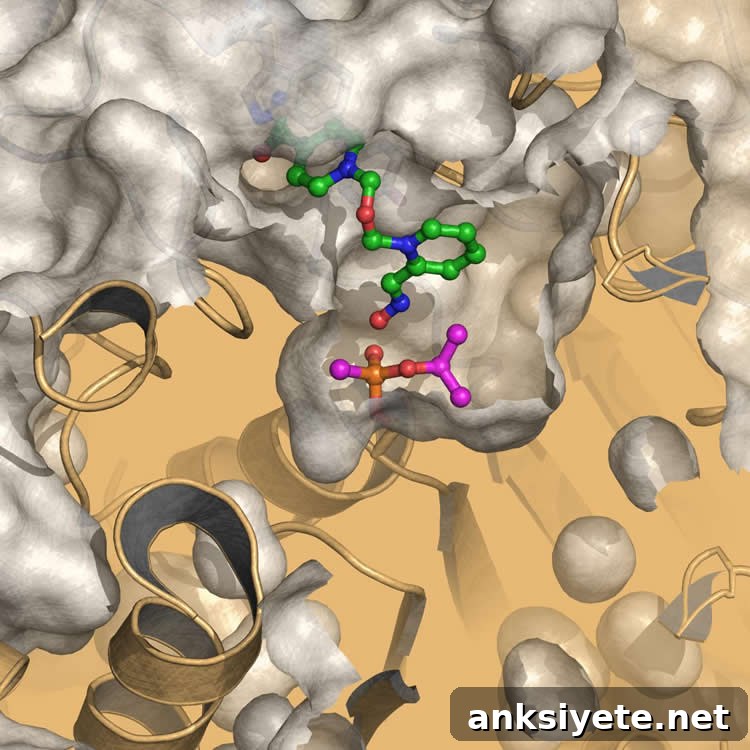
The nerve agent sarin triggers a lethal overstimulation of the nervous system that can be halted if an effective antidote is administered within minutes. A new study published in PNAS details, at atomic resolution, how one such antidote works to free the nervous system’s key enzyme from sarin’s grip. Researchers from the Swedish Defence Research Agency (FOI), Umeå University and German colleagues report the findings.
Sarin is a colourless, odourless liquid that is deadly even at very low exposures. Severe poisoning leads to blurred vision, nausea, difficulty breathing and, without rapid treatment, can result in death.
“Nerve agents are horrific weapons, and we hope these results will help develop more effective treatments,” says Anders Allgardsson, a biochemist at the Swedish Defence Research Agency (FOI).
Organophosphorus nerve agents like sarin act by disabling acetylcholinesterase (AChE), an essential enzyme that terminates signalling by the neurotransmitter acetylcholine. When sarin binds covalently to AChE, the enzyme can no longer break down acetylcholine, which causes an accumulation of the neurotransmitter and dangerous overstimulation of nerves. The antidote HI‑6 is known to reactivate AChE by removing the bound nerve agent, but the precise molecular steps of that reactivation have remained unclear.
After years of work, chemists at FOI and Umeå University have now resolved a three‑dimensional prereaction structure that captures HI‑6 and sarin in the act, moments before the covalent bond to AChE is broken. The high‑resolution model maps atom positions in detail and reveals how atomic rearrangements precede bond cleavage, offering a clear picture of the reactivation event.
The breakthrough came from combining X‑ray crystallography with advanced quantum chemical calculations and complementary biochemical experiments. Diffraction data showed only a faint signal for the antidote and nerve agent in the active site, so the team integrated those experimental data with density functional theory (DFT) calculations. Large‑scale computations were performed on the High Performance Computing Center North (HPC2N) at Umeå University to refine and validate the structural model.
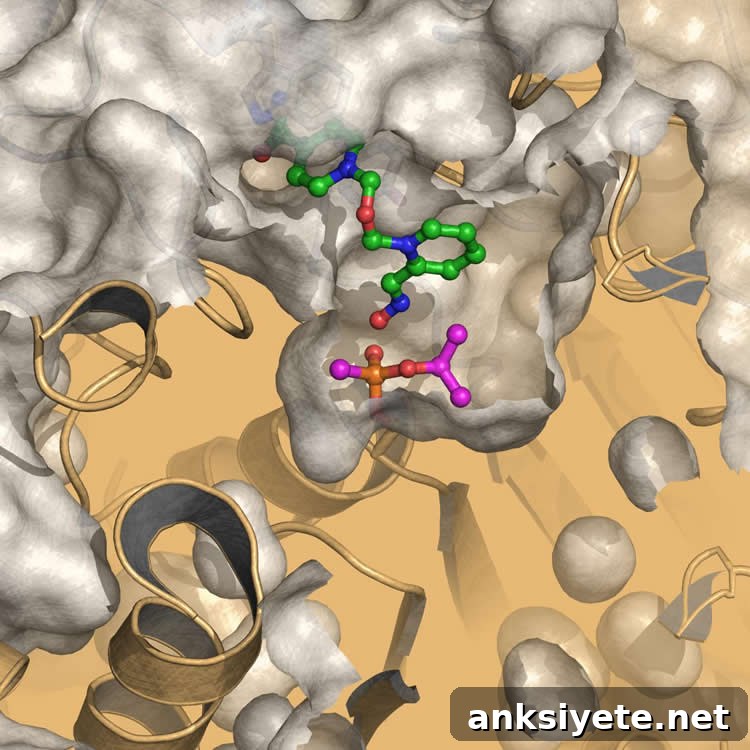
“X‑ray crystallography revealed only a faint trace of the configuration we expected, so we turned to quantum chemical methods to interpret it,” explains Anna Linusson, Professor in the Department of Chemistry at Umeå University. “After intensive calculations and model refinement on HPC2N, the pieces fell into place.”
The combined computational and experimental evidence supports the conclusion that the weak crystallographic signal corresponds to a bona fide prereaction complex formed by HI‑6 and the sarin‑inhibited AChE. The team also performed biochemical tests in which they altered the enzyme by mutation and used isotopic substitutions, helping to confirm the proposed mechanism and key interactions within the active site.
Results from kinetic experiments further indicate a conformational change in the sarin adduct precedes bond cleavage, and isotope experiments point to an isotope‑sensitive step in the reactivation pathway. Taken together, these findings illuminate the molecular choreography of how HI‑6 approaches and removes sarin, offering structural starting points for rational, structure‑based design of improved antidotes against sarin and related nerve agents.
“After seven years of effort using multiple complementary techniques, we can now present a consistent and detailed picture of how HI‑6 engages sarin,” says Allgardsson. “This opens new opportunities to design better reactivators informed by precise structural data.”
Funding: The research is a collaboration between Umeå University, the Swedish Defence Research Agency (FOI) and the German Bundeswehr Institute of Pharmacology and Toxicology.
Source: Ingrid Söderbergh – Umeå University
Image credit: FOI, Swedish Defence Research Agency.
Original research: Full open access article: “Structure of a prereaction complex between the nerve agent sarin, its biological target acetylcholinesterase, and the antidote HI‑6” by Anders Allgardsson, Lotta Berg, Christine Akfur, Andreas Hörnberg, Franz Worek, Anna Linusson, and Fredrik J. Ekström in PNAS. Published online May 2, 2016. DOI: 10.1073/pnas.1523362113
Abstract
Structure of a prereaction complex between the nerve agent sarin, its biological target acetylcholinesterase, and the antidote HI‑6
Organophosphorus nerve agents disrupt cholinergic signalling by forming a covalent bond with the active site of acetylcholinesterase (AChE), which prevents normal breakdown of acetylcholine and can lead to fatal overstimulation. Current therapies include oxime antidotes such as HI‑6 that restore AChE activity, but the molecular mechanism of reactivation has been unclear. In this study, the authors combined diffusion‑trap cryocrystallography with density functional theory (DFT) calculations to capture and analyse prereaction conformers of HI‑6 bound to Mus musculus AChE inhibited by sarin. The structural and computational analyses reveal previously unobserved conformations and suggest that cleavage of the AChE–sarin covalent bond is preceded by a rearrangement within the sarin adduct. Complementary reactivation kinetics and solvent kinetic isotope effect experiments indicate an isotope‑sensitive step in the mechanism and identify a potentially important interaction between Glu202 and the O‑isopropyl group of sarin. These insights clarify features of the reactivation pathway and provide a robust structural framework to guide the rational development of improved antidotes. The work also demonstrates how DFT can aid interpretation and validation of crystallographic data for complex, reactive biological systems.