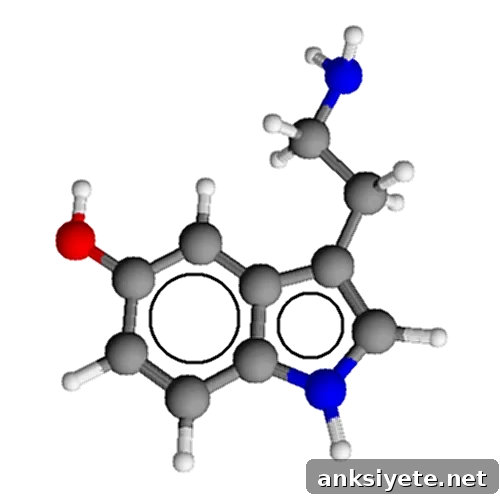
An interdisciplinary team from the University of Texas Medical Branch at Galveston and the University of Houston has identified a novel way to influence serotonin signaling that could lead to more effective medicines with fewer side effects.
Serotonin signaling plays a central role in many physiological and behavioral processes, and disruptions in that system have been linked to depression, addiction, epilepsy, obesity, and a variety of eating disorders. Most drug discovery efforts aimed at the serotonin system have focused on the receptor “active site,” the region of the receptor that directly binds serotonin and triggers intracellular signaling. However, receptor function can also be modified at distant binding sites by other interacting proteins in a process known as allosteric regulation.
The UTMB–UH team focused on one particularly important serotonin receptor, 5-HT2C, and on an interacting protein called PTEN. PTEN binds to 5-HT2C at a site distant from the receptor’s active site and modulates its function. Because the receptor can bind serotonin and PTEN at different locations simultaneously, PTEN’s presence produces an allosteric effect that weakens serotonin signaling through 5-HT2C.
“This offers a fresh strategy: rather than targeting the active site alone, we can target the receptor’s regulatory interactions,” said Kathryn Cunningham, professor at UTMB and senior author of the study. The researchers designed molecules that interfere with the receptor–PTEN binding, altering receptor behavior without competing at the serotonin binding site itself.
To block the PTEN interaction, the team used a fragment of the 5-HT2C receptor where PTEN normally attaches. These receptor fragments, or peptides, are small sections of the protein that can compete for PTEN binding. One peptide, previously called 3L4F, proved to be an effective candidate. In cell-free assays and cultured cells, 3L4F enhanced 5-HT2C receptor responses by binding to PTEN and preventing PTEN from weakening serotonin signaling. Importantly, 3L4F showed selectivity: it affected 5-HT2C receptors but had no measurable effect on the closely related 5-HT2A receptor.
Laboratory behavioral studies in rats supported the biochemical findings: administration of 3L4F increased behavioral responses consistent with enhanced 5-HT2C signaling. “We tested both human cells and animal models because the goal is to translate these insights into potential therapeutics,” said Noelle Anastasio, a UTMB postdoctoral fellow and lead author of the paper. “Targeting protein–receptor interactions to create drugs and research tools is a new direction with strong promise.”
Recognizing the limitations of larger peptides for drug development, the researchers shortened 3L4F to about half its original size while preserving similar activity. Using computational molecular modeling, they identified which amino acids were critical for PTEN binding. That structural information will guide medicinal chemistry efforts to design smaller, drug-like molecules that mimic the peptide’s activity with improved stability and bioavailability.
“We’ve established proof of principle,” Cunningham said. “Now we can use chemistry to generate new molecules that may be useful for treating addictions and other disorders. Alongside drug development, there’s intense scientific interest in understanding the biology of the 5-HT2C–PTEN interaction and its relevance to conditions such as addiction, alcoholism, depression, obesity, and disordered eating. This work helps clarify the neurobiology behind those disorders and opens new therapeutic avenues.”
By shifting the focus from classic active-site antagonists or agonists to modulators of protein–receptor interfaces, this research highlights an alternative path for selectively tuning serotonin signaling. Allosteric modulation through peptide-derived inhibitors could reduce off-target effects and provide finer control over receptor activity, addressing long-standing challenges in developing safe, effective neuropsychiatric and metabolic therapeutics.
Notes about this neuroscience research
Additional UTMB authors include Marcy Bubar, Nicole Bremer, Sonja Stutz, Robert Fox, Thressa Smith, Yowjiun Jeng, Sarah Swinford, Patricia Seitz, Fernanda Laezza and Cheryl Watson. Additional University of Houston authors include Anton Agarkov, Marc Charendoff, John Craft and James Briggs. The research received support from the Klarman Family Foundation, the Foundation for Prader-Willi Research and the National Institute on Drug Abuse.
Contact: Jim Kelly – University of Texas Medical Branch at Galveston
Source: UTMB press release
Image Source: Image credited to Xxxx00 at Wikimedia Commons; licensed as public domain.
Original Research: Abstract for “Peptide Inhibitors Disrupt the Serotonin 5-HT2C Receptor Interaction with Phosphatase and Tensin Homolog to Allosterically Modulate Cellular Signaling and Behavior” by Noelle C. Anastasio et al., Journal of Neuroscience. Published online January 23, 2013, doi: 10.1523/JNEUROSCI.2656-12.2013