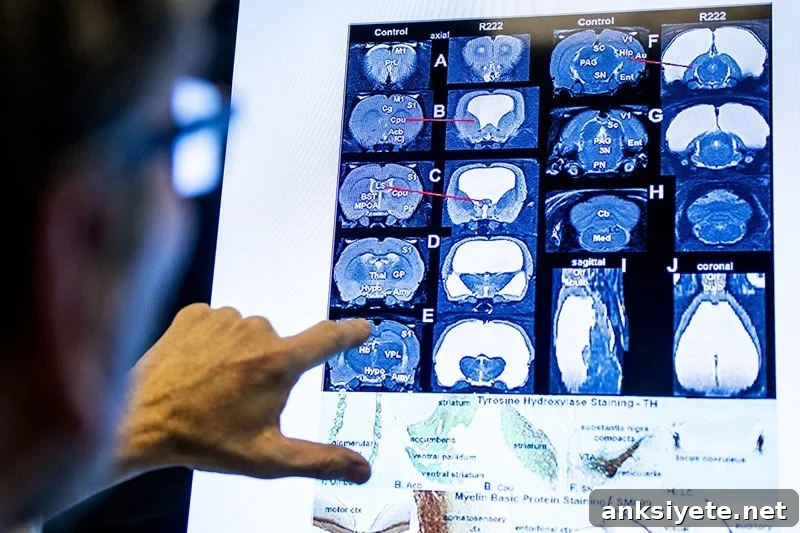
Summary: Rat R222 was born with severe hydrocephalus that compressed and flattened much of its brain as fluid filled the skull. Neuroimaging and behavioral testing showed that, despite dramatic anatomical loss, R222 retained sight, hearing, smell, touch, normal movement, and spatial memory. The case reveals extreme neuroplasticity—how the nervous system reorganizes to preserve function—and suggests lessons for understanding minimal neural architectures in biology and technology.
Source: Northeastern University
Background: During routine scans of aged laboratory rats, researchers in Craig Ferris’s lab encountered an extraordinary case: a two‑year‑old animal that behaved like its peers but whose brain was overwhelmingly displaced and compressed by cerebrospinal fluid. Labeled R222, the animal presented an extreme example of hydrocephalus in which much of the cortex had been thinned or replaced by fluid. Yet the rat still saw, smelled, heard, and responded to touch—prompting a detailed investigation into how neural function had been preserved.
Ferris, a professor of psychology at Northeastern University and director of the Center for Translational Neuroimaging, describes R222 as “one of nature’s miracles.” Surviving to the equivalent of a senior age in human years with such severe deformation is highly unusual. The condition appears congenital: the rat’s behavior and adaptation indicate it had developed with the disorder rather than acquired it later in life.
Neuroimaging initially suggested the animal had almost no recognizable brain tissue. But follow‑up analyses revealed that essential processing had relocated into compact, remaining regions. Visual, olfactory, and tactile inputs were processed across distributed areas of the residual brain, including the brainstem and cerebellum, which showed global activation during functional MRI studies. Structures normally associated with memory, such as the hippocampus, were present but severely distorted and displaced toward the posterior hindbrain.
To compare behavior, the team ran standard tests used to evaluate memory, spatial learning, and motor function. Each rat was observed in a Plexiglas enclosure to gauge how it explored new objects and space, guided through mazes to test spatial memory, and walked across a balance beam to assess coordination. In nearly every test, R222 performed comparably to age‑matched controls. The only notable difference was reduced exploration of a novel environment—an observation consistent with heightened anxiety rather than a sensory or motor deficit.
Detailed biochemical tracing and BOLD MRI helped the researchers identify the displaced but functioning tissue. The scans demonstrated that much of the sensory processing had been redistributed to the brainstem, cerebellum, and other compact regions that remained after tissue loss. Ferris explains that, for rats, olfaction is a dominant sense and much of their behavior is guided by smell; in R222, that evolutionary default likely supported survival despite the loss of large cortical territories.
“This animal just defaulted to what evolution gave it in the beginning, along with all the other animals, to help it survive.”
The findings raise broader questions about the minimal neural substrate required for basic perception and survival. While rats are anatomically and behaviorally different from humans—relying more on scent and different brain organization—the study highlights the remarkable capacity of neural systems to reorganize after severe developmental disruption. The research also invites reflection on efficiency in natural and artificial systems: how much processing hardware is necessary to accomplish core tasks, and how can function be maintained when resources are limited?
Source:
Northeastern University
Media Contacts:
Aria Bracci – Northeastern University
Image Source:
Image credit: Ruby Wallau/Northeastern University.
Original Research: Open access
“Life without a brain: Neuroradiological and behavioral evidence of neuroplasticity necessary to sustain brain function in the face of severe hydrocephalus.” C. F. Ferris et al., Scientific Reports. doi: 10.1038/s41598-019-53042-3
Abstract
A two‑year‑old rat (R222) lived with extreme hydrocephalus that dramatically altered brain size and organization. Much of the cortex was thinned or replaced by cerebrospinal fluid, yet the animal retained normal motor function and sensory responses to sight, sound, smell, and touch. The hippocampus and other subcortical structures were malformed and displaced but the rat demonstrated spatial memory comparable to controls. BOLD MRI revealed global activation to visual, olfactory, and tactile stimulation, particularly in the brainstem and cerebellum. These results illustrate neuroadaptation following substantial tissue loss and prompt consideration of what constitutes the “bare minimum” neural architecture necessary for survival.