
Summary: New research reveals how nerve cells in the gut are organised during development, shedding light on mechanisms that may underlie common gastrointestinal disorders.
Source: Francis Crick Institute
Scientists have identified developmental rules that shape the organisation of nerve cells within the gut’s enteric nervous system — a discovery that could help explain the origins of disorders such as irritable bowel syndrome and chronic constipation.
The study, published in Science, maps how the enteric nervous system (ENS) — a dense network of roughly half a billion neurons and numerous supporting glial cells within the gut wall — is assembled in mice. Led by researchers at the Francis Crick Institute in collaboration with groups at the University of Leuven, Stanford University, the Hubrecht Institute and the Quadram Institute Bioscience, the work was funded by the Francis Crick Institute, the Medical Research Council and the UK Biotechnology and Biological Sciences Research Council.
Often called the “second brain” because of its large population of neurons and autonomous control over many gut functions, the ENS manages everything from gastric acid production and coordinated muscle contractions that move food, to interactions with immune cells and gut microbes and communication with the central nervous system. Yet its circuit architecture has appeared disordered. The new research explains how well-organised function emerges from that apparent chaos.
“Although the gut wall contains many different nerve cell types that look scattered, the ENS produces precise and stereotyped functions,” says Vassilis Pachnis, group leader at the Francis Crick Institute. “We set out to discover the developmental logic that turns seemingly random cell distributions into a functional neural network.”
Tracing cell lineages during development
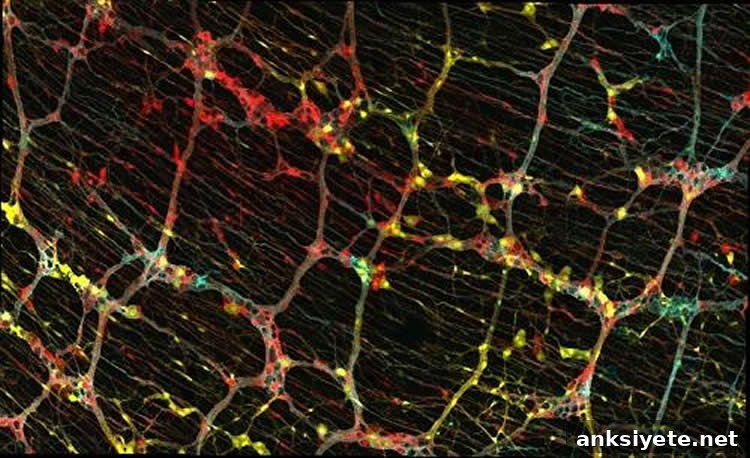
The team used genetic labelling to track individual ENS progenitor cells — the stem-like cells that divide and produce neurons and glia during development. Each progenitor was marked with a unique colour so that all of its descendants could be followed from embryonic stages into adulthood. By analysing which cell types arose from single progenitors and where those cells settled, the researchers reconstructed how ENS architecture forms over time.
Results showed that some progenitors were committed to producing only neurons, others produced only glial cells (the supporting cells of the nervous system), and a subset gave rise to both neurons and glia. Descendants from the same progenitor tended to remain close together and formed compact cellular clusters. Clusters descended from neighbouring progenitors overlapped at their borders, producing an arrangement similar to overlapping sets in a Venn diagram when viewed at the gut surface.
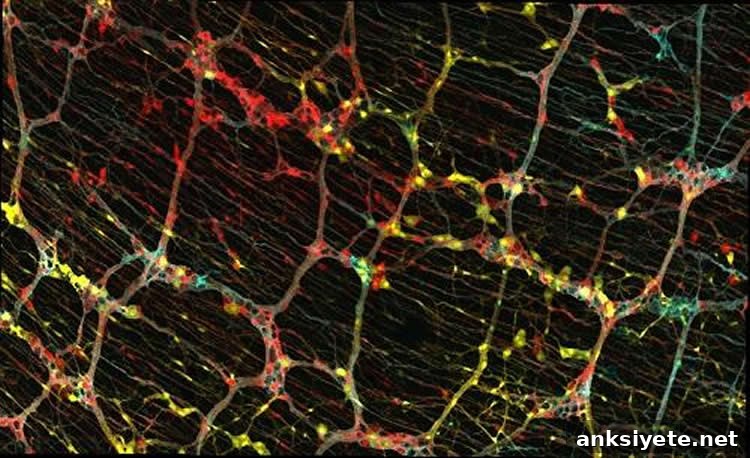
Crucially, this close spatial relationship among clonally related cells extended across the full thickness of the gut wall. Clonal descendants arranged themselves into overlapping columns that spanned from the serosal surface to the mucosa layer, revealing an organised three-dimensional scaffold for the ENS rather than a random distribution limited to a single plane.
Functional consequences of clonal organisation
To test whether these lineage relationships influence neural activity, the researchers applied mild electrical stimulation to the ENS and recorded responses. Neurons that derived from the same progenitor responded synchronously, indicating that clonal origin predicts functional coupling within the network. This finding supports the idea that developmental lineage helps determine both the spatial arrangement and coordinated activity of enteric circuits.
“The synchronised responses we observed suggest that the developmental history of cells is a fundamental determinant of how enteric networks regulate gut function,” says Reena Lasrado, first author of the paper.
Implications for human gut disorders
Understanding the developmental blueprint of the ENS opens a new perspective on gastrointestinal disease. If the blueprint is altered during embryonic development or early life, the resulting miswiring could predispose to chronic conditions such as constipation, dysmotility syndromes or functional bowel disorders like irritable bowel syndrome. The authors suggest that studying ENS development and its molecular regulators may reveal mechanisms behind common gut disorders and point toward targeted therapies.
Funding: The Francis Crick Institute, Medical Research Council, UK Biotechnology and Biological Sciences Research Council.
Source: Francis Crick Institute. Original research published in Science: “Lineage-dependent spatial and functional organization of the mammalian enteric nervous system” by Reena Lasrado, Werend Boesmans, Jens Kleinjung, Carmen Pin, Donald Bell, Leena Bhaw, Sarah McCallum, Hui Zong, Liqun Luo, Hans Clevers, Pieter Vanden Berghe, and Vassilis Pachnis. Published online May 19, 2017. DOI: 10.1126/science.aam7511.
Summary of the abstract
The enteric nervous system is essential for digestive function and gut homeostasis. This study demonstrates that the ENS’s neuroglial networks are formed from overlapping clonal units founded by neural crest–derived progenitors. The spatial layout of these clones arises from local proliferation, interactions among unrelated neuroectodermal cells, ordered colonization along the gut wall’s serosa–mucosa axis, and growth of the gut itself. Single-cell transcriptomics and mutational analysis revealed dynamic molecular states in ENS progenitors and identified the RET gene as a regulator of neuronal commitment. Clonally related enteric neurons display synchronous activity in response to stimulation, indicating that lineage relationships structure the peripheral nervous system.
This article summarises peer-reviewed research that maps developmental rules shaping the enteric nervous system. The findings highlight how lineage and spatial organisation together produce coordinated neural activity that supports gut function and may inform future studies into gastrointestinal disorders.