
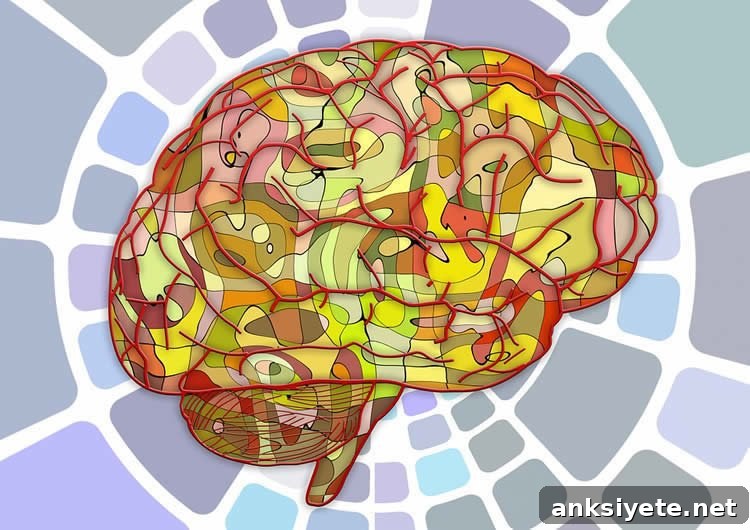
Summary: Researchers report that specific brainwave patterns help suppress the most obvious associations, enabling access to more remote and creative ideas.
Source: Queen Mary University of London.
Scientists at Queen Mary University of London and Goldsmiths, University of London find that the brain must suppress obvious ideas to reach the most creative ones.
Creativity often requires moving away from common, immediately accessible thoughts, but the neural mechanisms that allow this shift have been unclear.
A new study, published in the Proceedings of the National Academy of Sciences (PNAS), identifies brainwaves—specifically alpha oscillations in the right temporal region—as a critical mechanism that inhibits habitual thinking and opens access to more distant associations.
The researchers observed that these alpha oscillations increase when people need to suppress misleading or dominant associations during creative tasks.
Such obvious associations appear in both convergent thinking (finding a single, unconventional solution) and divergent thinking (generating many novel ideas).
Higher levels of alpha activity in the right temporal area were associated with producing ideas that are further removed from the most familiar or well-known uses of an object or concept.
To test causality, the team also applied a non-invasive electrical stimulation method called transcranial alternating current stimulation (tACS) at alpha frequency over the right temporal cortex. This procedure produced little to no discomfort and allowed the researchers to examine whether boosting alpha oscillations would enhance the suppression of obvious associations.
The results showed that applying alpha-frequency stimulation improved participants’ ability to inhibit dominant links in both convergent and divergent creative tasks, supporting the idea that right temporal alpha oscillations play a causal role in creative thinking.
Lead researcher Dr Caroline Di Bernardi Luft of Queen Mary University of London explained: “To generate alternative uses for an everyday object such as a glass, we must first overcome our prior experience that defines a glass primarily as a container. Our study demonstrates that right temporal alpha oscillations are a key neural mechanism for overriding these obvious associations.”
“To understand how new and appropriate ideas are produced, we break creativity down into its component processes. By isolating and characterizing these subprocesses experimentally, then reintegrating them, we can build a clearer picture of creativity as a whole,” she added.
The team measured brain activity using electroencephalography (EEG), which records electrical signals from sensors on the scalp, enabling them to monitor natural oscillatory patterns. Combining EEG with tACS allowed the researchers both to observe and to modulate the relevant brain rhythms, clarifying their functional role.
In the laboratory, participants completed tasks designed to probe associative search. For example, when asked to list concepts linked to a given word, people typically move from strong, immediate associations toward weaker, more remote ones (for example: cat → dog → animal → pet → human → people → family). The study tracked how the brain navigates this progression and how alpha oscillations help suppress the strongest, most misleading associations so that more remote ideas can emerge.
Earlier work has shown that some individuals regularly outperform others in creative tasks because they can bypass strong, familiar associations; this study adds direct evidence that alpha oscillations are centrally involved in enabling that bypass.
Professor Joydeep Bhattacharya of Goldsmiths, University of London and co-author of the study commented: “As Robert Frost wrote, ‘Two roads diverged in a wood, I took the one less travelled by, and that has made all the difference.’ Choosing the less obvious path is essential for creative thinking, and our findings explain how the brain supports that choice.”
The researchers aim to extend these findings by examining how these neural processes operate in real-world creative problem solving outside the laboratory and whether safe, practical stimulation systems could be developed to support creativity on demand.
Funding: The work was carried out as part of CREAM (Creativity enhancement through advanced brain mapping and stimulation), a project supported by the European Commission.
Source: Rupert Marquand, Queen Mary University of London
Publisher: NeuroscienceNews.com
Image Source: NeuroscienceNews.com image (public domain)
Original Research: The study appears in Proceedings of the National Academy of Sciences (PNAS).
Queen Mary University of London. “Brainwaves Suppress Obvious Ideas to Help Us Think More Creatively.” NeuroscienceNews, 10 December 2018.