
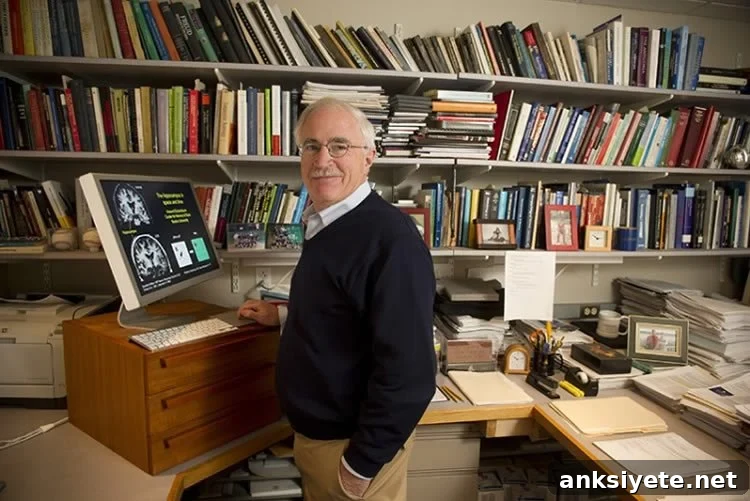
My journey to becoming an “Eichenbaumer” began on April 1, 2005. After my interview at Boston University, a fellow applicant emailed to say he had been denied admission because of funding shortages. Panicked, I wrote to Howard to tell him how much I wanted to join his lab and work with him. He replied immediately: “I am working on this – stay tuned.” A few hours later he welcomed me into the lab after securing a teaching fellowship to fund my first year.
A few months later I moved to Boston to begin graduate training: a 22-year-old, wide-eyed, in love with neuroscience and eager to throw myself into research. My first year was a blur of coursework, teaching responsibilities, and an introduction to cognitive behavior experiments with rodents. Even so, my passion never wavered because I had the honor of being mentored by Howard. Many were drawn to him because of his reputation in neuroscience, but few had the privilege of experiencing his mentorship up close—his brilliance, contagious enthusiasm, and relentless energy. He was also very much Howard: a proud dad, a Sox fan, and a down-to-earth Boston man.
Those who knew Howard well remember his sharp sarcasm and occasional moods, but also his warmth and wit. He gathered a group of smart, driven students and postdocs who made the lab a uniquely supportive place. We spent long hours together—inside the lab, in stairwells, and on the steps near the Pike—sharing laughter, tears, and the daily struggles that come with research and life in your 20s and 30s.
Howard was always on the move. Though he traveled frequently, the lab was his first priority. He answered emails promptly—even if the reply was a single emphatic line—and he made time for us whenever he was on campus. Any Eichenbaumer could tell when Howard was present by the line outside his office door. Meetings with him could leave you invigorated or frustrated, but you always left with clarity and direction.
Howard is best known for his pioneering work on memory, but I will always remember him as a gifted science writer. He constantly wrote—grants, papers, reviews, and books—and published an impressive body of work throughout his career. He had a rare ability to translate complex science into clear, engaging prose for general audiences. Regardless of background or education, readers could pick up his books and immediately connect to his storytelling, his curiosity, and his love for the science.
Publishing with Howard was an intense process. Once the data were in, there was no slowing him down. He pushed for excellence at every step, and the final manuscript usually emerged near-perfect. His exacting standards shaped my own approach to research and writing. Passing Howard’s test meant your work met a high bar, and the first paper accepted under his mentorship remains one of my most rewarding achievements. The time I spent writing papers and my thesis with him taught me how to be a scientist and a clear, disciplined writer—skills I still rely on today.
After graduation I endured a difficult postdoctoral experience and eventually decided to leave academic research. Many expected me to seek another postdoc, but I knew stepping away was the right choice. Under Howard’s halo, the lab culture often modeled rigorous science—yet outside that environment I encountered sloppy practices, p-hacking, and a lack of respect for the scientific method in some places. I worried about how colleagues would react to my decision and most of all about Howard’s response. He met my choice with support and confidence in my ability to succeed in a different career, for which I will be forever grateful.
Now I write with tears in my eyes because those days with Howard have passed and our time with him is over. On October 5th we gathered at Boston University to remember Howard and reflect on both his scientific contributions and his personal impact. It was a long and difficult day, but I left feeling grateful for everything he gave us: the connections he forged, the inspiration he provided, and the care he invested in so many students and colleagues.
In recent months I’ve had several dreams about Howard. In some, I get to say goodbye. In others, he’s alive and planning the next experiment. In one recurring dream, he’s simply curious about how we all turned out.
So, Howard, we all turned out alright. We work across industry, academia, consulting, and healthcare. We have families and children, living in the U.S. and abroad. We are passionate about our work and committed to doing it well because you trained us to meet the world with curiosity, rigor, and integrity.
Any Eichenbaumer knows that, in our imaginations, Howard has carved out a corner of the universe for a new office—stacks of journals, scribbles across a whiteboard, papers piled high, and a constant hum of ideas. He paces while he speaks, types furiously to clear his inbox, and greets us with that quick, characteristic smile. That is the image I carry of him: a source of inspiration, boundless energy, and devotion to science.
Thank you, Howard. We carry your lessons forward, walking in your footsteps every day, forever connected by the passion you instilled in us and the work you loved—especially the study of memory.
NeuroscienceNews.com would like to thank Loren for sharing her personal memories of Dr. Eichenbaum.
Source: Loren DeVito, PhD – StickyInk.Net
Publisher: Organized by NeuroscienceNews.com.
Image Source: Images credited to Loren DeVito.