
Summary: Researchers report that sleep deprivation intensifies and prolongs pain.
Source: UC Berkeley.
Poor sleep does more than leave us tired — it can amplify and prolong physical pain by disrupting key brain circuits that detect pain and trigger the body’s natural pain relief, according to researchers at the University of California, Berkeley.
Published in the Journal of Neuroscience, the study helps explain the cycles that link sleep loss, chronic pain, and related problems such as increased reliance on pain medications. National surveys have long shown high rates of sleep disturbance among people with chronic pain; this research identifies the neural changes that help explain why.
“If inadequate sleep increases pain sensitivity, as our results show, then sleep quality should be treated as a central factor in patient care, especially in medical settings,” said Matthew Walker, a UC Berkeley professor of neuroscience and psychology and the senior author on the study.
The researchers measured how sleep deprivation changes pain perception by exposing healthy volunteers to controlled heat stimuli while scanning their brains with functional magnetic resonance imaging (fMRI). The volunteers — young adults without chronic sleep or pain disorders — first had their individual baseline pain thresholds measured after a full night’s sleep, then repeated the test after a sleepless night.
As expected, the sleepless participants reported pain at lower temperatures than after a normal night of rest, demonstrating greater sensitivity. On average subjects rated thermal discomfort around 111°F (about 44°C) after a full night’s sleep, but reported discomfort at roughly 107°F following sleep deprivation. In other words, the same noxious stimulus felt more painful when the brain had been deprived of sleep.
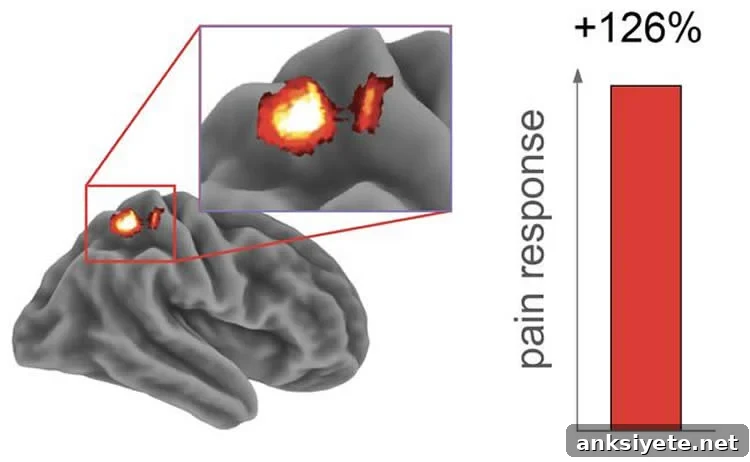
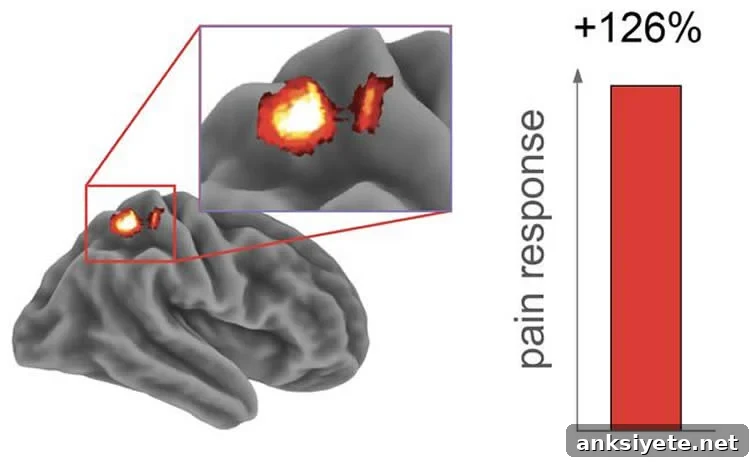
Brain imaging revealed two complementary disruptions that explain the heightened pain. First, activity increased sharply in the somatosensory cortex, the region that receives and processes incoming pain signals. Second, activity dropped in brain areas that normally dampen pain, including the nucleus accumbens — part of the brain’s reward circuitry that helps release dopamine and activate natural pain-relief pathways — and the insular cortex, which evaluates the emotional and contextual significance of painful stimuli.
“Sleep loss not only boosts the parts of the brain that sense pain, it also impairs systems that normally help suppress pain,” said Adam Krause, lead author and a doctoral student at UC Berkeley’s Center for Human Sleep Science. “When those pain-modulating systems are blunted, the same injury can produce a much larger pain experience.”
To extend the laboratory findings to everyday life, the researchers also analyzed survey data from more than 230 adults recruited nationwide. Participants reported their nightly sleep duration and daily pain levels for several days. The results showed that even relatively small nightly reductions in sleep were associated with measurable increases in next-day pain sensitivity.
“The survey data reinforce the experimental results: subtle changes in sleep — the kinds of sleep loss many people consider trivial — can meaningfully increase pain the following day,” Krause said. This link holds across ages and typical day-to-day variations in sleep schedules.
The study underlines sleep’s role as a natural analgesic. Improving sleep quality could therefore be a nonpharmacological strategy to reduce pain and improve recovery, particularly in clinical settings. Walker notes the irony that many patients experience poor sleep in hospitals, where noisy wards and frequent interruptions are common.
“Our findings suggest that protecting uninterrupted sleep in inpatient settings could reduce patients’ pain, speed recovery, and shorten hospital stays,” Walker said. He advocates designing hospital environments and routines that promote restorative sleep as part of standard medical care.
In addition to Matthew Walker and Adam Krause, the study’s co-authors include Aric Prather at the University of California, San Francisco; Tor Wager at the University of Colorado Boulder; and Martin Lindquist at Johns Hopkins University. The research appears in the Journal of Neuroscience and was summarized by UC Berkeley communications.
Source: UC Berkeley (summary by Yasmin Anwar).
Publisher: Neuroscience News (article organized from the university summary).
Image credit: Matthew Walker and Adam Krause.
Original research: The study is published in the Journal of Neuroscience.