
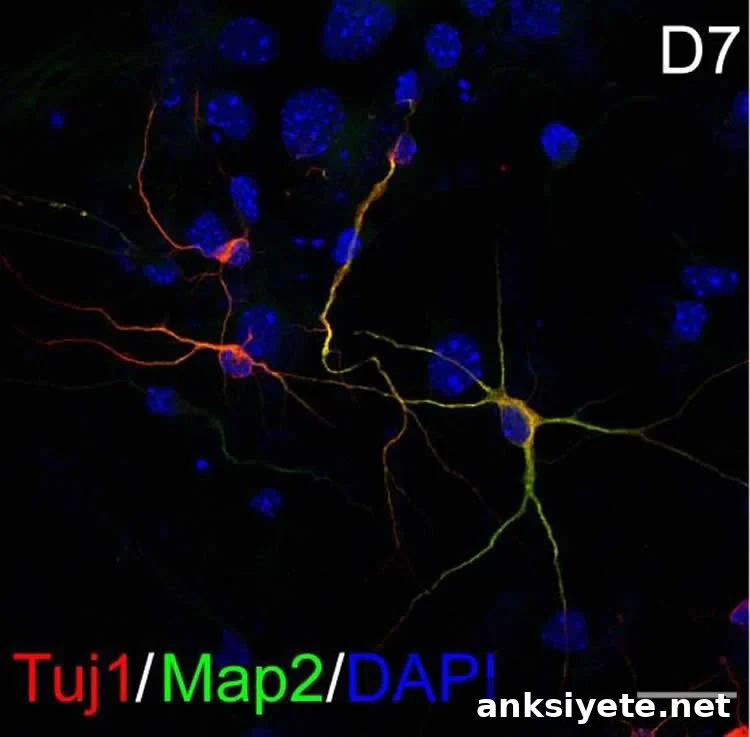
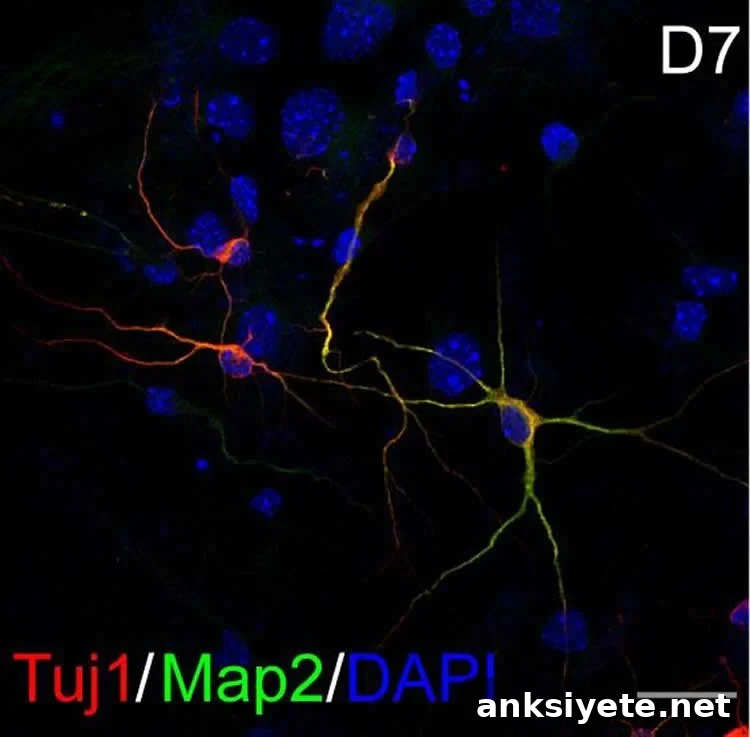
Two independent laboratories in China have reported converting skin cells into neurons using only cocktails of small molecules. One team converted human fibroblasts from healthy donors and Alzheimer’s patients, while the other converted mouse fibroblasts. Both studies, published in Cell Stem Cell, demonstrate that a purely chemical approach can reprogram somatic cells without introducing transcription factors, potentially avoiding some technical and safety issues associated with genetic methods.
A central challenge in cell reprogramming is ensuring that the converted cells not only look like neurons but also behave like them at the molecular and functional levels. Both teams present evidence that chemically induced neurons show neuronal gene-expression patterns, generate action potentials, and form synapses in ways comparable to neurons produced by transcription-factor-driven methods. Each group used a seven-molecule cocktail, with species-specific recipes and protocols detailed in their supplemental material.
Jian Zhao of the Shanghai Institutes for Biological Sciences and Tongji University, co-leader of the human study, reports that the chemical protocol reduces expression of skin-cell programs while activating neuronal transcription factors. By modulating multiple signaling pathways, the small molecules shift gene expression toward a neuronal identity and promote direct conversion without passing through a proliferative neural progenitor stage. Bypassing that intermediate reduces some safety concerns tied to other reprogramming strategies.
The human-focused study, co-led by Gang Pei, demonstrates that this chemical-only approach can generate neurons from fibroblasts of patients with familial Alzheimer’s disease. Much prior disease-modeling work has relied on transcription factors to generate induced pluripotent stem cells (iPSCs) before differentiating them into neurons. A transgene-free, chemical method offers an alternative route for disease modeling and, potentially in the long term, cell-replacement strategies, though the approach is still at the proof-of-concept stage.
Hongkui Deng and colleagues at the Peking University Stem Cell Research Center emphasize the practical advantages of small molecules: they are cell-permeable, cost-effective, synthetically accessible, easy to standardize and store, and their effects can be reversed or tuned by changing concentration and exposure time. This tunability can reduce the complexity and safety concerns associated with introducing exogenous genes.
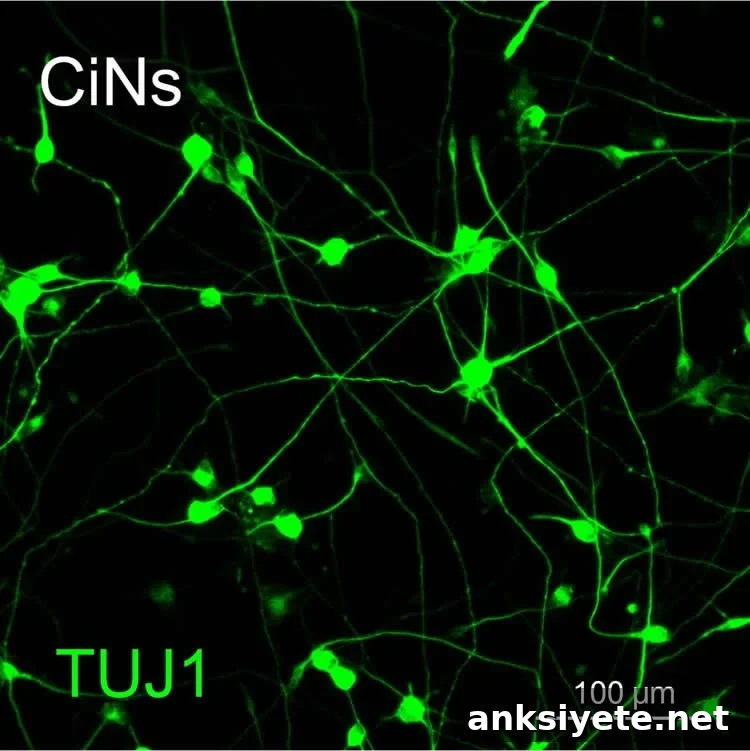
Deng’s team screened many compounds and identified a key inhibitor, I-BET151, which suppresses fibroblast-specific transcriptional programs. They also found that neurogenesis inducers such as ISX9 help activate neuron-specific genes and support maturation. After optimizing induction and maturation steps, the chemically induced mouse neurons showed neuron-specific markers, generated action potentials, and formed functional synapses. The authors report yields of up to >90% TUJ1-positive cells after 16 days of induction in their mouse protocol.
Both groups are now focused on improving efficiency, increasing the robustness of functional maturation, and generating specific neuronal subtypes. Deng notes efforts to produce patient-specific functional neurons and defined subtypes for translational medicine using pure chemical formulas. Jian Zhao adds that similar chemical strategies, with adjusted cocktails, could likely generate different neuronal subtypes and that it remains to be tested whether such chemical induction can be achieved in vivo in organisms with neurological disease or injury.
Funding (Paper 1): Supported by grants from the Chinese Academy of Sciences, the Ministry of Science and Technology, the Shanghai Zhangjiang Stem Cell Research Project, the National Natural Science Foundation of China, and the National Science and Technology Support Program.
Funding (Paper 2): Supported by the National Basic Research Program of China, the National Natural Science Foundation of China, the Ministry of Science and Technology, the Key New Drug Creation and Manufacturing Program, and the Ministry of Education of China.
Source: Joseph Caputo – Cell Press
Image credits: Human image: Gang Pei and Jian Zhao. Mouse image: HongKui Deng.
Original Research: “Small-Molecule-Driven Direct Reprogramming of Mouse Fibroblasts into Functional Neurons” by Xiang Li et al., Cell Stem Cell. Published online June 8, 2015. doi:10.1016/j.stem.2015.06.003
“Direct Conversion of Normal and Alzheimer’s Disease Human Fibroblasts into Neuronal Cells by Small Molecules” by Wenxiang Hu et al., Cell Stem Cell. Published online June 13, 2015. doi:10.1016/j.stem.2015.07.006
Abstract
Small-Molecule-Driven Direct Reprogramming of Mouse Fibroblasts into Functional Neurons
Highlights
- Chemical screening identified a seven-compound cocktail capable of direct reprogramming.
- Functional, mature neurons were generated from fibroblasts using chemicals alone.
- Inhibition of BET family bromodomains (e.g., I-BET151) suppresses the fibroblast program.
- The neurogenesis inducer ISX9 is required to activate neuronal gene expression.
Summary
This study shows that mouse fibroblasts can be directly converted into neurons with a defined mixture of small molecules. Induction produced high yields of TUJ1-positive cells within 16 days, and subsequent maturation yielded cells with neuron-specific expression, action potentials, and synaptic activity. Mechanistically, BET bromodomain inhibition disrupted the fibroblast transcriptional program while ISX9 and related components activated neuronal genes. These results provide proof of principle that somatic cell fates can be altered across lineages without genetic manipulation by concurrently suppressing the original program and inducing an alternative neuronal fate.
Abstract
Direct Conversion of Normal and Alzheimer’s Disease Human Fibroblasts into Neuronal Cells by Small Molecules
Highlights
- Human fibroblasts were converted directly into neuronal cells using a seven-molecule chemical cocktail.
- Electrophysiological characteristics of the resulting human chemical-induced neurons (hciNs) are similar to those derived from iPSCs and transcription-factor-induced neurons.
- hciNs show strong neuronal gene expression and reduced fibroblastic signatures.
- hciNs derived from familial Alzheimer’s disease patient fibroblasts exhibited disease-relevant Aβ abnormalities.
Summary
The human study demonstrates a transgene-free, chemical-only approach to convert human fibroblasts into neurons without an intervening neural progenitor stage. The chemically induced human neurons resemble iPSC-derived and transcription-factor-induced neurons in morphology, gene-expression profiles, and electrophysiological behavior. The method was also used to generate neurons from patients with familial Alzheimer’s disease, illustrating potential applications for disease modeling and future regenerative approaches while highlighting the need for further optimization and validation.