
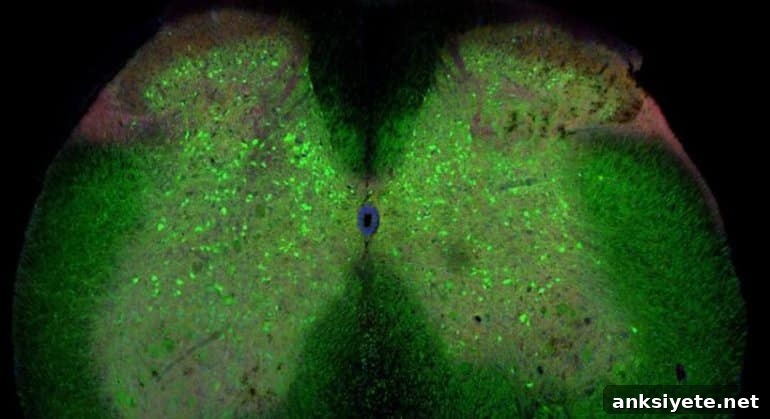
Summary: In mouse models of ALS, inhibitory neurons in the spinal cord lose their synaptic connections onto motor neurons. Although a direct causal link to ALS onset has not been established, researchers propose that the reduction in inhibitory signaling may help explain why motor neurons degenerate in ALS.
Source: University of Copenhagen
Amyotrophic lateral sclerosis (ALS) is a severe neurodegenerative disease in which spinal motor neurons that control muscles and movement progressively die. There are currently no effective treatments that halt or reverse the disease, and life expectancy after diagnosis is typically limited. New knowledge about early disease mechanisms is therefore urgently needed.
Researchers at the University of Copenhagen have gained new insights into early ALS development by studying a well-established mouse model. Their work focuses not only on motor neurons themselves but also on the inhibitory interneuron circuits that regulate motor neuron activity.
“We discovered that inhibitory interneuron networks in the spinal cord progressively lose their connections to motor neurons, particularly affecting the cells that directly control muscle contraction. While we cannot yet say these changes cause ALS, the loss of inhibitory input presents a plausible mechanism that could make motor neurons more vulnerable and eventually contribute to their death,” says Ilary Allodi, Assistant Professor at the Department of Neuroscience and first, co-corresponding author of the study.
Much ALS research has concentrated on motor neurons because their failure leads directly to the clinical symptoms of muscle weakness and paralysis. The University of Copenhagen team deliberately took a circuit-level approach, examining how interneuron activity and connectivity shape motor neuron function.
“Given that interneurons set the tone of motor neuron activity, we wanted to know whether changes in these circuits occur before motor neuron loss. We found that inhibitory connections are lost from motor neurons at an early stage, before overt motor neuron degeneration. This suggests that disrupted inhibition may be a contributing factor to motor neuron vulnerability in ALS,” explains Ole Kiehn, Professor at the Department of Neuroscience and senior, co-corresponding author.
Fast-twitch motor neurons are affected first
In ALS patients, degeneration often begins with motor neurons that innervate fast-twitch muscle fibers, causing loss of coordination and movement speed long before more fundamental functions like breathing are impacted. The mouse model used in this study mirrors that pattern.
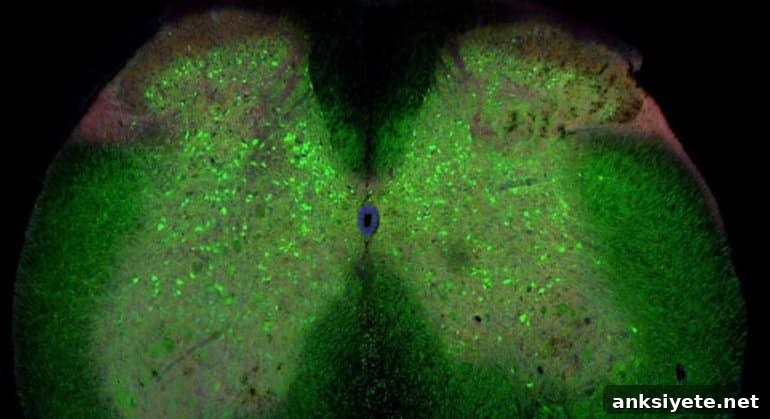
“In our model, inhibitory connections onto fast motor neurons are lost before those onto slow motor neurons. The decline specifically involves a class of inhibitory cells known as V1 interneurons,” says Roser Montañana-Rosell, a PhD student and joint first author of the study.
The loss of V1 interneuron input coincides with a distinct locomotor deficit in the mice. Before obvious symptoms appear, affected animals show reduced walking speed and altered limb coordination—changes that the researchers link to decreased V1-to-motor neuron signaling.
Implications for early intervention
The team emphasizes that human studies are needed to determine whether the same cellular changes occur in patients. Nevertheless, there is no specific reason to expect that comparable mechanisms are absent in humans.
Ilary Allodi notes that understanding the signaling pathways between interneurons and motor neurons could open new avenues for therapy. “By focusing on interneurons, future experiments may be able to enhance inhibitory signaling onto motor neurons and thereby delay or prevent motor neuron degeneration at an early stage,” she says.
About this ALS research news
Source: University of Copenhagen
Contact: Mathias Traczyk – University of Copenhagen
Image: The image is credited to Ilary Allodi, University of Copenhagen
Original Research: Open access. “Locomotor deficits in a mouse model of ALS are paralleled by loss of V1-interneuron connections onto fast motor neurons” by Ilary Allodi, Roser Montañana-Rosell, Raghavendra Selvan, Peter Löw & Ole Kiehn. Nature Communications
Abstract
Locomotor deficits in a mouse model of ALS are paralleled by loss of V1-interneuron connections onto fast motor neurons
ALS is marked by a progressive inability to perform coordinated movements. Motor neurons that supply fast-twitch muscle fibers show selective vulnerability, but the mechanisms behind this differential degeneration and its impact on motor output remain unclear.
This study reveals that fast motor neurons receive stronger inhibitory synaptic input than slow motor neurons, and that disease progression in the SOD1G93A mouse model causes a selective loss of inhibitory synapses on fast motor neurons. V1 inhibitory interneurons display a similar pattern of innervation and synapse loss. From postnatal day 63 onward, a reduction in V1 interneuron numbers is detectable in the SOD1G93A mice.
The degeneration of V1 interneurons precedes motor neuron death and accompanies the emergence of a specific locomotor deficit affecting speed and limb coordination. Silencing V1 spinal interneurons in healthy mice reproduces this locomotor phenotype, while silencing them in SOD1G93A mice after the phenotype appears does not produce additional effects.
Together, these findings identify a potential non-cell-autonomous source of motor neuron vulnerability in ALS and link disease-related changes in locomotor behavior to the loss of inhibitory V1-interneuron input onto fast motor neurons.