
Summary: People who carry the APOE4 gene variant linked to Alzheimer’s disease have oligodendrocytes that mismanage cholesterol, preventing proper delivery of lipids needed to form myelin sheaths. This myelin deficiency may help explain aspects of Alzheimer’s pathology and cognitive decline.
Source: MIT
Carrying one copy of the APOE4 gene raises Alzheimer’s disease risk roughly threefold and two copies raise it about tenfold, yet the cellular mechanisms behind this elevated risk have remained unclear.
A new study led by researchers at MIT, published Nov. 16 in Nature, clarifies how APOE4 affects a specific brain cell type and links that effect to reduced myelination and impaired cognition. The investigators combined analyses of postmortem human brains, lab-grown human brain cells, and genetically engineered mice to trace how APOE4 alters lipid handling in oligodendrocytes—the cells responsible for producing myelin, the fatty insulation that enables fast, reliable neuronal communication.
Using single-nucleus RNA sequencing (snRNAseq), the team compared gene expression across major brain cell types in people with APOE4 versus those with the more common, risk-neutral APOE3. Their data show cell-type-specific disturbances in lipid pathways: while lipid metabolism is broadly affected, the exact pathways disrupted differ by cell type. In oligodendrocytes, APOE4 is associated with increased expression of cholesterol synthesis genes and clear defects in cholesterol transport.
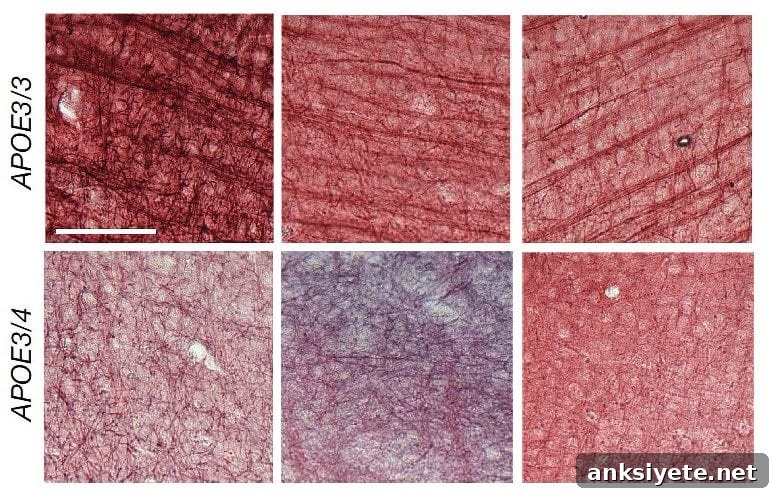
The researchers found that APOE4-carrying oligodendrocytes tend to accumulate cholesterol inside their cell bodies instead of delivering it along their processes to wrap neuronal axons. This defective cholesterol distribution coincides with reduced expression of myelination genes and visibly thinner myelin sheaths in APOE4 brains. Because myelin is essential for efficient neuronal signaling, such deficits could contribute directly to cognitive symptoms seen in Alzheimer’s disease.
Study lead Li-Huei Tsai, director of The Picower Institute for Learning and Memory and the Aging Brain Initiative at MIT, emphasized that the work reveals a coherent picture of lipid dysregulation across cell types while highlighting important differences in the specific lipid pathways affected in each cell type. The findings add to prior work from Tsai’s and collaborators’ labs tying Alzheimer’s to lower expression of oligodendrocyte myelination genes.
Many methods to examine myelination
The study analyzed postmortem brain tissue from participants in longitudinal aging cohorts and generated a snRNAseq dataset covering more than 160,000 nuclei from 11 cell types in prefrontal cortex samples of 32 individuals: 12 with APOE3/3, 12 with APOE3/4, and eight with APOE4/4. Samples were balanced for age, sex, and Alzheimer’s diagnosis where feasible, and the full dataset has been made available by the authors.
Analyses revealed both expected Alzheimer’s signatures and novel, genotype-specific patterns. Oligodendrocytes from APOE4 carriers showed pronounced upregulation of cholesterol synthesis genes together with markers of disrupted cholesterol trafficking. Histological and lipidomic analyses confirmed abnormal cholesterol accumulation inside oligodendrocyte cell bodies and a relative scarcity of cholesterol around axons—consistent with impaired lipid delivery for myelin assembly.
To isolate the effect of APOE genotype, the team generated oligodendrocytes from patient-derived induced pluripotent stem cells engineered to differ only at the APOE locus. APOE4 oligodendrocytes hoarded intracellular cholesterol, displayed signs of endoplasmic reticulum stress linked to lipid overload, and exported less cholesterol to their membranes. When co-cultured with neurons, APOE4 oligodendrocytes produced markedly less myelin compared with APOE3 oligodendrocytes, irrespective of neuronal genotype.
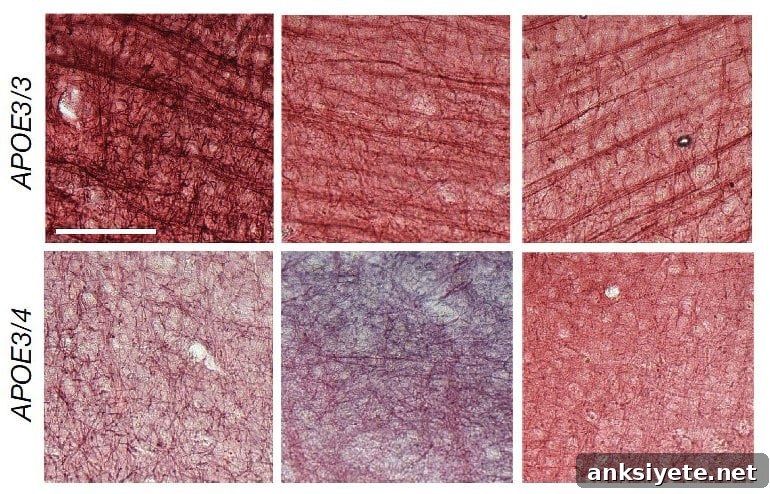
Direct tissue imaging reinforced these findings: myelin sheaths in APOE4 carriers were thinner, including reduced myelination in the corpus callosum that connects the two hemispheres. Mouse models carrying human APOE4 recapitulated the same myelination defects compared with APOE3 mice.
A productive intervention
Seeking a therapeutic angle, the investigators tested compounds that influence cholesterol handling. Statins, which decrease cholesterol synthesis, did not restore oligodendrocyte function. However, cyclodextrin—an agent that facilitates cholesterol transport—reduced intracellular cholesterol accumulation in APOE4 oligodendrocytes and improved their ability to myelinate neurons in culture. In APOE4 mice, cyclodextrin treatment enhanced axonal myelination and produced measurable gains in memory performance on behavioral tests, linking restored lipid distribution and myelination to improved cognition in this model.
Tsai noted that correcting cell-type-specific lipid defects offers a promising strategy to counter APOE4-driven pathology, but emphasized that multiple brain cell types will likely need to be targeted. “We can rescue oligodendrocyte function and myelination in lab and mouse models,” she said, “but effective clinical approaches will also need to address microglia, astrocytes, and vascular contributions to fully combat Alzheimer’s disease.”
The study’s lead authors include Joel Blanchard, Djuna Von Maydell, Leyla Akay, and Jose Davila Velderrain, with senior contributions from Li-Huei Tsai and Manolis Kellis. Additional authors contributed to sequencing, histology, lipidomics, and animal studies across collaborating laboratories.
About this Alzheimer’s disease research news
Author: Press Office
Source: MIT
Contact: Press Office – MIT
Image: The image is credited to Tsai Laboratory/MIT Picower Institute
Original Research: Closed access.
Title: “APOE4 impairs myelination via cholesterol dysregulation in oligodendrocytes” by Li-Huei Tsai et al. Nature
Abstract
APOE4 impairs myelination via cholesterol dysregulation in oligodendrocytes
APOE4 is the strongest genetic risk factor for Alzheimer’s disease, yet its full impact on the human brain has been incompletely characterized. To map APOE4’s effects, the authors performed single-cell transcriptomic profiling of postmortem human brains from APOE4 carriers and non-carriers. APOE4 was associated with widespread, cell-type-specific changes in gene expression, particularly in pathways governing cholesterol homeostasis and transport.
Histological, lipidomic, stem-cell-derived cellular, and targeted-replacement mouse experiments showed aberrant cholesterol deposition within oligodendrocytes and a corresponding reduction in myelination. Pharmacologically improving cholesterol transport increased axonal myelination and enhanced learning and memory in APOE4 mice. Together, these results provide a single-cell atlas of APOE4 transcriptional effects in the aging human brain and establish a mechanistic link between APOE4, cholesterol mislocalization, deficient myelination, and memory impairment, highlighting potential therapeutic strategies for Alzheimer’s disease.