
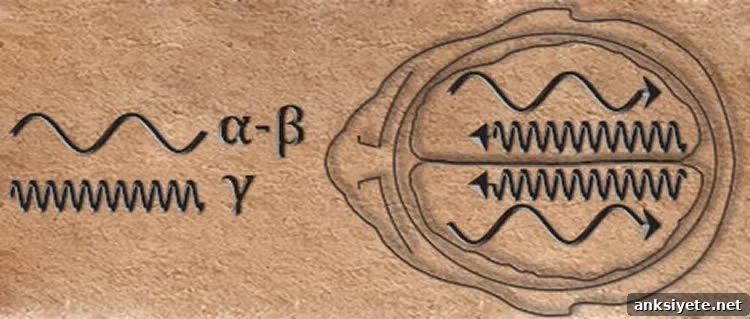
The human brain employs distinct frequency bands to route information between lower and higher cortical areas.
In the visual system, the cortex receives and processes visual input and relays it from lower to higher regions. Information also travels in the reverse direction: higher areas send signals to lower areas to guide perception and attention. How the brain determines which pathway to use has long been unclear. Researchers at the Ernst Strüngmann Institute (ESI) for Neuroscience in Frankfurt, in collaboration with the Max Planck Society, have now shown that human visual cortex uses different frequency channels depending on whether information is being sent bottom-up or top-down. This discovery builds on important prior work in macaque monkeys and could shed light on psychiatric conditions in which these signaling channels become confused.
“Bottom-up” and “top-down” describe complementary processing streams in the brain. Bottom-up communication begins with sensory input—light hitting the retina—and flows upward through successive visual areas. Pascal Fries of the Ernst Strüngmann Institute explains that bottom-up processing continuously conveys incoming sensory data as we observe our environment.
Top-down processing, by contrast, uses prior knowledge, expectations, and current goals to shape perception. It adjusts and prioritizes incoming data, steering attention toward relevant stimuli or suppressing irrelevant information. This top-down influence can act automatically, for instance when a sudden threat captures attention, or deliberately, when we search for an object or follow instructions. Fries notes that many cognitive abilities depend on this feedback control.
Anatomical pathways allowing top-down projections from higher to lower visual areas have been known for some time, but the mechanisms that carry top-down signals remained elusive. Work in macaque monkeys provided a crucial lead. Studies there revealed that bottom-up signals predominantly use the gamma frequency band, around 60 Hz, while top-down signals propagate primarily in the alpha and beta bands, roughly 10–20 Hz. In macaques, rhythmic activity in a lower area can entrain the rhythm of a higher area to send information forward, and conversely feedback is carried in slower alpha-beta oscillations.
Guided by these macaque findings, the researchers searched for the same frequency-specific channels in the human brain. They used magnetoencephalography (MEG), a noninvasive technique that records the magnetic fields produced by neuronal electrical currents with sensors placed around the head. MEG captures fast, oscillatory brain activity, but raw MEG signals reflect a mixture of sources and must be disentangled using advanced signal-processing methods to estimate activity in distinct brain areas.
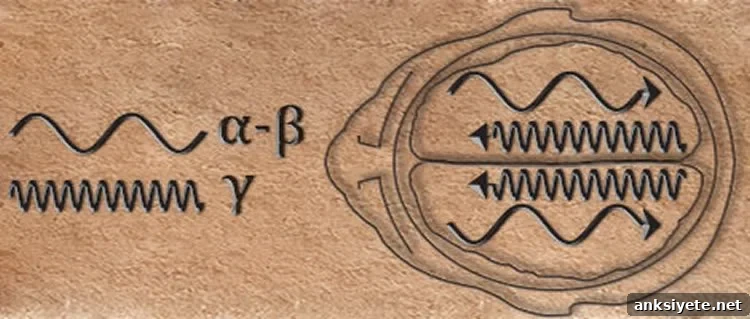
Because macaque and human visual systems are closely related, the macaque results helped interpret the human MEG data. The investigators analyzed directed interactions between visual areas and found the same separation by frequency: feedforward (bottom-up) influences were strongest in the gamma band, while feedback (top-down) influences were dominant in the alpha–beta band. Using these rhythmic interactions, the team established a functional hierarchy among visual regions.
Specifically, the study examined 26 visual areas in the human brain, including regions that are uniquely human. By comparing MEG-derived directed influences with macaque laminar connectivity patterns, the researchers confirmed a consistent hierarchical organization. They further showed that alpha–beta feedback affected ventral and dorsal visual streams differently, highlighting the functional specificity of these frequency channels.
These findings have potential clinical relevance. In several psychiatric disorders, top-down and bottom-up signaling appear to be disrupted or misaligned. For example, evidence suggests that in some patients with schizophrenia, feedback signals do not interact with incoming sensory signals in the usual way. Fries illustrates the problem: whereas a healthy person can see ambiguous sensory input—for instance a cloud that resembles a face—and understand it as an interpretation rather than a literal perception, a person with impaired top-down control might treat that interpretation as though it were a genuine sensory experience. Such misattribution can contribute to hallucinations or false beliefs.
Source: Martha Krumbach – Max Planck Institute
Image Credit: ESI / G. Michalareas
Original Research: Abstract for “Alpha-beta and gamma rhythms subserve feedback and feedforward influences among human visual cortical areas” by Georgios Michalareas, Julien Vezoli, Stan van Pelt, Jan-Mathijs Schoffelen, Henry Kennedy, and Pascal Fries, published in Neuron. doi:10.1016/j.neuron.2015.12.018
Abstract
Alpha-beta and gamma rhythms subserve feedback and feedforward influences among human visual cortical areas
Highlights
• Gamma mediates forward (feedforward) influences among human visual areas
• Alpha–beta rhythms mediate feedback (top-down) influences among human visual areas
• Human inter-areal directed influences align with macaque laminar connectivity patterns
• Rhythmic inter-areal dynamics define a functional hierarchy of 26 human visual areas
• Alpha–beta feedback affects ventral and dorsal visual streams differently
Summary
Primate visual cortex is organized in a hierarchical fashion. Studies in macaques showed that bottom-up and top-down influences are carried by distinct frequency channels by relating directed inter-areal influences to laminar anatomical projections. Because direct laminar anatomical data are not available in human subjects, the authors compared seven homologous macaque and human visual areas by correlating macaque laminar projection patterns with human inter-areal directed influences measured with MEG. They demonstrate that feedforward influences predominate in the gamma band, whereas feedback influences predominate in the alpha–beta band. These rhythmic inter-areal influences establish a functional hierarchy among the examined human visual areas that matches the macaque anatomical hierarchy closely. Extending the analysis yields a hierarchy of 26 human visual areas, including regions unique to humans, and reveals differential alpha–beta effects across ventral and dorsal streams.
“Alpha-beta and gamma rhythms subserve feedback and feedforward influences among human visual cortical areas” by Georgios Michalareas et al., Neuron. Published online January 20, 2016. doi:10.1016/j.neuron.2015.12.018