
Summary: Researchers used a visual search experiment to show that the human visual system can form spatial representations of objects that lie beyond the limits of our immediate visual field.
Source: Tohoku University
Spatial representations of the environment, including areas outside the immediate visual field, are essential for guiding movement through three-dimensional space. Although we typically see only what lies in front of us, the brain appears to hold information about the full surrounding scene. Until now, this idea had not been tested directly with an experiment designed to probe perception around the entire 360° environment.
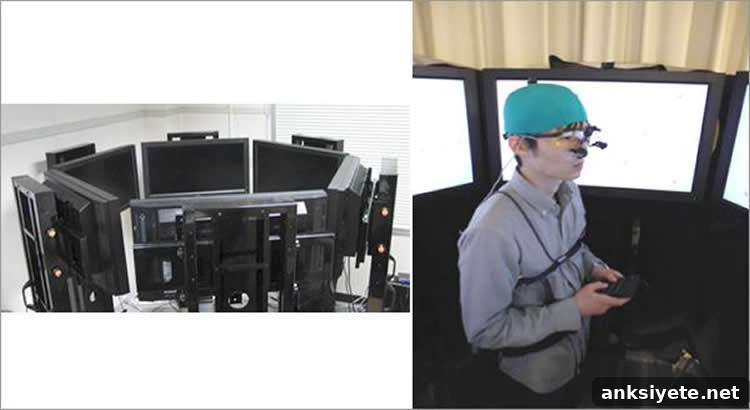
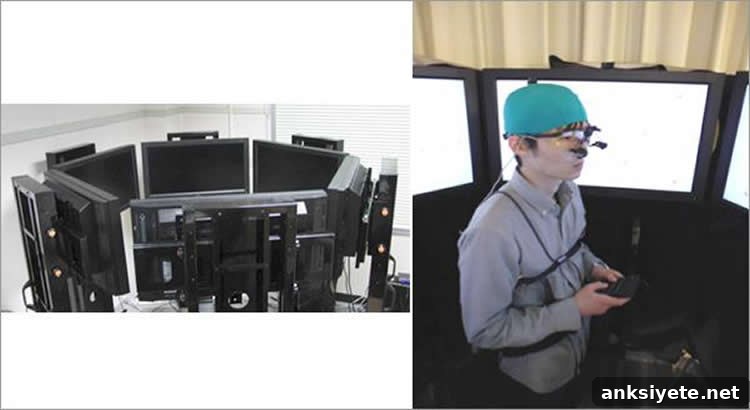
A research team led by Professor Satoshi Shioiri at the Research Institute of Electrical Communication, Tohoku University, carried out a controlled visual search experiment to investigate whether people implicitly learn and retain information about objects located around them—including behind their backs. The investigators built a six-panel display that surrounded each participant, covering the full 360-degree visual environment. On every panel, six letters were presented simultaneously, creating a scene made up of multiple displays placed around the viewer.
Participants were asked to find a specified target letter while the researchers recorded the time taken to locate it. Across repeated trials, the same spatial layouts were presented multiple times. The experiment measured how quickly participants found the target with repeated exposure to those surrounding layouts, even when they were not consciously aware that the configurations had been repeated. The researchers observed a robust decrease in search time for repeated spatial arrangements—a phenomenon known as the contextual cueing effect.
Crucially, the learning effect appeared not only in the time needed to find the target once the viewer had reached the correct display, but also in the time required to move attention or gaze to the display that contained the target. This demonstrates that the implicit learning encompassed spatial relationships across multiple displays, rather than being restricted to local search within a single panel. The effect persisted even when the target display and the repeated layout were separated by as much as 120°, indicating that the learned representation covers visual information far beyond the immediate frontal field of view.
The results provide compelling evidence that the brain forms and uses a wider, more global representation of the environment: a 360-degree map of surrounding space that can guide behavior without conscious awareness. In practical terms, this internal representation would allow a person to “look back” mentally or direct action toward unseen areas without physically turning, which supports smooth and efficient movement through complex environments.
This study represents the first direct, experimental demonstration that spatial learning and contextual cueing can operate across the full surround of the viewer. By linking perceptual learning with the spatial demands of movement, the research takes an important step toward understanding how the brain integrates visual information from multiple viewpoints to construct a coherent spatial model of the environment.
Research group: Satoshi Shioiri and colleagues, Research Institute of Electrical Communication, Tohoku University.
Publisher: Organized content originally reported by NeuroscienceNews.
Image Source: Image credited to Satoshi Shioiri.
Original research: Open-access article titled “Spatial representations of the viewer’s surroundings” by Satoshi Shioiri, Masayuki Kobayashi, Kazumichi Matsumiya & Ichiro Kuriki, published in Scientific Reports (May 2018). DOI: 10.1038/s41598-018-25433-5.
MLA: Tohoku University. “Eyes in the Back of the Head.” NeuroscienceNews, 10 May 2018.
APA: Tohoku University (2018, May 10). Eyes in the Back of the Head. NeuroscienceNews.
Chicago: Tohoku University. “Eyes in the Back of the Head.” NeuroscienceNews. Accessed May 10, 2018.
Abstract
Spatial representations of the viewer’s surroundings
Accurate spatial representation of surroundings, including regions outside the current visual field, is essential for navigating three-dimensional environments. To build such representations, the brain must integrate visual inputs from different viewpoints that together cover the full 360° of visual angles. This study reports a learning effect for spatial layouts presented on six displays that surround the viewer: repeated use of the same surrounding layout produced faster visual search times (the contextual cueing effect). The learning effect was evident both in the time taken to reach the display containing the target and in the time to find the target within that display, indicating implicit learning of spatial configurations across displays. Moreover, because learning transferred between layouts and targets presented as far as 120° apart, the effect appears to rely on representations that include visual information well outside the immediate frontal field of view.