
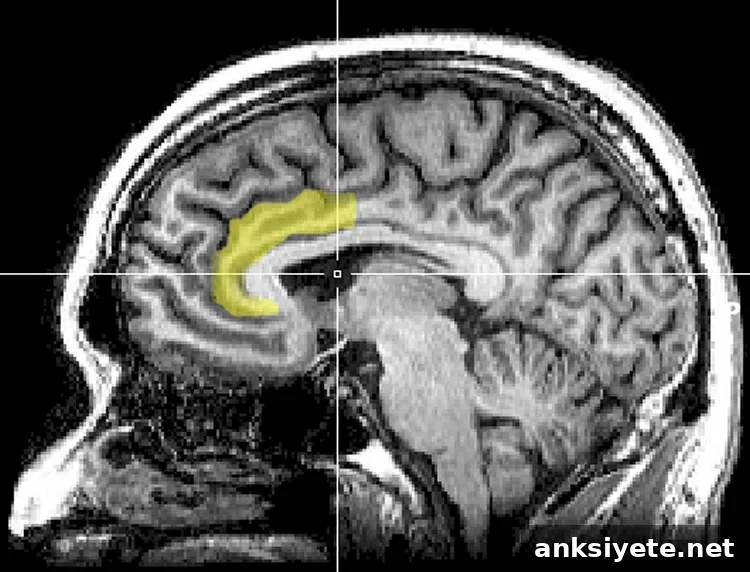
How our brains react to other people’s good fortune appears linked to self-reported empathy, new research led by UCL finds.
Published in the Journal of Neuroscience and supported by the Medical Research Council, the study identifies the anterior cingulate cortex (ACC) as a brain region that is particularly sensitive to rewards experienced by others. Crucially, the pattern of ACC activity differs depending on an individual’s level of trait empathy.
When volunteers rated themselves as highly empathetic, their ACC showed a selective response only when someone else was likely to receive a reward. By contrast, individuals who reported lower empathy showed ACC activity both for others’ expected rewards and when they themselves were unlikely to win. These distinctions in neural specialization may help explain differences in social behaviour and empathy in conditions such as psychopathy and autism.
To investigate how the brain encodes vicarious reward prediction, researchers scanned the brains of 30 male participants aged 19–32 using functional magnetic resonance imaging (fMRI). During scanning, volunteers viewed visual cues that signalled either a high or low probability of a monetary reward for themselves or for another person. Participants also completed a questionnaire measuring empathy in the week before the scan, providing a trait-level measure to relate to brain activity.
Lead author Patricia Lockwood (UCL Psychology & Language Sciences) explained: “We examined whether people who report higher empathy show a brain response that is particularly tuned to other people’s positive outcomes. We wanted to know if the ACC distinguishes between rewards for others and rewards for oneself and whether that distinction varies with empathy.”
Across the sample, the ACC was reliably activated when another person was very likely to win money. However, the degree of specialization—how exclusively the ACC signalled others’ rewards rather than self-related outcomes—varied with empathy scores.
Participants whose ACC activation was most specialized for others showed a response only when the other person was likely to receive a reward; these individuals scored high on the empathy questionnaire. In contrast, participants with less specialized ACC responses also displayed activation when they themselves faced low chances of winning; these individuals reported lower empathy.
Professor Essi Viding, senior author of the study, said: “It was exciting to observe that individual differences in empathy change how specialized the ACC is for processing other people’s rewards. Future work should explore whether this specialization relates to other personality traits, such as competitiveness, and how it influences real-world social interactions.”
Understanding how the ACC encodes vicarious reward predictions could offer new insights into disorders of social behaviour. If the ACC’s specialization for others’ rewards is reduced or altered in conditions like psychopathy or autism, this might help explain difficulties with empathy or with feeling genuinely happy for others’ success.
Funding: Medical Research Council (MRC).
Source: Margaret-Anne Orgill – UCL
Image source: Geoff B Hall (image credited to the author and used for illustrative purposes).
Original research: Full open access article “Encoding of Vicarious Reward Prediction in Anterior Cingulate Cortex and Relationship with Trait Empathy” by Patricia L. Lockwood, Matthew A.J. Apps, Jonathan P. Roiser, and Essi Viding, Journal of Neuroscience. Published online October 7, 2015. doi:10.1523/JNEUROSCI.1703-15.2015
Abstract (summary)
The study tested whether a subregion of the anterior cingulate cortex in the gyrus (ACCg) is specialized for predicting rewards received by others and whether that specialization varies with trait empathy. Using fMRI, researchers measured brain responses to cues predicting high or low reward probability for either the participant or another person. Results showed that the ACCg consistently signalled the likelihood of rewards delivered to others. Importantly, ACCg responses covaried with trait emotion contagion—a core component of empathy. In individuals high in emotion contagion, ACCg activity was selective for others’ predicted rewards; in those low in emotion contagion, the region also responded to information about the participant’s own rewards. These findings demonstrate that the ACCg encodes probabilistic predictions about others’ rewards and that individual differences in ACCg specialization are linked to trait empathy.
Significance: The ability to predict when others will receive rewards supports successful social interactions—cooperation, competition, and empathic responses. This study reveals a neural substrate for vicarious reward prediction and shows that its degree of specialization varies with empathy, offering a potential neural mechanism relevant to social disorders such as psychopathy and autism.