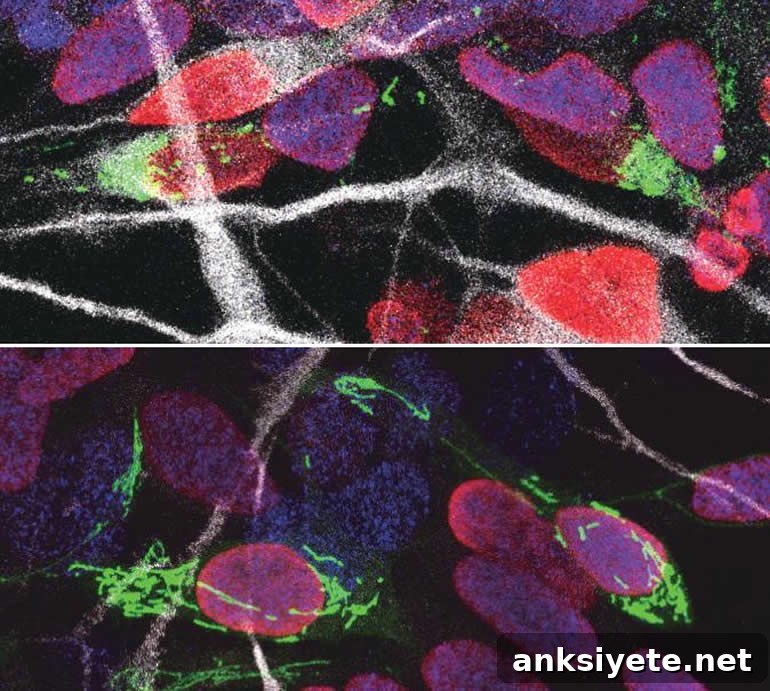
Summary: Mitochondria control when and how neural stem cells become neurons during brain development. This discovery helps explain aspects of human brain evolution and clarifies how mitochondrial defects can contribute to neurodevelopmental disorders.
Source: VIB
Mitochondria, the cell’s energy-producing organelles, do more than supply fuel to brain cells. In a new study published in Science, a Belgian research team led by Pierre Vanderhaeghen (VIB-KU Leuven, ULB) shows that mitochondrial behavior directly influences a critical step of brain development: the decision of neural stem cells to become neurons. The team found that the balance between mitochondrial fission and fusion drives this fate choice during a narrowly timed window after cell division—one that lasts twice as long in human cells as in mouse cells. These results reveal an unexpected developmental role for mitochondria and may shed light on how mitochondrial dysfunction contributes to neurodevelopmental disease and how human brains grew larger during evolution.
The human brain contains billions of diverse neurons, each produced during development when neural stem cells stop self-renewing and commit to specific neuronal identities. This process, called neurogenesis, is tightly controlled to build the brain’s complex architecture. Small changes in how neural stem cells time and execute neuron production can have large effects on brain size and complexity, which makes understanding the mechanisms that control neurogenesis a key question in developmental neuroscience.
To investigate these mechanisms, Vanderhaeghen and colleagues focused on mitochondria. Although primarily known for generating cellular energy, mitochondria are dynamic organelles that continually undergo fusion (joining) and fission (splitting). Previous work had hinted that these dynamics are linked to cell fate decisions in several stem cell systems, but whether and how mitochondrial remodeling contributes to neuronal fate commitment in the developing cortex was unclear.
Fission versus fusion directs cell fate
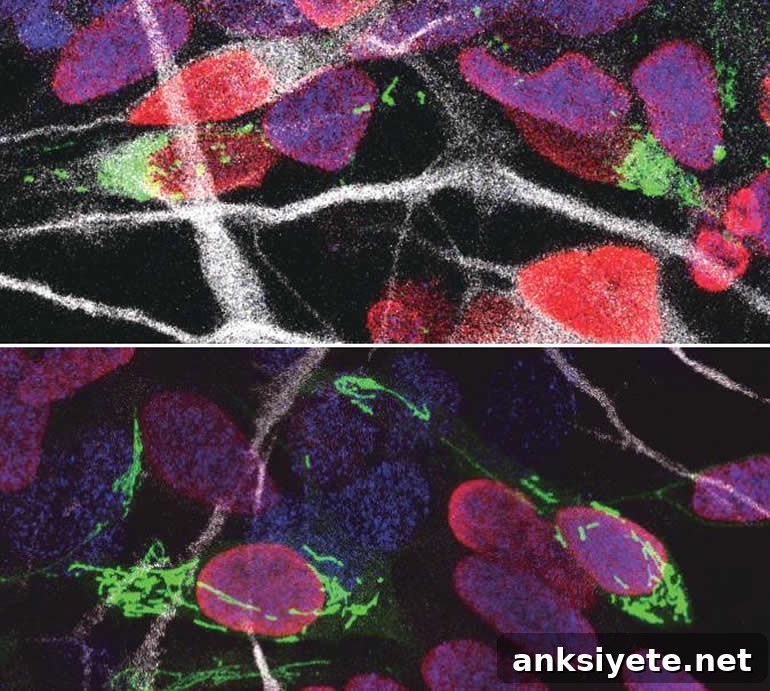
Using a new imaging method developed by postdoctoral researcher Ryohei Iwata, the team tracked mitochondrial behavior in neural stem cells at the moment they divide and in their immediate daughter cells. They observed a clear pattern: daughter cells that will continue to self-renew display mitochondrial fusion, producing elongated, interconnected mitochondrial networks; by contrast, daughter cells destined to become neurons show increased mitochondrial fission, resulting in fragmented mitochondria.
The connection between mitochondrial shape and fate was not merely correlative. Manipulating mitochondrial dynamics altered cell outcomes: promoting fission biased daughter cells toward neuronal differentiation, while inducing fusion after mitosis redirected cells back toward self-renewal. These experimental results indicate that mitochondrial remodeling after division can causally influence whether a neural progenitor commits to a neuronal fate or remains a progenitor.
A restricted postmitotic time window that differs between species
Importantly, the influence of mitochondrial dynamics is confined to a restricted postmitotic period immediately after cell division. Pierre Casimir, a PhD student in the lab, emphasizes that this period of fate plasticity is limited in duration. Strikingly, the researchers found that the window during which mitochondrial state can redirect fate is about twice as long in human cortical progenitors compared with mouse progenitors.
This species difference could help explain why human neural progenitors exhibit greater self-renewal capacity and produce a larger number of neurons over development, contributing to the expanded size and complexity of the human cortex. The findings suggest a plausible mechanistic link between an ancient organelle’s dynamics and the evolutionary expansion of human brain size and cognitive abilities.
Implications for disease and therapeutic approaches
Beyond evolutionary biology, the study has implications for understanding neurodevelopmental disorders. Many inherited mitochondrial diseases affect brain development, and these results indicate that some consequences may stem from disrupted mitochondrial remodeling and the resulting misregulation of neural stem cell fate. The identification of a postmitotic period of fate plasticity also has potential relevance for cell reprogramming strategies that aim to convert non-neuronal cells into neurons for research or therapeutic applications, since interventions targeting mitochondrial dynamics may influence the efficiency and outcome of such conversions.
Study information and acknowledgments
This research was led by Pierre Vanderhaeghen at VIB-KU Leuven and ULB, with key experimental work from Ryohei Iwata and contributions from other lab members including Pierre Casimir. The original work appears in Science under the title “Mitochondrial dynamics in postmitotic cells regulate neurogenesis.” The study combined live imaging and experimental manipulation of mitochondrial fission and fusion in both mouse and human cortical progenitors to demonstrate a causal role for mitochondrial remodeling in cell fate decisions.
Source:
VIB
Contacts:
Liesbeth Aerts – VIB
Image credit:
VIB – Ryohei Iwata.
Abstract
Mitochondrial dynamics in postmitotic cells regulate neurogenesis
The conversion of neural stem cells into neurons is associated with organelle remodeling, yet the causal relationship between organelle dynamics and fate change has been unclear. This study examined mitochondrial dynamics during mouse and human cortical neurogenesis and tested their functional role. Shortly after cortical stem cells divide, daughter cells that will self-renew undergo mitochondrial fusion, while daughter cells that maintain high levels of mitochondrial fission become neurons. Promoting mitochondrial fission encourages neuronal fate, whereas inducing fusion after mitosis redirects daughters toward self-renewal. These effects occur within a restricted postmitotic time window that is approximately twice as long in human cells, consistent with their greater self-renewal capacity. The results reveal a postmitotic period of fate plasticity during which mitochondrial dynamics are tightly linked to cell fate.