
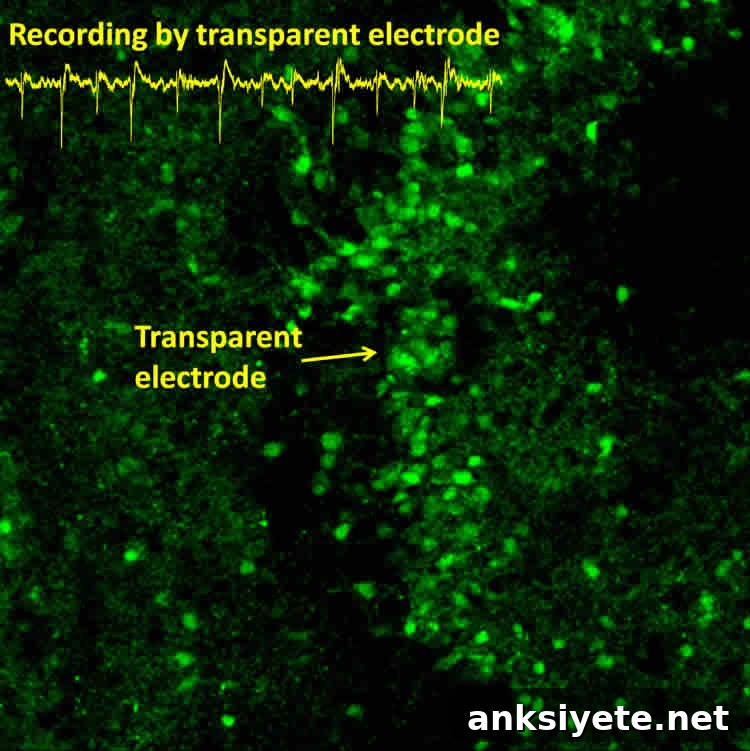
Researchers from the Perelman School of Medicine and the School of Engineering at the University of Pennsylvania, together with collaborators at The Children’s Hospital of Philadelphia (CHOP), have developed a new class of transparent graphene microelectrodes that overcome a key limitation in studying brain circuitry.
Transparent graphene microelectrodes for simultaneous imaging and electrophysiology
Understanding how neural circuits operate in epilepsy and other neurological disorders requires both high-resolution optical imaging and precise electrical recordings. Traditional metallic microelectrodes, however, are opaque and cast shadows that obscure the underlying tissue, forcing researchers to choose between clear optical views or accurate electrophysiological signals. The new approach uses a single-atom-thick layer of graphene to produce fully transparent microelectrodes that enable simultaneous high-resolution neuroimaging and electrophysiological recording across the same brain region.
The work, led by the Center for NeuroEngineering and Therapeutics (CNT) under senior author Brian Litt, PhD, was reported in Nature Communications. Co-first authors Duygu Kuzum, PhD, and Hajime Takano, PhD, describe a neuroelectrode platform built from graphene that combines the spatial precision of calcium imaging with the temporal fidelity of electrophysiology. This simultaneous capability makes it possible to map electrical events to individual cells and local circuits in real time.
Graphene offers critical advantages beyond transparency: it resists corrosion that commonly affects metal electrodes in biological environments, and it has intrinsically low electrical noise, which improves signal-to-noise ratios in neural recordings. Unlike indium tin oxide, an alternative transparent conductor that is brittle and expensive, graphene is flexible and can conform closely to neural tissue. That flexibility enables thin, soft electrode arrays that minimize tissue disruption while maintaining optical clarity.
In experiments on rat hippocampal slices, the team performed calcium imaging using both confocal and two-photon microscopy while recording electrical signals through the graphene electrodes. The combined data revealed temporal details of seizure and seizure-like events at the level of single cells and microcircuits. Though the published work used single-electrode configurations, the fabrication approach can be scaled to larger arrays to cover broader cortical or hippocampal regions for more extensive circuit mapping.
Beyond neuroscience research, the transparent graphene microelectrodes have potential applications wherever precise electrical recording is required, including cardiac pacemakers or peripheral nerve stimulators. Graphene’s nonmagnetic properties also make these probes compatible with MRI, enabling artifact-free imaging that is not possible with many metallic implants. Additionally, graphene’s anti-corrosive behavior may extend the functional lifespan of implanted devices by reducing deleterious electrochemical reactions at the tissue interface.
The project reflects an interdisciplinary collaboration across CNT, Penn’s departments of Neuroscience, Pediatrics, and Materials Science, and CHOP’s Division of Neurology. Ertugrul Cubukcu’s lab in Materials Science and Engineering contributed graphene processing and materials characterization, while Douglas Coulter’s lab at CHOP led the calcium imaging and two-photon microscopy experiments with Hajime Takano. Additional in vivo electrophysiology and sensory stimulation studies were carried out in collaboration with laboratories led by Marc Dichter, Halvor Juul, Timothy Lucas, and colleagues including Julius de Vries and Andrew Richardson.
As the technology matures and larger, denser arrays are developed, the team anticipates new insights into how normal neural circuits become dysregulated in epilepsy and other disorders. The combination of spatially resolved optical data and millisecond-scale electrical recordings opens the possibility of identifying waveform markers tied to specific circuits, tracking these features across space and time, and testing how targeted interventions affect circuit dynamics.
The work was supported by grants from the National Institutes of Health (R01-NS063039, 1U24 NS 63930-01A1, R01-NS038572, RO1-NS082046), Citizens United for Research in Epilepsy (CURE) through the Julie’s Hope Award, and the Mirowski Family Foundation.
Contact: Karen Kreeger – University of Pennsylvania
Source: University of Pennsylvania press release
Image Source: Images credited to Hajime Takano, Duygu Kuzum, and Euijae Shim and adapted from the University of Pennsylvania press release
Original Research: “Transparent and flexible low noise graphene electrodes for simultaneous electrophysiology and neuroimaging” by Duygu Kuzum et al., published in Nature Communications (published online October 20, 2014).