
Brain networks that manage internal and external tasks mature more slowly in ADHD
Analysis of brain scans from more than 750 children and adolescents reveals a consistent difference in brain network development between those with attention-deficit/hyperactivity disorder (ADHD) and their peers without the condition. The study finds that children and teens with ADHD show delayed maturation of connectivity both within and between large-scale brain networks that support internally directed thought and externally directed attention.
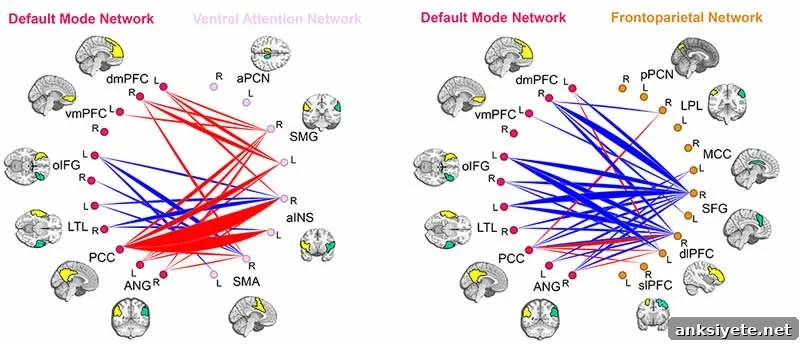
Using advanced connectomic analyses of resting-state functional magnetic resonance imaging (fMRI) data, the researchers detected weaker or lagged development of connections inside the default mode network (DMN)—the network associated with internally focused processes such as daydreaming—and between the DMN and task-positive networks (TPNs) that support externally focused attention and goal-directed behavior. These maturational delays help explain common ADHD symptoms such as distractibility and difficulty sustaining focus.
The study examined fMRI scans from 275 young people diagnosed with ADHD and 481 comparison participants without ADHD. Resting-state fMRI measures spontaneous brain activity when a person is not performing a specific task, allowing researchers to assess how different functional networks are connected and how those connections change with age.
The investigators focused on large-scale intrinsic networks that mature gradually from childhood through young adulthood. They found that maturation of connectivity in the DMN was delayed in participants with ADHD. In addition, connections between the DMN and two externally oriented networks—the frontoparietal network and the ventral attention network—also showed delayed development. The lagged connections with these task-related networks were concentrated in specific brain regions rather than being uniformly distributed.
These findings align with other structural and functional studies of ADHD that have reported alterations in regions belonging to the DMN and task-positive networks. By mapping developmental trajectories of inter-network connectivity, this work adds a developmental, connectomic perspective that helps link brain network maturation to behavioral symptoms.
Understanding how these networks mature over time may also clarify why ADHD follows different courses across individuals: some children show symptom remission as they grow older, while others continue to meet criteria for ADHD into adulthood. Future longitudinal research tracking network maturation could reveal neural signatures that predict persistence or remission of symptoms.
Lead author Chandra Sripada, M.D., Ph.D., and colleagues at the University of Michigan Medical School used publicly shared fMRI datasets and high-performance computing to carry out the connectomic analysis. Sripada emphasizes that open data and collaboration were essential to this work, enabling the large-scale comparisons required to detect developmental lags in network architecture.
Connectomics, the study of large-scale patterns of connectivity among thousands of brain nodes, requires powerful computational tools and extensive datasets. By examining whole-network communication patterns rather than isolated regional pairs, this approach can reveal systems-level developmental differences that relate directly to cognition and behavior.
Sripada and his team view this study as a coarse-grained mapping that now opens the door to finer-grained investigations. The next steps include isolating individual network components and specific connection patterns that most strongly differentiate ADHD from typical development. Those more detailed signatures could eventually form the basis of a diagnostic neuromarker—an objective, brain-based indicator that might aid diagnosis and track treatment response.
Connectomic methods could also be applied to other disorders characterized by atypical brain network maturation. For example, evidence suggests autism may involve accelerated or altered network development in some systems, while schizophrenia and mood disorders have been linked to disrupted connectivity. Expanding shared fMRI datasets across these conditions will strengthen the ability of connectomics to uncover disorder-specific and transdiagnostic network signatures.
Ongoing studies: To move toward a neuromarker for ADHD, the research team has begun follow-up studies enrolling children and adults with and without ADHD. These studies collect new resting-state fMRI data and clinical measures to track how network maturation relates to symptoms and treatment response. fMRI scans do not expose participants to ionizing radiation.
Study contributors and funding: In addition to Chandra Sripada, the study’s authors include computer and psychiatry specialists Daniel Kessler and Mike Angstadt. The research was supported by National Institutes of Health funding, institutional pilot grants, and private foundation support. The analysis used fMRI scans compiled from large public repositories.
Originally submitted by Kara Gavin and written by Kara Gavin for the University of Michigan press release. The peer-reviewed study is titled “Lag in maturation of the brain’s intrinsic functional architecture in attention-deficit/hyperactivity disorder” by Chandra S. Sripada, Daniel Kessler, and Mike Angstadt, published in the Proceedings of the National Academy of Sciences.