
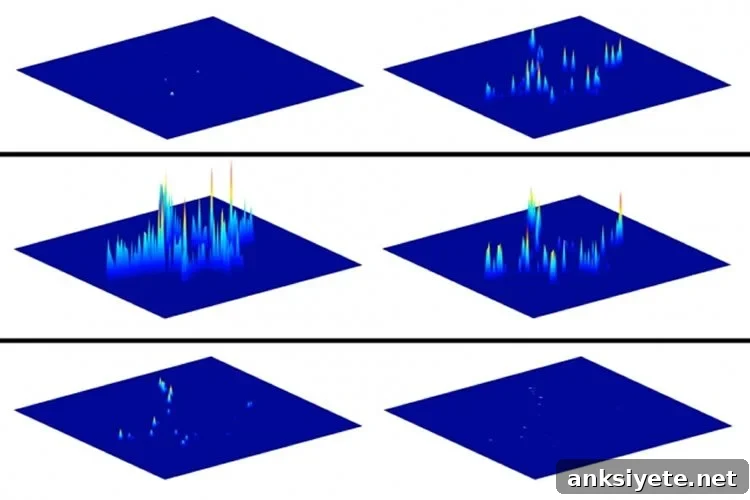
Summary: New nanosensors that detect dopamine release from single cells could give researchers clearer insight into how dopamine shapes brain activity.
Source: MIT.
New technology may help neuroscientists map how dopamine influences brain circuits
Researchers at MIT have created an extremely sensitive detector capable of tracking dopamine secretion from individual neurons. Dopamine is a key neurotransmitter involved in reward-motivated behavior, learning, and memory, and this new tool lets scientists observe its release and spread with exceptional spatial and temporal resolution.
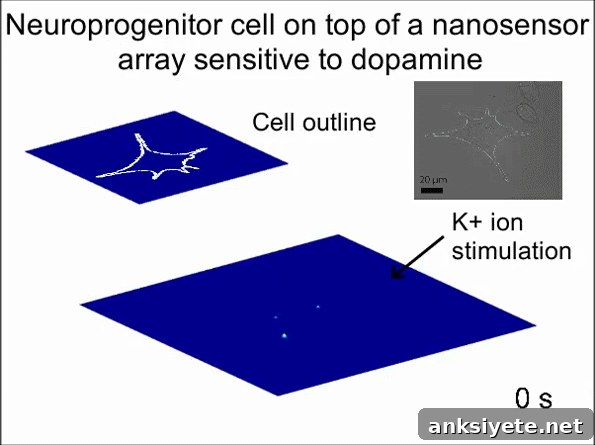
The team built arrays containing more than 20,000 tiny optical sensors that respond when dopamine binds to them. Placing a single cell on one of these nanosensor arrays allows real-time visualization of where and when dopamine is released. This level of detail has been difficult to achieve with traditional methods, such as microelectrodes, which can only position a limited number of sensors near a cell.
“Now, in real time, and with good spatial resolution, we can see exactly where dopamine is being released,” says Michael Strano, the Carbon P. Dubbs Professor of Chemical Engineering and senior author on the study published in the Proceedings of the National Academy of Sciences. Using the arrays, the researchers have already discovered surprising patterns of release in neural progenitor cells that were not visible with previous techniques.
How the nanosensors work
The sensors are based on carbon nanotubes—hollow, nanometer-thick cylinders of carbon that fluoresce when illuminated by a laser. By wrapping these nanotubes with specific DNA sequences or proteins, the surface can be tuned to interact selectively with particular molecules. In this work the researchers coated the nanotubes with a DNA sequence that increases fluorescence in the presence of dopamine. When dopamine molecules bind to the nanotube coating, the signal brightens and indicates the location of release.
Because the team deposited tens of thousands of these coated nanotubes on a glass slide, the resulting array acts like a high-resolution optical grid that reports any dopamine secreted by a cell placed on it. This approach provides both high sensitivity and a dense spatial map of dopamine concentration as it changes over time.
Observing dopamine diffusion and release sites
Dopamine is unusual among neurotransmitters because, in addition to acting across synapses, it can diffuse away from the release site and affect neighboring neurons more broadly. Mapping that diffusion and identifying exactly where dopamine is released on the cell surface are essential steps toward understanding how dopamine creates both local and more widespread effects in neural tissue.
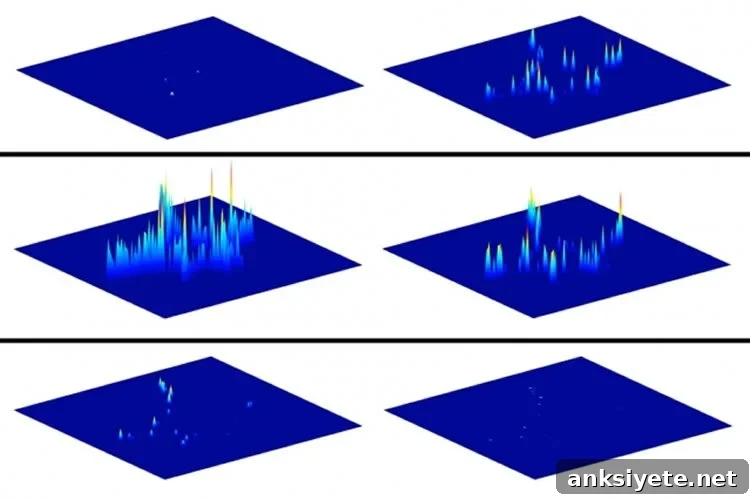
To investigate release locations, the researchers placed individual neural progenitor cells, known as PC-12 cells, onto the nanosensor arrays. PC-12 cells adopt a neuron-like morphology with multiple protrusions that resemble developing axons. After triggering dopamine release, the array revealed which sensors brightened immediately and which lit up later as dopamine diffused outward. Those time-resolved patterns allowed the team to trace the trajectories and spread of dopamine around each cell.
Contrary to expectations that dopamine release would be concentrated at the tips of cellular protrusions—potential synaptic sites—the array data showed that substantial release often came from the sides of those extensions. “We have falsified the notion that dopamine should only be released at these regions that will eventually become the synapses,” Strano notes. This counterintuitive finding highlights the advantage of a dense nanosensor array for resolving spatial patterns of neurotransmitter release.
The measurements also showed that much of the released dopamine travels away from the cell along protrusions that extend in opposite directions, demonstrating directed diffusion even when release originates from lateral regions of the projections. These observations raise new questions about how release geometry shapes signaling and how multiple nearby cells might influence each other through extracellular dopamine.
Future directions
These nanosensor arrays open several avenues for further research. Scientists can now ask how the direction of synaptic input affects where and when a neuron releases dopamine, how neighboring cells alter each other’s extracellular dopamine profiles, and how disease or drugs influence the spatial dynamics of dopamine signaling. The technology could also be adapted to detect other neurotransmitters by modifying the nanotube coatings, enabling comparative studies of multiple signaling molecules at high spatial resolution.
Funding and acknowledgments
The work was funded by the National Science Foundation, the National Institutes of Health, a University of Illinois Center for the Physics of Living Cells Postdoctoral Fellowship, the German Research Foundation, and a Liebig Fellowship. The study’s lead author is Sebastian Kruss, formerly a postdoc at MIT and now at Göttingen University. Coauthors include Daniel Salem, Barbara Lima, Edward Boyden, Lela Vukovic, and Emma Vander Ende.
Publication
The research appears in the Proceedings of the National Academy of Sciences (PNAS).