
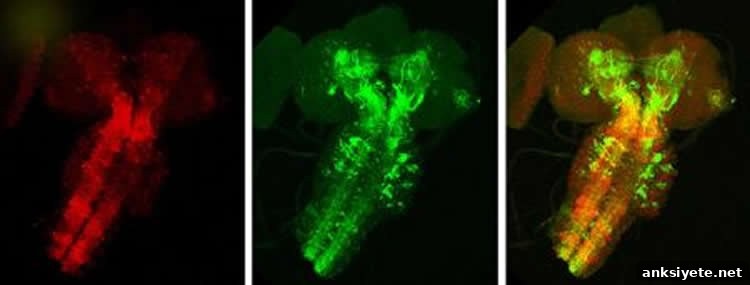
Summary: Scientists at Caltech have created a new method to visualize direct connections between individual cells in the fly brain.
Source: CalTech.
Researchers at Caltech have devised a genetic system that reveals which individual cells in the fruit fly brain make direct contact with one another. The technique offers a practical route toward neuron-by-neuron “wiring diagrams” for flies and other animals, a resource that could clarify how neural circuits are organized and how miscommunication leads to disease.
“To understand how the brain functions, we need to know how neurons are wired together,” says Carlos Lois, research professor in the Division of Biology and Biological Engineering at Caltech and the lead investigator of the study, published in the November issue of the journal Development. “It is similar to diagnosing how a computer works by inspecting the connections among its transistors.”
Animals depend on many specialized cell types that exchange signals to coordinate behavior and physiology. Neurons, for example, signal to muscle cells to generate movement. When communication breaks down—such as during cancer progression—cells may ignore inhibitory cues from their neighbors and proliferate or migrate uncontrollably. Mapping physical contacts between cells is therefore a fundamental step toward understanding normal physiology and disease.
In this study, Lois and colleagues engineered a synthetic genetic labeling system in the fruit fly Drosophila melanogaster that marks which cells are in direct contact. Although the initial implementation targets the nervous system, the same approach can be adapted to monitor cell networks across other organs.
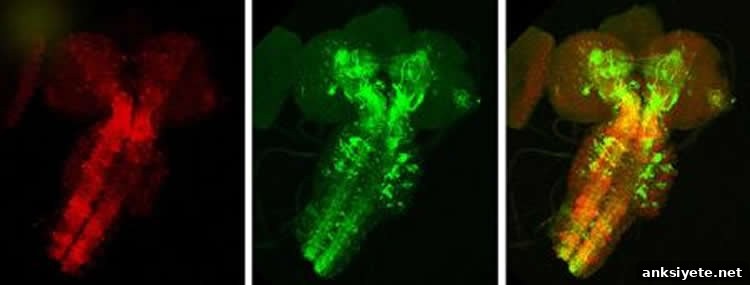
The method separates cells into two functional groups: emitters and receivers. Engineered emitter cells display a ligand and a red fluorescent marker. Any adjacent cell that receives the ligand is triggered to express a green fluorescent protein, marking it as a receiver. By imaging the red and green signals under the microscope and overlaying the images, researchers can directly visualize which cells touch each other and build stepwise maps of connectivity.
“Think of it like exploring social links one degree at a time. We begin with a defined emitter population to identify their immediate contacts. Then we can switch to those contacted cells as new emitters to trace further connections,” Lois explains. This iterative tracing allows construction of local wiring patterns that can be expanded to larger networks.
Technically, the system relies on genetic manipulation. Selected emitter neurons or glial cells are programmed to express two components: a red fluorescent protein to mark their position, and a membrane-bound ligand that can activate an engineered receptor on neighboring cells. All cells in the animal are genetically capable of acting as receivers; they carry a dormant green fluorescent reporter that is turned on only when they encounter the ligand. Thus, contact with red ligand-producing cells causes the neighboring cells to fluoresce green, creating a visible map of direct cell-cell contacts.
Beyond simple mapping, the platform can be combined with tools that alter cell behavior to investigate function. By changing which cells express the ligand or by modifying their connectivity, researchers can test how rewiring specific neurons affects circuit output and behavior. “Just as we learn how a circuit’s function changes by reconfiguring transistors, we can probe neural function by altering cellular interactions and observing behavioral consequences,” says Lois.
The authors highlight potential applications beyond basic neuroscience. For example, the system could trace the physical paths cancer cells take when leaving a tumor and invading other tissues, or identify specific cell types that interact with tumor cells during metastasis.
Lois and colleagues envision extending this approach to generate comprehensive wiring diagrams at the single-neuron level in flies and eventually in mice. Although producing full neuron-to-neuron maps in larger brains will be technically challenging and time-consuming, these detailed connectivity maps would provide critical insight into how complex brains are assembled and how disrupted communication contributes to disease.
Source: Whitney Clavin – CalTech
Image source: Lois Laboratory, Caltech.
Original research: Abstract for “Monitoring cell-cell contacts in vivo in transgenic animals” by Ting-Hao Huang, Tarciso Velho, and Carlos Lois in Development. Published online November 2016 doi:10.1242/dev.142406
CalTech. “The Wiring of Fly Brains: Mapping Cell-to-Cell Connections.” NeuroscienceNews. 2 November 2016.
Abstract
Monitoring cell-cell contacts in vivo in transgenic animals
The authors developed a synthetic genetic system based on ligand-induced intramembrane proteolysis to monitor cell-cell contacts in living animals. When a ligand on one cell interacts with its engineered receptor on a neighboring cell, intramembrane proteolysis cleaves the receptor’s transmembrane domain and releases a protein fragment that activates transcription in the contacted cell. The system enables regulated gene expression between interacting cells both in vitro and in vivo in transgenic Drosophila. Using this approach, the researchers detected interactions between neurons and glia within the Drosophila nervous system. They also showed that expressing the ligand in a subset of neurons with restricted brain localization induces transcriptional activation in a corresponding subset of glial cells that contact those neurons. This tool can be used to monitor cell-cell interactions in animals and to genetically manipulate cells that engage in direct contact.
Study: “Monitoring cell-cell contacts in vivo in transgenic animals” by Ting-Hao Huang, Tarciso Velho, and Carlos Lois. Development. Published online November 2016. doi:10.1242/dev.142406