
Summary: Mice carrying a human Scn1a gene variant linked to Dravet syndrome developed spontaneous seizures, showed disturbed breathing patterns, and died prematurely, providing new insights into sudden unexpected death in epilepsy (SUDEP).
Source: University of Connecticut
Researchers at the University of Connecticut have identified a potential genetic link between seizures and fatal respiratory failure in epilepsy, reporting their findings in the journal eLife.
“People with epilepsy face an elevated risk of premature death, yet the underlying causes remain unclear,” says Dan Mulkey, a neuroscientist in UConn’s Department of Physiology and Neurobiology.
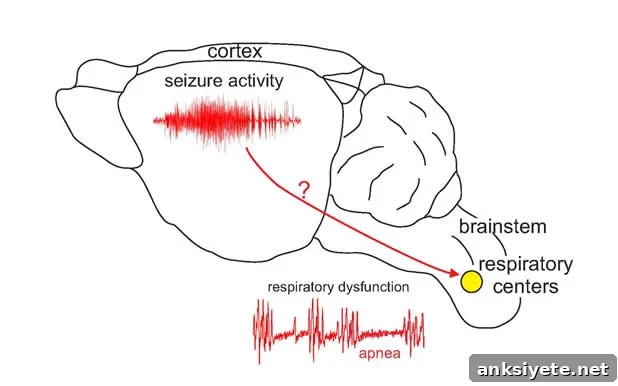
Sudden unexpected death in epilepsy (SUDEP) affects more than one in every 1,000 people with epilepsy each year, and its causes are poorly understood. The prevailing theory holds that severe seizures originating in the cerebral cortex spread downward to the brainstem, disrupting critical processes such as breathing and heart rate. The brainstem, located at the base of the brain where it connects to the spinal cord, controls these life-sustaining functions, and it is anatomically distant from the cortex.
“It’s like, if the seizure is in New York, the brainstem is in San Francisco,” Mulkey explains.
However, many patients who die of SUDEP show no clear signs of a convulsive seizure at the time of death, and breathing difficulties can occur in epilepsy independently of seizures. That prompted Mulkey and colleagues—graduate students Fu-Shan Kuo and Colin Cleary—to explore a genetic explanation: could the same mutation that triggers cortical seizures also impair brainstem circuits that control breathing?
To investigate, the team used mice engineered to carry a human Scn1a gene mutation associated with Dravet syndrome, a severe, treatment-resistant epilepsy. The Scn1a gene encodes a sodium channel subunit that regulates sodium flow into neurons. Dysfunctional sodium channels can disturb neuronal excitability, and more than 1,200 Scn1a mutations have been linked to epilepsy. Dravet syndrome typically results from mutations that substantially disrupt channel function, producing severe, fever-sensitive seizures and a high SUDEP risk.
Paradoxically, many Scn1a mutations reduce sodium channel activity rather than increasing it. The key is which neurons are affected: inhibitory neurons—which normally restrain excessive activity—are particularly vulnerable. When these inhibitory “bouncers” are weakened, excitatory neurons can become hyperactive and trigger runaway network activity that manifests as seizures.
Kuo set out to answer two central questions: first, whether mice with the Dravet-associated Scn1a mutation develop breathing abnormalities and die early in a pattern consistent with SUDEP; and second, whether inhibitory neurons in the brainstem respiratory centers are impaired by the mutation.
The behavioral and physiological data were definitive. Mice carrying the Scn1a variant experienced spontaneous seizures that worsened with elevated temperature, mirroring the febrile sensitivity seen in people with Dravet syndrome. These mice also died prematurely, with most not surviving past three weeks of age—consistent with SUDEP-like outcomes.
Respiratory testing revealed clear dysfunction. Affected mice showed periods of hypoventilation and prolonged apneas and failed to increase ventilation appropriately in response to elevated carbon dioxide levels, a normal compensatory response. These breathing abnormalities indicate impaired respiratory drive and chemosensitivity.
“The mouse model recapitulates key aspects of the human condition, including seizure susceptibility, temperature sensitivity, disordered breathing, and premature death,” Mulkey says.
At the cellular level, Kuo examined the retrotrapezoid nucleus (RTN), a brainstem region essential for detecting CO2/H+ levels and driving respiration. In this region, inhibitory neurons expressing the Scn1a A1783V variant were less excitable than normal, consistent with a loss of inhibitory control. Conversely, neighboring glutamatergic chemosensitive RTN neurons were hyper-excitable, which would be expected to increase respiratory drive. The net effect on the overall breathing rhythm appears to be disorganized—producing unstable breathing patterns, paradoxical pauses, and a reduced ventilatory response to CO2.
While the findings establish that loss of Scn1a function in inhibitory neurons disrupts respiratory control, the precise circuit mechanisms that convert this cellular imbalance into fatal respiratory failure remain unresolved. To narrow down the causal pathway, the researchers plan follow-up experiments using mice that express the Scn1a mutation selectively in brainstem inhibitory neurons or, alternatively, only in cortical inhibitory neurons. If mice with cortical-restricted mutations fail to develop SUDEP-like respiratory failure, that would argue against the idea that seizures must propagate from cortex to brainstem to cause fatal respiratory arrest. The team also intends to map other components of the breathing network to identify vulnerable nodes that could be targeted to stabilize breathing.
Ultimately, the goal is to pinpoint interventions that preserve or restore proper breathing rhythm and CO2 responsiveness in people with Dravet syndrome and other epilepsy forms at risk for SUDEP. Identifying molecular or circuit-level targets could lead to therapies that reduce respiratory collapse and save lives.
Source:
University of Connecticut
Media Contacts:
Kim Krieger – University of Connecticut
Image Source:
The image is credited to Dan Mulkey and Virge Kask, University of Connecticut.
Original Research: Open access
“Disordered breathing in a mouse model of Dravet syndrome”. Fu-Shan Kuo, Colin M Cleary, Joseph J LoTurco, Xinnian Chen, Daniel K Mulkey (corresponding author). eLife. doi: 10.7554/eLife.43387
Abstract
Disordered breathing in a mouse model of Dravet syndrome
Dravet syndrome (DS) is a severe epileptic encephalopathy associated with high incidence of sudden unexpected death in epilepsy (SUDEP). Respiratory failure is a leading suspected cause of SUDEP, and patients with DS often display breathing abnormalities. The mechanisms linking Scn1a mutations to respiratory dysfunction are unknown. This study shows that mice expressing a DS-associated Scn1a missense mutation (A1783V) conditionally in inhibitory neurons exhibit spontaneous seizures, premature death, hypoventilation, prolonged apneas, and a reduced ventilatory response to CO2. At the cellular level, inhibitory neurons in the retrotrapezoid nucleus (RTN) carrying the Scn1a A1783V variant were less excitable, while glutamatergic chemosensitive RTN neurons were hyper-excitable, indicating that loss of Scn1a function in inhibitory neurons can disrupt respiratory control at both cellular and whole-animal levels.